
 Bitaigen Research
- Binance Smart Chain (BSC) Overview: A parallel chain developed by Binance. In 2022, Binance merged Binance Chain (BC) and Binance Smart Chain (BSC) into the BNB Chain.
- BNB Chain supports an EVM‑compatible multi‑chain ecosystem: Smart contracts can be deployed to build a decentralized environment similar to Ethereum, and DeFi projects are fully supported. EVM compatibility makes it easy for developers to port DApps and contracts from Ethereum.
- BNB token burn mechanism: BNB is the native token of the Binance ecosystem and can be used to pay fees or interact with DApps. Based on the price of BNB and the number of BSC blocks, periodic burns are executed to control the total supply.
- Funding BNB Chain – important notice: When transferring assets, be absolutely certain you select the correct network (BEP‑2 and BEP‑20 are not interchangeable); using the wrong network can result in permanent loss of funds.
Binance Smart Chain (BSC) is an Ethereum‑compatible parallel chain launched by Binance for deploying smart contracts. In 2022 it merged with Binance Chain to become BNB Chain, creating a multi‑chain system that belongs to a single ecosystem.
In this article we outline the technical positioning of Binance Smart Chain, its evolutionary relationship with BNB Chain, and its role in cross‑chain and DeFi ecosystems. By analysing the architecture diagram and key mechanisms, readers can quickly clarify concepts, master funding procedures and contract‑deployment basics. Subsequent sections will delve into security considerations and future development trends, making a thorough read worthwhile.
What Is Binance Smart Chain (BSC)?
Binance Smart Chain (BSC) is an EVM‑compatible parallel chain launched by Binance, dedicated to the deployment and execution of smart contracts. After its launch, many DeFi projects that originally ran on Ethereum migrated to BSC to benefit from lower transaction fees and faster block times.
Differences Between Binance Smart Chain and “Binance Chain”
- Different positioning: Binance Chain (BC) focuses on high‑performance transaction matching and is primarily used for issuing and trading native tokens; Binance Smart Chain provides a full‑stack, Ethereum‑like decentralized computation environment.
- Core characteristics
- EVM compatibility: BSC is built on the Ethereum Virtual Machine (EVM), allowing Ethereum developers to migrate contracts without rewriting code.
- Fast transactions: The average confirmation time for a single transaction is under 10 seconds.
- Cross‑chain interoperability: BSC and Binance Chain are linked via a cross‑chain bridge that enables free movement of assets between the two chains.
February 2022: Consolidation into BNB Chain
In February 2022 Binance combined Binance Chain (BC) and Binance Smart Chain (BSC) into the BNB Chain, establishing an EVM‑compatible multi‑chain ecosystem and introducing staking and governance capabilities.
BSC Getting‑Started Guide 1: Wallets
Before interacting with BSC you need a wallet that supports the chain. The three wallets listed below are the most widely used in the community.
1. MetaMask

MetaMask is available as a Chrome extension and offers a very user‑friendly experience. Although it is fundamentally an Ethereum wallet, you can connect to BSC by adding a custom network configuration; the UI remains identical to the Ethereum view.
2. Trust Wallet
Trust Wallet is a mobile‑first solution that supports a large number of DApps directly, making it a convenient choice for smartphone users.
3. Binance Chain Wallet
Offered by Binance itself, this browser‑extension wallet is purpose‑built for BSC. It features a clean UI and is compatible with both Chrome and Firefox.
BSC Getting‑Started Guide 2: Funding Your Wallet
Once you have a compatible wallet, you must move assets onto BSC. Below are the two most common funding methods.
Quick tip: BSC uses BEP‑20 tokens
- BEP‑2: Token standard used on Binance Chain (BC).
- BEP‑20: Token standard used on Binance Smart Chain (BSC). Selecting the wrong network will cause the assets to become unrecoverable.
Method 1: Withdrawal from Binance Exchange
On the Binance exchange (or Binance.US for U.S. residents) select “Withdraw”, then switch the network to BSC (BEP‑20). This will send the chosen cryptocurrency to the address of your BSC‑compatible wallet. Double‑check the network type to avoid accidental loss.
Method 2: Binance Bridge
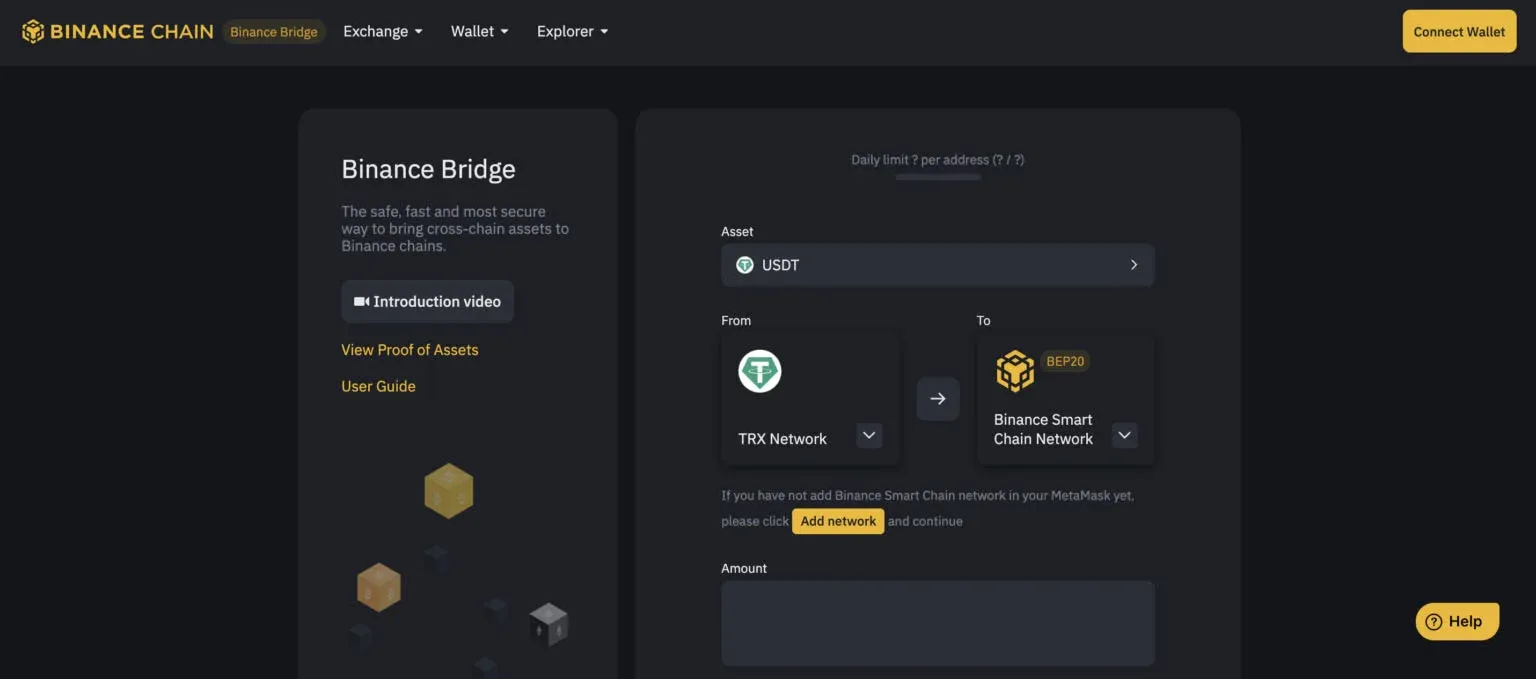
The Binance Bridge is intended for assets that are not already held on the Binance exchange. Users can select a source chain (e.g., Ethereum or TRON) and have their tokens wrapped into BEP‑20 assets on BSC. The transfer can be tracked in real‑time on the “Proof of Assets” page.
How Are BSC Transaction Fees Calculated? Are They Significantly Lower Than Other Chains?
Fee = Gas Units × Gas Price.
- Gas Price is expressed in Gwei (1 Gwei = 10⁻⁹ BNB).
- Gas Units depend on the complexity of the transaction or contract; a standard BEP‑20 transfer typically consumes about 21,000 Gas.
BSC employs a PoSA (Proof‑of‑Staked‑Authority) consensus mechanism, which delivers high throughput and relatively stable, low gas prices. Compared with Ethereum, the majority of BSC transactions cost less than $1 USD, providing a clear cost advantage.
Tax note: Crypto gains may be taxable in your jurisdiction. Consult a local tax professional to understand your obligations.
How to Look Up a BSC Address?
The blockchain explorer BscScan lets you quickly retrieve information about any address:
- Visit BscScan
- Enter a wallet or contract address in the search bar
- Review balances, transaction history, token holdings, etc.
- Use the filter tools to focus on specific transaction types (e.g., BEP‑20 transfers)
BscScan also offers advanced features such as fund‑flow tracing and gas‑usage analytics, making it an essential tool for the BNB ecosystem.
Key Features of BEP‑20
- Interoperability: Compatible with BEP‑2, enabling cross‑chain transfers.
- Low fees: Transaction costs are considerably lower than those of ERC‑20 tokens.
- Efficiency: Block time is roughly 3 seconds, which suits high‑frequency trading scenarios.
Tracking Metrics on BSC: BscScan
BscScan is maintained by the same team that built EtherScan, so the interface and workflow feel familiar to Ethereum users. This similarity reduces the learning curve for asset tracking on BSC.
What Is BEP‑20? How Does It Differ From Other Token Standards?
BEP‑20 is the token standard for BSC, analogous to Ethereum’s ERC‑20. It provides developers with a uniform contract interface for creating, issuing, and managing tokens.
Popular DApps on Binance Smart Chain (BSC)
Low fees have attracted a large number of projects. Below are some of the most widely used DApps:
- PancakeSwap: The largest Automated Market Maker (AMM) on BSC, offering token swaps, liquidity mining, lottery, NFTs, and token launchpads.
- Venus: A DeFi lending platform that supports borrowing and liquidity mining for BEP‑20 assets and can mint the stablecoin VAI.
- Autofarm: A yield aggregator that automatically allocates funds to the highest‑yielding farms, similar to Yearn but built on BSC.
- BurgerSwap: Another AMM that provides token swapping and liquidity provision.
- Spartan Protocol: A synthetic asset platform that enables the creation of liquidity pools, synthetic tokens, and lending markets.
- Cream: Originally an Ethereum lending protocol, now available in a dedicated BSC version.
Additional DApps can be discovered via DefiStation, DappRadar, or the Math dApp Store.
How to Avoid Sending BEP‑20 Tokens to the Wrong Blockchain? What to Do If It Happens?
Preventative Measures
- Select the correct network: Always choose “BNB (BEP‑20)” when initiating a transfer.
- Double‑check address formats: BNB‑Chain addresses start with `0x`; ensure the receiving wallet supports BEP‑20.
- Test with a small amount: Send a minimal amount first to confirm successful receipt before moving larger sums.
Recovery Options If an Error Occurs
- Multi‑chain wallets: If you used MetaMask or another wallet that supports multiple chains, switch to the appropriate chain and manually add the token’s contract address to display the mistakenly‑sent assets.
- Contact the exchange: If the tokens were sent to an exchange, reach out to their support team promptly, provide the transaction hash (TxID), and request a “coin recovery” service. Note that for U.S. users, this should be directed to Binance.US support rather than the global Binance platform.
BSC: Low‑Fee Engine Driving Ecosystem Growth
Because of its low transaction costs and rapid block times, BSC has attracted a substantial user base and a plethora of projects. As the ecosystem continues to expand, BSC is poised to play an increasingly significant role in the broader blockchain industry.
---
This article introduced the Binance Smart Chain (BSC) concept, its relationship with BNB Chain, and practical usage tips. For further reading, search for previous articles by Bitaigen (比特根) or follow the related links below. Happy exploring within the BSC ecosystem!
Related Reading
- BSC Architecture, Consensus & BEP‑20: Top DeFi DApps Explained
- BNB Chain’s Local‑Dog Meme Tokens: Risks & Opportunities
- BNB Chain Daily Tx Volume Jumps to 7M – Low Gas, High Speed
💡 Register on Binance with referral code B2345 for the maximum trading fee discount. See Binance complete guide.



