
 Bitaigen Research
 In this article we systematically explain the core concepts of Blockchain as a Service (BaaS), differentiate it from BTAAS, and showcase how it is implemented on both public and private chains through examples. Whether a company wants to get started quickly or a developer needs to build the underlying framework from scratch, clear guidance is provided to help determine the most suitable service model. Keep reading to master the full panorama of blockchain cloudification.
Fundamental Concepts and Evolution of Blockchain BaaS
With the widespread adoption of cloud computing, blockchain technology is gradually extending toward an “as‑a‑service” model. BaaS (Blockchain as a Service) essentially hosts blockchain nodes, consensus mechanisms, storage, and other low‑level resources on a cloud platform, allowing users to access blockchain functionality without having to set up their own hardware infrastructure.
In the hierarchy of cloud services, the most common layers are IaaS, PaaS, and SaaS. BaaS adds blockchain capabilities to this stack, making Blockchain as a Service a reality.
Difference Between BaaS and BTAAS
Industry definitions for these two terms are not fully standardized, but a common distinction is:
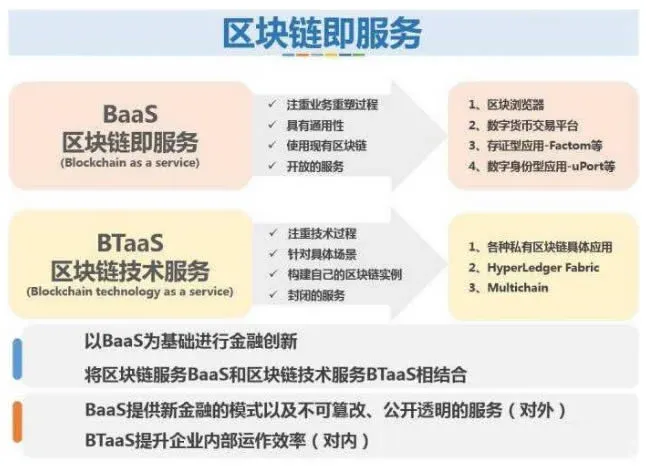
- BaaS: Focuses on providing complete blockchain instances (such as Bitcoin, Ethereum, and other public chains) together with higher‑level features like querying, transaction submission, and block generation. Users simply call the offered APIs.
- BTAAS: Emphasizes delivering the underlying blockchain technology stack (e.g., Hyperledger, MultiChain, private‑chain Ethereum). Developers must build their own business logic on top of this framework.
The diagram below (omitted) visually illustrates the two concepts, helping readers quickly differentiate them.
Two Main Categories of Blockchain BaaS Offerings
Blockchain Services:
From a broad perspective, this category deploys public‑chain nodes directly in the cloud, leveraging the elasticity of cloud resources for data storage, network load, and computational scheduling. Take the Bitcoin network as an example: the chain currently contains several hundred GB of data, and storing all of it locally would impose significant storage and compute burdens. Migrating the node to a cloud platform allows users to benefit from cloud fault tolerance, load balancing, and dynamic scaling, thereby reducing operational costs and improving interaction efficiency. Such services often give rise to extensions like notarization‑type solutions (e.g., Factom) or digital‑identity platforms (e.g., uPort), which in turn power block explorers, cryptocurrency exchanges, and other publicly accessible interfaces.
Blockchain Technology Services:
Blockchain technology itself comprises cryptography, consensus algorithms, P2P networking, and distributed system principles. Technology services concentrate on providing a bundled framework or operating system for these low‑level components, such as Hyperledger Fabric or a private Ethereum network. Enterprises can use these frameworks to rapidly construct chain‑based applications that meet their specific requirements, potentially achieving higher security and auditability than traditional internet technologies.
Some authors illustrate the difference with a cloud‑service analogy: Alibaba Cloud offers instances (IaaS/PaaS), freeing users from hardware concerns; similarly, BaaS supplies pre‑deployed public‑chain instances, while BTAAS delivers the blockchain development framework, leaving the upper‑layer business development and deployment to the user.
Natural Fit Between Blockchain and Cloud Platforms
The core attributes of blockchain—decentralization, distributed ledger, consensus mechanisms, cryptographic algorithms, and smart contracts—align closely with cloud computing’s distributed processing, parallel execution, networked storage, virtualization, load balancing, and elastic resource scheduling. Whether dealing with public, consortium, or private chains, organizations can leverage public, private, or hybrid cloud deployment models to achieve substantial cost reductions and enhanced system reliability.
Major Vendors’ BaaS Product Landscape
- Microsoft Azure: Launched its Azure‑based blockchain service in August 2016, supporting roughly 26 different blockchain implementations (according to data collected at the end of 2016) and offering sandbox environments for development and testing.
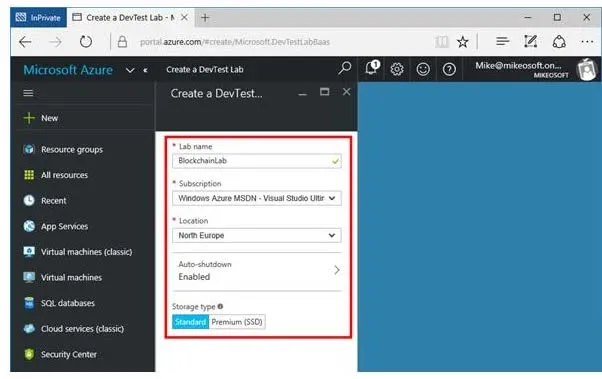
- IBM: Introduced a blockchain service platform on the Bluemix cloud in February 2016. Developers can utilize a full DevOps toolchain to create, deploy, run, and monitor on‑chain applications directly on IBM Cloud.
- Amazon AWS: In May 2016, partnered with Digital Currency Group (a major blockchain investor) to provide secure Blockchain‑as‑a‑Service offerings for companies in its portfolio, assisting financial institutions, insurers, and technology firms in conducting business within a controlled environment.
In addition, domestic cloud providers such as Alibaba Cloud and Huawei Cloud have rolled out their own BaaS solutions, creating a highly competitive ecosystem.
Outlook
As blockchain technology continues to evolve and cloud services mature, BaaS use‑cases will broaden further, and related architectures will be refined in terms of security, scalability, and usability. For enterprises seeking a fast entry into the blockchain space, BaaS offers a low‑barrier, low‑cost pathway.
This concludes the comprehensive walkthrough of “Blockchain Basics: What Is a Blockchain BaaS Service.” For more updates, follow the subsequent articles published by Bitaigen.
💡 Register on Binance with referral code B2345 for the maximum trading fee discount. See Binance complete guide.



