
 Bitaigen Research
 Summary
- Sharding is the process of dividing a blockchain into smaller “shards” to address scalability challenges on Layer 1 networks.
- Sharding can increase transaction throughput, lower processing and storage costs, and improve overall network performance.
- Because of security concerns and the complexity of cross‑shard transactions, sharding still faces certain limitations.
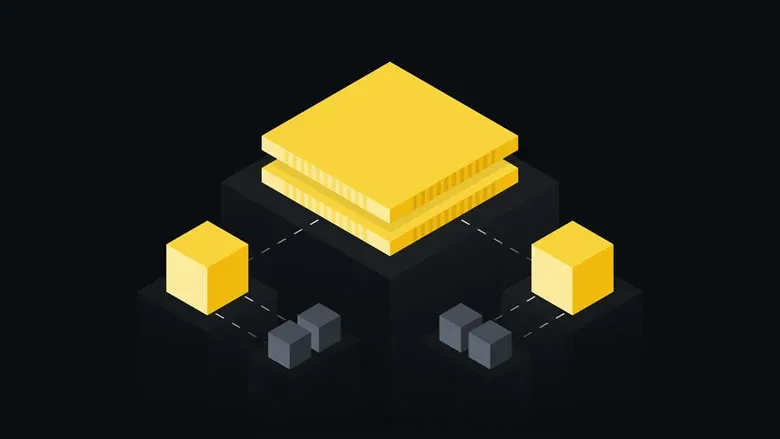
In this article we outline the core principles and implementation pathways of sharding, detail its advantages in boosting throughput and reducing costs, and objectively assess the constraints introduced by cross‑shard security and transaction complexity. The goal is to help readers quickly grasp the full picture of this key scaling technology, with later sections providing deeper technical details and practical considerations.
Introduction
Sharding splits a blockchain network into multiple parallel sub‑chains (shards), achieving horizontal partitioning that enables transactions to be processed in parallel, thereby increasing speed and capacity while reducing the storage and computational burden on individual nodes. However, it also introduces cross‑shard transaction complexity and security risks.
Blockchains hold great promise in decentralization, transparency, and security, but scalability has long been the bottleneck in the “blockchain trilemma.” Sharding is a pivotal technical approach designed to enhance scalability without sacrificing decentralization.
What Is Sharding?
Sharding borrows from the partitioning concept used in traditional databases: it involves breaking a large database into more manageable subsets (the “shards”). In the blockchain context, the network is divided into several sub‑chains, each capable of independently processing transactions and smart contracts, which raises overall throughput.
How Does Sharding Work?
To understand the operating mechanism of sharding, one must first distinguish the two fundamental data‑processing models in blockchains: sequential processing and parallel processing.
- Sequential processing: Every node must store and verify all transactions, account balances, and historical records across the entire network. This model enhances security but limits processing speed.
- Parallel processing: Multiple operations can be executed simultaneously, markedly improving efficiency.
Sharding employs horizontal partitioning to split the total workload of the network into several subsets, meaning that not every node needs to handle every transaction. Each shard functions like an independent database, capable of performing its own transaction validation and state updates.
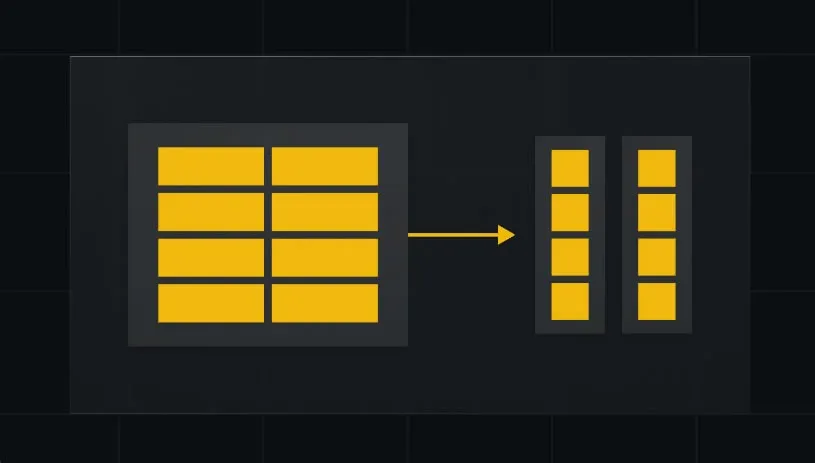
Horizontal vs. Vertical Partitioning
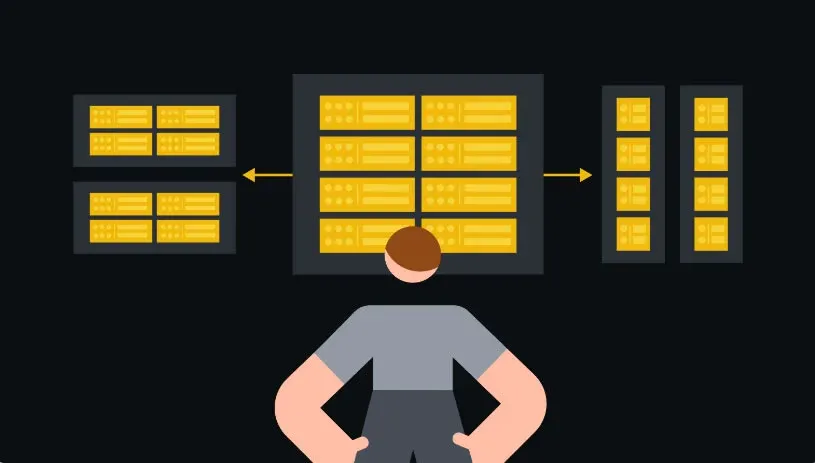
Horizontal partitioning divides data row‑wise and distributes those rows across different nodes, preserving the integrity of each row. This approach is suitable for implementing sharding in blockchain networks.
Vertical partitioning splits data column‑wise, retaining only specific attribute subsets—for example, storing “name, status” in one table and “description, photo” in another.
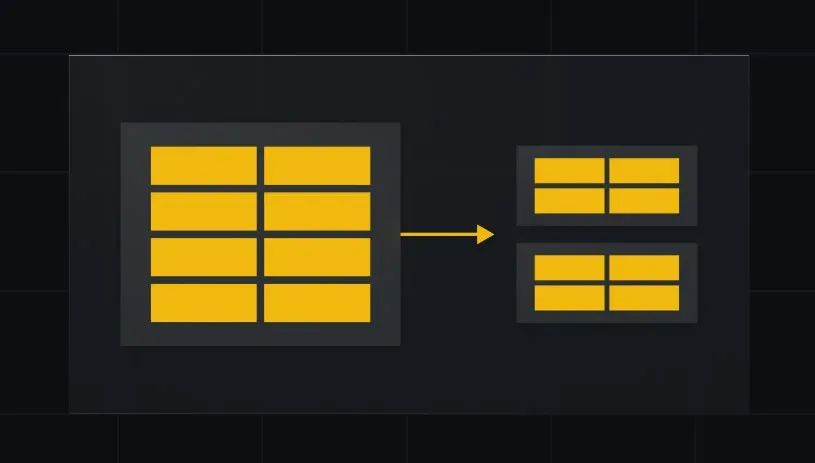
In a blockchain scenario, vertical partitioning would make it difficult to retrieve complete transaction information, limiting scalability. In contrast, horizontal partitioning keeps each shard with a full set of transaction data, aligning with decentralization requirements.
Why Is Horizontal Partitioning Preferred?
- Scalability: Horizontal partitioning breaks data into smaller pieces; each shard can operate independently, allowing transactions to be processed in parallel and dramatically increasing network throughput.
- Decentralization: Nodes only need to handle the shard(s) they are assigned, lowering computational and storage barriers and encouraging broader participation.
- Security and Integrity: Every shard retains a complete copy of the blockchain’s blocks, ensuring data consistency and resistance to attacks.
Benefits of Sharding
The following outlines the primary gains that sharding brings to blockchain ecosystems:
- Higher Transaction Speed
- Transactions execute concurrently on different shards, boosting overall throughput.
- For instance, Zilliqa achieves thousands of transactions per second through sharding.
- Reduced Processing and Storage Costs
- Nodes store and validate only the data of their assigned shard, significantly lowering hardware requirements.
- This reduction lowers entry barriers and promotes a more democratic network.
- Improved Network Performance
- Shards run independently; new nodes join only the relevant shard, avoiding the need for full‑network synchronization.
- Network capacity scales linearly with the number of shards, delivering smoother user experiences.
Sharding technology continues to evolve, and future enhancements may unlock additional optimizations.
Limitations of Sharding
Despite its advantages, sharding still encounters several challenges:
- Single‑Shard Takeover Attacks
- An adversary who controls the majority of hash power in a single shard can launch a “1 % attack,” which is riskier than attacking the entire network.
- Cross‑Shard Transaction Complexity
- Transactions that span multiple shards require extra coordination mechanisms; mishandling can lead to double‑spending risks.
- Data Availability Issues
- If the nodes responsible for a particular shard go offline, the associated data may become temporarily unavailable, affecting overall accessibility.
- Network Security and Load Balancing
- Uneven shard allocation can cause resource skew, impacting network stability.
- Node Synchronization Latency
- Updating state across shards takes time; latency between nodes may reduce overall performance.
Sharding in Ethereum
Ethereum 2.0 (also known as “Eth2” or the “Serenity phase”) incorporates sharding as a core component of its upgrade roadmap. The rollout is staged, with the final phase (Phase 2) slated to fully implement sharding to increase throughput, lower transaction fees, and alleviate congestion.
The development team has conducted multiple rounds of testing focused on security, decentralization, and cross‑shard communication to ensure a smooth transition once the feature is live.
Conclusion
Sharding offers a viable pathway to address the blockchain trilemma: it significantly enhances scalability while preserving decentralization and security. Although issues such as cross‑shard transactions, attack surfaces, and data availability remain active research topics, the impending deployment of sharding on major chains like Ethereum 2.0 is turning industry expectations into tangible progress.
For a deeper dive into sharding, feel free to explore additional articles published by Bitaigen.
*Translation by*
Related Reading
- Ethereum Sharding 2023: Faster Performance, Lower Gas Fees
- Ethereum Pectra Upgrade 2025: Faster, Cheaper Transactions
💡 Register on Binance with referral code B2345 for the maximum trading fee discount. See Binance complete guide.



