
 Bitaigen Research
 Cross‑chain bridges are infrastructure that enables the transfer of assets and information between different blockchains, allowing cross‑chain asset swaps and supporting multi‑chain DeFi applications, thereby improving asset liquidity.
A Cross‑chain Bridge (often simply called Bridge) functions to let cryptocurrencies be traded on two distinct chains and is a crucial piece of infrastructure in the blockchain world.
As the blockchain sector has evolved, many public chains have emerged after Bitcoin and Ethereum, and assets are now distributed across these various chains. However, assets on different chains cannot be exchanged or transferred directly.
In the blockchain world, a cryptocurrency can only be exchanged/traded on the same chain, but today there are many public chains.
For example, USDT on Ethereum and USDT on BSC both bear the same name, yet they are recorded on different chains and cannot be traded directly.
Many newcomers to DeFi often encounter “insufficient asset” or “insufficient gas fee” warnings because the actual chain that holds their assets differs from the chain required by the protocol.
By using a cross‑chain bridge, assets can be moved from one blockchain to another.
There are numerous types of cross‑chain bridges, each operating in a different manner. Nowadays, a bridge can be accessed directly through a crypto wallet, and the system can automatically find the lowest‑cost, fastest, and smallest‑slippage route.
This article systematically explains the operating principles of cross‑chain bridges, common classifications, real‑world use cases, and key points that users should pay attention to.
In this article we systematically outline the core mechanisms and common types of cross‑chain bridges, analyze usage costs and potential risks, and help readers quickly determine when and how to safely move assets between chains. We also provide practical tool recommendations to help locate the cheapest and fastest bridging paths directly from a wallet.
What a Cross‑chain Bridge Is: A Tool that Enables Blockchains to Communicate and Interconnect
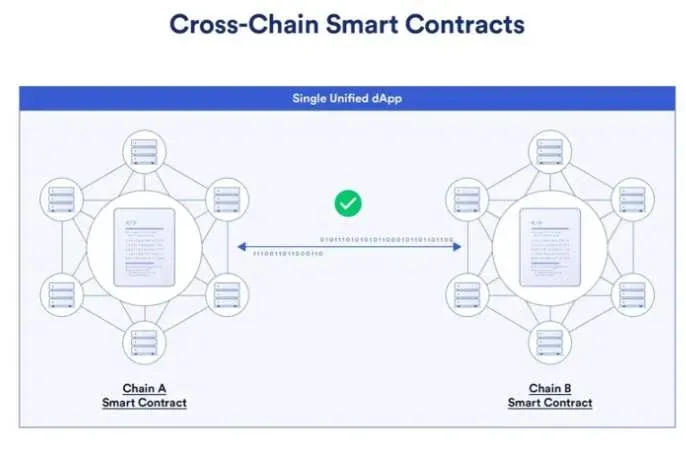
A cross‑chain bridge is a tool that lets blockchains communicate with each other, enabling cross‑chain asset exchange and trading.
Cross‑chain bridges are also known as blockchain bridges (English: *Cross‑chain Bridge* or *Blockchain Bridge*), commonly abbreviated as Bridge, which is the most widely used term in the industry.
Fundamentally, a blockchain is a public ledger, and each chain maintains its own independent ledger with a distinct data format. Because the formats differ, two chains cannot directly communicate or exchange assets, as they cannot interpret each other’s ledger structures.
Consequently, BTC on the Bitcoin chain, SOL on the Solana chain, and ETH on the Ethereum chain cannot be transferred directly between one another. Many people mistakenly assume that these cryptocurrencies can be swapped directly on an exchange; in reality, exchanges perform internal ledger entries and do not execute a true on‑chain swap.
Only through cross‑chain bridge technology can assets become interoperable across blockchains.
Core Value of Cross‑chain Bridges
- Mobilize assets across different chains, boosting liquidity
- Allow assets to freely participate in multi‑chain DeFi or DApps, providing greater flexibility
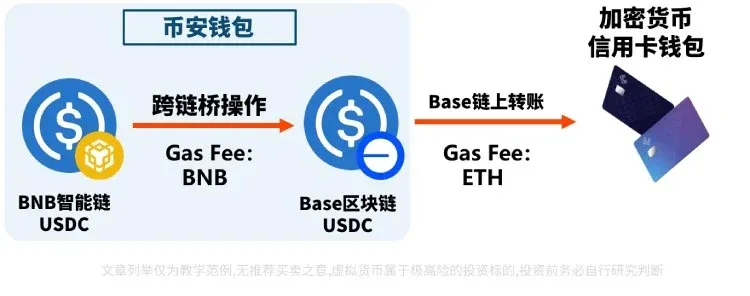
For instance, if you hold 1,000 USDC on BSC but the target DeFi wallet only supports the Base chain, you cannot use those tokens directly. By employing a cross‑chain bridge, the 1,000 USDC can be converted into a USDC token on Base, after which the assets become freely usable (the exact amount received will depend on the prevailing exchange rate, platform fees, and gas costs at the time of the bridge).
This scenario typifies what most users encounter and represents the core value proposition of cross‑chain bridges.
USDC moving from BSC to Base, then transferred on‑chain to a designated wallet
As DApps and DeFi services proliferate on various chains, assets that have been bridged can unlock many additional use cases.
For example, many staking and lending protocols are deployed on Ethereum, and only assets residing on Ethereum can interact with them. If your assets are spread across BNB, SOL, or other public chains, you must first bridge them to Ethereum before you can use those protocols.
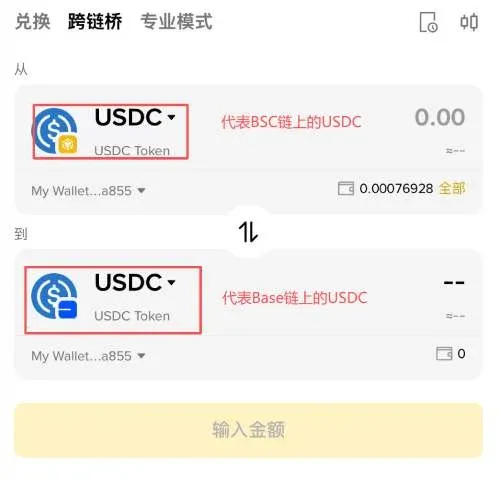
Bridge‑based token swaps are now as convenient as ordinary token trades
The figure below shows the full workflow inside a wallet‑integrated bridge when swapping USDC from BSC to Base: input amount → display rate → one‑click confirm, and the transaction completes.
Why Bridge Even When the Token Is the Same?
Many tokens are issued on multiple chains, but the issuances are not natively interoperable, so a bridge is still required.
Take USDT as an example; it is issued on the following chains:
- Ethereum
- Solana
- Tron
- BSC
- …and numerous other chains
Although the name is identical, USDT on Solana does not interoperate with USDT on Ethereum; a bridge must be used to move the assets.
Not all bridged tokens retain the same name after transfer. Wrapped tokens represent another common implementation. For instance, Bitcoin (BTC) does not have native support on Ethereum, so projects issue WBTC (Wrapped Bitcoin) as a 1:1 representation; on the Base chain you might encounter cbBTC (Coinbase Wrapped Bitcoin). The name, contract address, and redemption rules are defined by the issuing project, and a single chain may host multiple distinct wrapped versions of the same underlying asset.
Summary
- Some tokens (e.g., USDT, USDC) keep the same name after bridging.
- Tokens that are not native to the destination chain (e.g., BTC) require a wrapped version, and the name changes accordingly.
If you are unfamiliar with a token’s implementation, it is advisable to research it before performing a bridge transaction.
Use a Crypto Wallet Directly to Access Cross‑chain Bridges
Most mainstream wallets now embed bridge functionality, such as Binance Web3 Wallet. Opening the wallet gives immediate access without needing to authorize an external DApp.
About Binance
Binance is the world’s largest cryptocurrency exchange, with over 300 million registered users as of 2025 and support for more than 100 crypto assets.
If you have not yet created an account, you can register and download the app via the following links (U.S. residents should use Binance.US instead of the global platform):
- Binance registration (global) – copy the link into your browser
- Binance Android App download
Further reading: 2025 Binance guide – comprehensive tutorial on deposits, withdrawals, fees, and security.
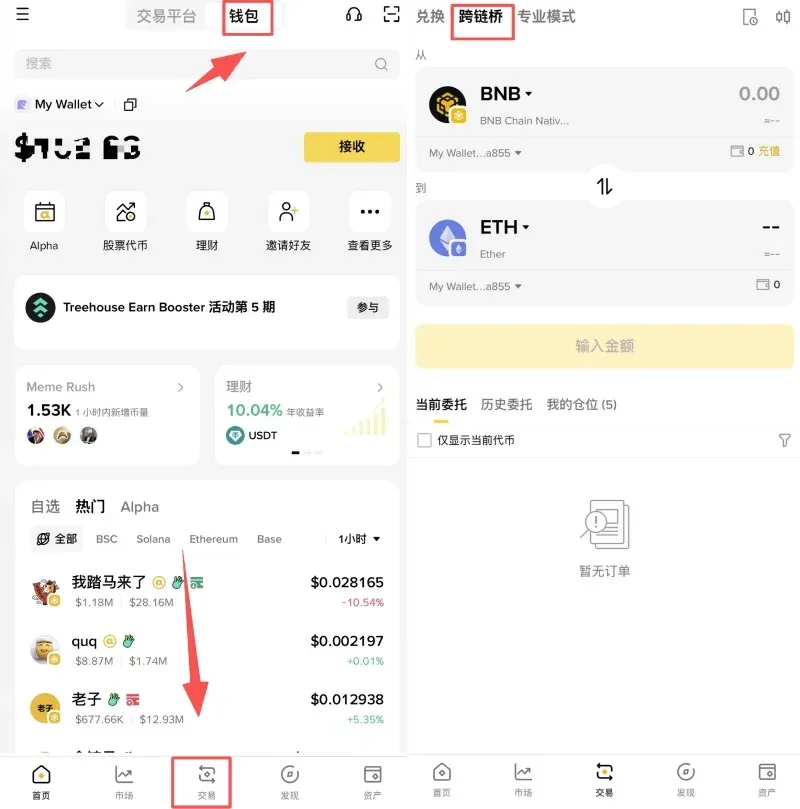
Example: to move USDC from the BSC chain to the Base chain, after selecting the source and destination chains, the Binance Web3 Wallet automatically matches the fastest and cheapest bridge route.
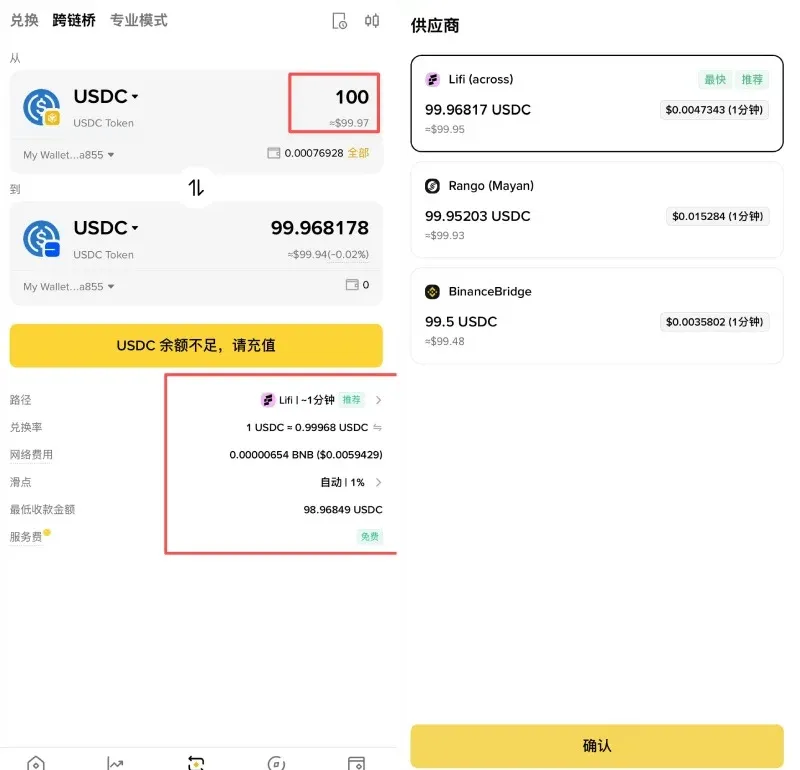
The Wallet Actually Connects to a Bridge Aggregator
Bridge aggregators combine multiple bridges and decentralized exchanges (DEXs), automatically comparing transaction fees and gas costs to select the optimal path for the user. Well‑known aggregators include LIFI, Rango, and others.
Wallet‑integrated solutions typically use an aggregator rather than a single bridge, offering:
- A “one‑stop” experience that completes bridging and swapping in a single step
- Easier discovery of low‑fee, low‑slippage routes
If you prefer to choose manually, you can also interact directly with single‑bridge platforms such as Relay or Mayan and authorize your wallet yourself.
Costs When Using a Cross‑chain Bridge: Gas Fee / Bridge Service Fee / Platform Fee
Three categories of fees are incurred when using a bridge:
| Fee Type | Meaning | Payable To |
|---|---|---|
| **Gas Fee** | Miner/validator fee for the underlying blockchain network | The blockchain itself |
| **Bridge Service Fee** | Fee charged by the bridge protocol, reflected in the exchange rate | The bridge protocol |
| **Platform Service Fee** | Additional fee charged by the wallet or platform | The wallet provider |
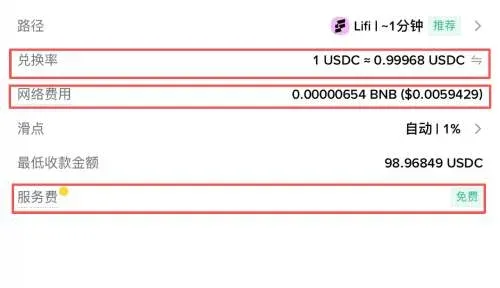
1. Gas Fee
- Also called a network usage fee; it is mandatory for any blockchain transaction.
- The fee is not deducted from the amount being bridged; it must be paid separately.
- Different chains require different native tokens for payment: Ethereum uses ETH, Solana uses SOL, BNB Smart Chain uses BNB, etc.
- Gas costs rise sharply during periods of network congestion and are relatively cheap when the chain is idle.
2. Bridge Service Fee
- Presented as a “rate” in the transaction quote.
- The fee is deducted directly from the amount being transferred. For example, a quoted rate of 1 USDC = 0.99969 USDC means that bridging 100,000 USDC will result in a deduction of 31 USDC, representing the bridge’s service charge.
- When using an aggregator, the quoted rate reflects the combined costs of the aggregator and the underlying bridge(s).
3. Platform Service Fee
- Some wallets charge this extra fee; others may waive it or offer promotional discounts.
- For the Binance Web3 Wallet, popular token bridges are typically fee‑free at the platform level.
Tax note: Gains or losses arising from cryptocurrency transactions, including bridge swaps, may be taxable in your jurisdiction. Please consult a qualified tax professional to understand your local obligations.
Advantages of Cross‑chain Bridges
For the average user, bridges provide three primary benefits (provided for informational purposes only and not as investment advice):
1. Asset Interoperability and Enhanced Liquidity
Bridges enable tokens that were previously confined to a single chain to be used elsewhere—for example, converting BTC to WBTC on Ethereum or moving ETH to BNB Chain—thereby markedly increasing the usefulness of the assets.
2. Multi‑chain DeFi and DApp Opportunities
Users can relocate assets to another chain to engage with that chain’s DEXs, lending platforms, staking services, etc. For instance, moving ETH to Arbitrum to take advantage of its low‑fee exchanges, or shifting funds to Polygon for borrowing and lending, allows flexible capital allocation.
3. Reduced Transaction Costs
By bridging assets to a lower‑fee Layer 2 network such as Arbitrum or Optimism, gas expenses can drop to roughly one‑tenth of those on the mainnet, delivering noticeable cost savings.
Risks Associated with Cross‑chain Bridges
When using a bridge, be aware of three common risk categories (presented solely as risk disclosures):
1. Smart‑contract Vulnerabilities
Bridges rely on smart contracts to lock assets. If the contract code contains bugs, attackers may exploit them to steal funds. In February 2022, the Wormhole bridge suffered a vulnerability that resulted in the loss of approximately 120,000 ETH (about $326 million at the time).
2. Centralized Validation Mechanism Failures
Some bridges employ centralized or a small set of validator nodes. If these nodes are compromised, asset security is jeopardized. In March 2022, the Ronin Network bridge was hacked, leading to the theft of roughly $620 million worth of assets.
3. Liquidity‑Pool Exhaustion
Liquidity‑pool bridges maintain funds on both the source and destination sides. If either side’s pool runs low, transactions may fail, experience excessive slippage, or be temporarily suspended. In August 2022, the Nomad bridge experienced a liquidity drain that affected about $190 million.
How Cross‑chain Bridges Operate: Liquidity Pools / Lock‑and‑Mint / Burn‑and‑Mint
Bridges act as “translators” between blockchains, and the three mechanisms below are the most common implementations:
1. Liquidity‑Pool Bridge
Liquidity‑Pool Bridges set up fund pools on both the source and destination chains. When a user initiates a bridge, the contract first locks the token in the source‑chain pool, then releases an equivalent amount (or a wrapped version) from the destination‑chain pool.
- Suitable for swapping many tokens across multiple chains.
- Requires sufficient liquidity providers (LPs); otherwise, transfers may stall or incur high slippage.
- Representative projects: Relay, Hop Protocol, Stargate Finance, cBridge, etc.
2. Lock‑and‑Mint
Lock‑and‑Mint was widely adopted early on, especially in official bridge protocols.
- The asset is locked in a smart contract on the source chain.
- Simultaneously, an equivalent wrapped token (e.g., WBTC, WETH) is minted on the destination chain.
- When returning assets, a “Burn & Release” process destroys the wrapped token and unlocks the original asset on the source chain.
Common implementations: Polygon PoS Bridge, Avalanche Bridge, among others.
3. Burn‑and‑Mint
Burn‑and‑Mint works similarly to Lock‑and‑Mint, but the original token is burned on the source chain rather than locked, and a fresh native token is minted on the destination chain.
- Representative projects: Circle CCTP, Chainlink CCIP, etc.
Classification of Cross‑chain Bridges
Bridges can be categorized along two dimensions: operational model (trusted vs. trustless) and ownership/connection scope (official bridge vs. cross‑chain bridge protocol), yielding four primary types.
Classification by Operational Model
| Type | Characteristics | Representative Projects |
|---|---|---|
| **Trusted Bridge** | Operated by a centralized entity; fast, low‑cost, user‑friendly UI; requires trust in the operator’s custody and security practices. | WBTC Bridge, Binance Bridge, Coinbase Bridge, Avalanche Bridge |
| **Trustless Bridge** | Fully based on smart contracts and decentralized validation; users retain direct control of assets. | Stargate Finance, Across, Synapse |
Classification by Ownership and Connection Scope
| Type | Description | Typical Examples |
|---|---|---|
| **Official (Canonical) Bridge Protocol** | Designated or operated by the native blockchain, usually linking the mainnet to its Layer 2 solutions; limited number |
Related Reading
- On‑Chain Fundamentals: Key DeFi Metrics for Investors
- TradFi vs DeFi: Key Differences Explained
- TVL in DeFi: How It’s Calculated, Why It Matters
💡 Register on Binance with referral code B2345 for the maximum trading fee discount. See Binance complete guide.



