
 Bitaigen Research
 In this article we systematically outline Ethereum’s evolution from Proof‑of‑Work to Proof‑of‑Stake, deeply analyze the cache and DAG mechanisms of Ethash, and dissect the core logic of the Casper consensus protocol. The goal is to help readers grasp technical details and future trends. Subsequent sections will reveal implementation specifics and migration challenges, so a careful read is worthwhile.
What is Ethereum’s consensus algorithm?
Ethereum’s consensus algorithm is currently the Ethash Proof‑of‑Work (PoW) algorithm, which is in the process of transitioning to the Casper Proof‑of‑Stake (PoS) protocol. The algorithm uses a large data set and a cache to deter ASICs. In the Serenity phase (Ethereum 2.0) the network will fully adopt Casper PoS.
How the large data set is generated

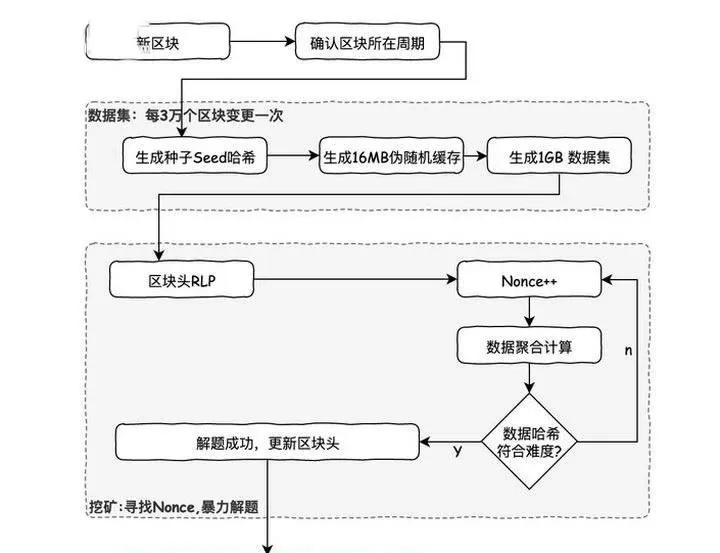
1. Small cache
- Initial size is 16 MB and it is refreshed every 30,000 blocks.
- The first element is derived by hashing a seed value; each subsequent element is generated by hashing the previous one. Light clients only need to store this cache to validate blocks.
2. Large DAG (Directed Acyclic Graph)
- Every element of the DAG is computed from the cache in a pseudo‑random order.
- Process: select a value at position A in the cache, hash A to obtain the index B, repeat this hashing 256 times, and the result becomes the first DAG element. The remaining elements are generated sequentially in the same manner.
3. Mining process
- As with Bitcoin, mining succeeds when a miner finds a nonce such that `H(header) ≤ target`.
- Steps (Ethereum):
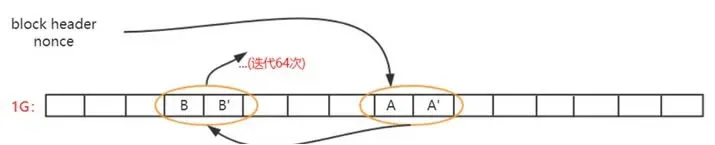
- Pick a random nonce, combine it with the block header and the DAG to compute an initial hash, which maps to position A.
- Read the element at A and its neighbour A′, and use those two values to compute the next positions B and B′.
- Repeat the above procedure a total of 64 times, thereby reading 128 elements in total.
- Hash those 128 elements to obtain a final value and compare it with the target; if the condition is met, the block is successfully mined.
The overall mining flow is illustrated in the diagram below:
4. Verification process
- Verification requires only a single hash computation and follows steps similar to mining.
- Full node: keeps the entire DAG in memory, performs 64 iterations, and then compares the resulting hash.
- Light node: rebuilds the necessary portion of the DAG from the small cache first, then runs the same verification steps.
Introduction to the consensus protocols used by ETH
Ethereum’s consensus mechanism has gone through four development stages:
| Stage | Name | Dominant consensus mechanism |
|---|---|---|
| 1 | Frontier | **PoW** (Ethash) |
| 2 | Homestead | **PoW** |
| 3 | Metropolis | **PoW** |
| 4 | Serenity | **PoS** (Casper) |
PoW (Proof‑of‑Work)
- Utilizes Ethash, which builds a massive DAG and cache to limit the advantage of raw hash power and to improve decentralization.
PoS (Proof‑of‑Stake) and Casper
- In PoS, a validator’s right to propose and attest to blocks is proportional to the amount of ether they lock up (i.e., coin‑age or stake‑days).
- Casper is Ethereum’s implementation of PoS with the following core features:
- Block proposal: validators collect transactions, assemble a block, and sign it.
- Voting (staking): validators cast weighted votes (0 – 1) based on the votes of other validators, applying a Byzantine‑fault‑tolerant rule that tolerates up to 33 % malicious actors.
- Penalty (slashing) mechanism: if a validator submits duplicate votes or votes that cannot be processed by the protocol, the validator loses the entire bonded stake, deterring malicious behavior.
- Client state‑finalization workflow:
- Download all blocks and voting records.
- For each block height, observe the voting outcome and accept the block only when the voting probability exceeds 0.5.
- Process the accepted blocks sequentially; the resulting chain state is the current blockchain state.
Summary
Ethereum’s Ethash uses a massive data set and cache to curb ASIC dominance, thereby achieving higher decentralization. Serenity (Ethereum 2.0) will fully shift to Casper PoS, introducing economic penalties to preserve security while improving network efficiency and sustainability.
The above constitutes “What is Ethereum’s consensus algorithm? Introduction to the consensus protocol used by ETH.” For deeper analyses of Ethereum’s consensus mechanisms, please follow Bitaigen (比特根) for additional articles.
*Note: Crypto transactions may be subject to taxation in your jurisdiction. Consult a tax professional for guidance. U.S. residents should use Binance.US for fiat‑on‑ramp services, while global users can use platforms that support SEPA or SWIFT transfers.*
Related Reading
- Understanding Ethereum Gas Fees: How They’re Calculated & Saved
- Blockchain Gas Fees Explained: How They Work & Why It Matters
- Understanding Ethereum Gas Fees: Costs, Validators, and Network Security
💡 Register on Binance with referral code B2345 for the maximum trading fee discount. See Binance complete guide.



