 Bitaigen Research
 Proof‑of‑Stake (PoS) Consensus Mechanism
Proof‑of‑Stake (PoS) is a consensus protocol that selects validators based on the amount of cryptocurrency they hold and the duration of holding (often called “coin‑age”). Representative tokens that use PoS include ADA, ONT, ATOM, as well as many other PoS‑based blockchains.
In this article we systematically outline the core principles of the PoS consensus mechanism, its advantages over Proof‑of‑Work (PoW), and the most prominent representative coins. The goal is to help readers quickly grasp how PoS operates and what to consider when choosing a PoS chain. Subsequent sections will dive deeper into security aspects and future applications, so a careful read is recommended.
What Is the PoS Consensus Mechanism?
Proof‑of‑Stake (PoS), also known as the Stake‑Based Proof mechanism, works on a principle similar to depositing money in a bank: the network distributes rewards proportionally to the amount of tokens staked and the length of time they are held. *Coin‑age* is calculated as the number of tokens multiplied by the number of days held. For example, holding 100 tokens for 30 days yields a coin‑age of 3,000.
Compared with Proof‑of‑Work (PoW), PoS offers two major benefits:
- Low Energy Consumption – No massive computational race is required, eliminating wasteful electricity usage.
- Resistance to 51 % Attacks – An attacker would need to control more than 51 % of the total token supply, and a successful attack would simultaneously depress the value of the attacker’s own holdings, making the cost prohibitively high.
Many digital assets start with PoW during their launch phase and later transition to PoS to secure the network more efficiently.
Representative Coins Using PoS
Common PoS‑based tokens include:
- ADA (Cardano)
- ONT (Ontology)
- ATOM (Cosmos)
These projects leverage PoS to reduce energy consumption and achieve faster consensus, thereby improving transaction throughput.
How PoS Works
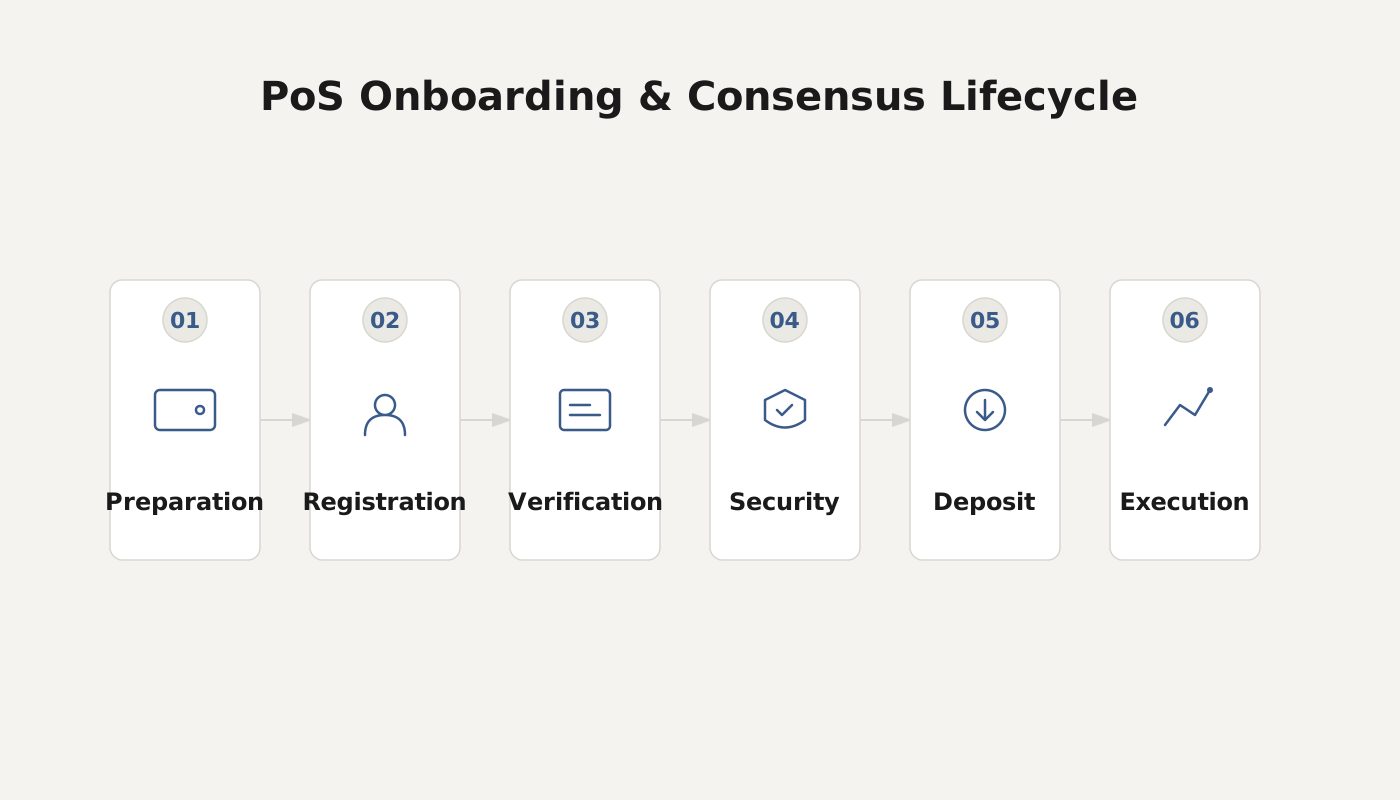
PoS addresses network inefficiency, resource waste, and node‑consistency problems through stake‑based accounting. The core principle is “the more you hold, the greater your influence.” The basic workflow is as follows:
- Node Eligibility – Anyone may apply to become a node, but must lock up a certain amount of the native token to qualify as a validator (candidate).
- Block‑Producer Election – The protocol employs a random algorithm to select a block‑producing node from the pool of candidates. The election is unpredictable and un‑manipulable, preventing any single party from monopolizing the process.
- Block Creation – The selected producer packages transactions into a new block and broadcasts it to the network.
- Block Validation – Other validator nodes inspect the block; once they confirm its correctness, the block is written to the blockchain and synchronized across all ledgers.
- Reward Distribution – The node that successfully created the block receives a token reward.

In PoW, every node competes in a power‑intensive hash race, leading to substantial waste. PoS raises the entry barrier by requiring “staked tokens,” so only qualified nodes can participate in accounting, drastically cutting overall energy use.

The election algorithm ensures randomness and fairness, preventing long‑term control by a single node. After the block producer finishes packaging, the block is validated by the entire network before being permanently recorded on the chain, completing one consensus cycle.

The specific competition rule is simple: the larger the stake, the higher the probability of being chosen to produce a block. Once a block is produced, the node broadcasts it, receives network confirmations, and earns the associated reward.

Advantages and Limitations of PoS
Advantages
- Energy‑Efficient & Eco‑Friendly – No need for high‑power mining hardware.
- Fast Consensus – Short block intervals improve transaction throughput.
Limitations
- Decentralization Risk – Large token holders obtain block‑production opportunities more frequently, potentially leading to a “rich‑get‑richer” scenario.
- Security Challenges – If the election algorithm is compromised, the network could be manipulated.
- Initial Distribution Ambiguity – An unfair initial token allocation can undermine the effectiveness of the stake‑based security model.

From an economic perspective, PoS relies heavily on user‑side staking behavior rather than on hardware investment. This can encourage short‑term speculative staking, which may affect network security and could even increase the potential for 51 % attacks. Consequently, during the code‑implementation phase, careful design of the election mechanism and token distribution is essential to balance security with decentralization.
The above content provides a systematic exposition of the PoS consensus mechanism, its representative coins, and its operational principles, giving readers a comprehensive view of its benefits and challenges. For more PoS‑related knowledge, please follow Bitaigen (比特根) for additional articles.
Note: Cryptocurrency gains may be taxable in your jurisdiction; consult a tax professional for guidance.
*For U.S. users, trading on Binance must be done through Binance.US, which complies with local regulations.*
Related Reading
- What Is Tether (USDT)? A Complete Guide to the Stablecoin
- BeaoCoin (BEC): Emerging International Meme Coin
- Lightning Network: Off‑Chain Scaling for Bitcoin
💡 Register on Binance with referral code B2345 for the maximum trading fee discount. See Binance complete guide.



