
 Bitaigen Research
From both technical and historical perspectives, we will outline the core principles, operational mechanisms, and real‑world blockchain projects that implement Proof‑of‑Work (PoW). With diagrams and case studies, readers can quickly grasp the security logic behind hash‑power competition and understand why PoW remains the consensus of choice for the majority of public chains. If you want to master this fundamental concept, keep reading.
What Is PoW (Proof‑of‑Work)?
Proof‑of‑Work (PoW) is a consensus mechanism that lets network nodes compete for the right to write new blocks by performing massive amounts of computation, earning block rewards in the process. It is the cornerstone that ensures ledger consistency and immutability in blockchain systems. Early projects such as Bitcoin, Ethereum, and Litecoin all employed PoW.
The PoW concept was first introduced by cryptographers Cynthia Dwork and Moni Naor in 1993. In 2008, Satoshi Nakamoto incorporated PoW into the consensus layer of the Bitcoin whitepaper, and the mechanism subsequently became the dominant consensus model for cryptocurrencies.
On August 7 2010, Satoshi posted on the Cryptography‑Punk forum: “Proof‑of‑Work has a beautiful property—it can be relayed through untrusted intermediaries.” Although PoW consumes a large amount of energy, it grants blockchains a powerful resistance to attacks—deceiving the network becomes prohibitively expensive.
How Proof‑of‑Work Operates
PoW creates a hash‑power race where nodes vie for the right to record transactions and claim block rewards. The core workflow is:
- Transaction Packaging – A node gathers pending transactions and assembles a candidate block.
- Hash Computation – The node repeatedly tries different nonces (random numbers), hashing the block each time until it finds a hash that satisfies the network’s difficulty target.
- Result Broadcast – The first node that discovers a qualifying hash broadcasts the block and its hash to the entire network; other nodes verify and adopt the block.
- Reward Distribution – The successful node receives newly minted cryptocurrency plus the transaction fees. The network then moves on to the next round of block creation.
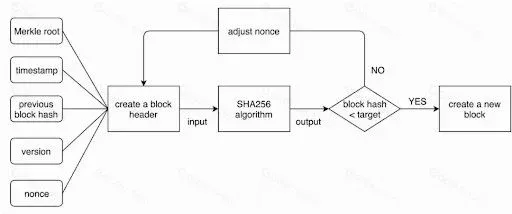
Because each round can only have one winner and rounds are independent of one another, the whole process is essentially a hash‑power game. The larger a participant’s hash‑power, the higher the probability of earning the reward. The time, hardware, and electricity that all nodes collectively invest constitute the security guarantee of the blockchain. More nodes and a more distributed hash‑power pool translate into stronger resistance against attacks.
Advantages of Proof‑of‑Work
- Simplicity of Implementation – The protocol is straightforward, making it easy to develop and deploy.
- High Decentralization – No central authority is required; any node can freely join or leave the network.
- Expensive Attack Cost – An adversary would need to control more than 50 % of the total hash‑power to alter the chain, which is financially prohibitive.
Limitations of Proof‑of‑Work
| Limitation Category | Specific Manifestation | Impact |
|---|---|---|
| Energy Consumption | On May 10 2021, global Bitcoin mining consumed approximately **149.37 TWh** annually—more electricity than the total consumption of over 100 countries. | Environmental pressure, regulatory risk |
| Low Efficiency | Average block time is about 10 minutes, yielding roughly **7 transactions per second (TPS)**; a full confirmation can take up to an hour. | Transaction latency, limited throughput |
| Hardware Barrier | Progression from CPU → GPU → ASIC has driven up equipment costs, concentrating hash‑power in large mining pools. | Decline in decentralization |
Which Blockchains Use PoW?
1. Bitcoin (BTC) and Its Forks
- Bitcoin – The first cryptocurrency to adopt PoW, using the SHA‑256 hash algorithm.
- Forks – Bitcoin Classic, Bitcoin Cash (BCH) and others continue to rely on the same PoW mechanism.
2. Litecoin (LTC)
- Employs the Scrypt hash function, which is somewhat less demanding than Bitcoin’s SHA‑256, yet remains a PoW system.
3. Ethereum (ETH) – Historical
- From 2015 to 2022, Ethereum ran on PoW (Ethash). In 2022 it completed the “Merge” to Proof‑of‑Stake (PoS) and no longer uses PoW.
4. Other Projects Still Running PoW
| Project | Primary Hash Algorithm | Notes |
|---|---|---|
| Dogecoin (DOGE) | Scrypt | Still PoW‑based; future migration is possible. |
| Monero (XMR) | RandomX | Privacy‑focused PoW solution. |
| Zcash (ZEC) | Equihash | PoW that supports zero‑knowledge proofs. |
Conclusion
Proof‑of‑Work, as the earliest blockchain consensus mechanism, laid the foundation for decentralization, security, and censorship‑resistance. Its strengths lie in straightforward implementation and high attack cost, but energy waste, low transaction throughput, and hash‑power centralization have become increasingly problematic. As newer public chains roll out more energy‑efficient and scalable consensus models, PoW continues to wield considerable influence thanks largely to Bitcoin’s market dominance. Whether a “perfect consensus” that simultaneously delivers security, decentralization, and high efficiency will emerge remains an open question worthy of ongoing observation.
This article provides a complete analysis of “What is PoW (Proof‑of‑Work)? How does it work? Which blockchains adopt PoW?” For further reading on PoW and related topics, follow the other articles published by Bitaigen.
Related Reading
- FG Nexus vs Ethereum: Institutional Capital & Edge
- BSC Overview: Core Features, BEP‑20 Tokens & Top DApps
- InfoFi Evolution: How Data Becomes a Crypto Asset in 2024
💡 Register on Binance with referral code B2345 for the maximum trading fee discount. See Binance complete guide.



