
 Bitaigen Research
 Real‑World Asset (RWA) Tokenization has become one of the most promising applications in the blockchain space. According to a research report by Redstone, by mid‑2025 the RWA market size has exceeded $23 billion, achieving more than 260 % growth within just six months.
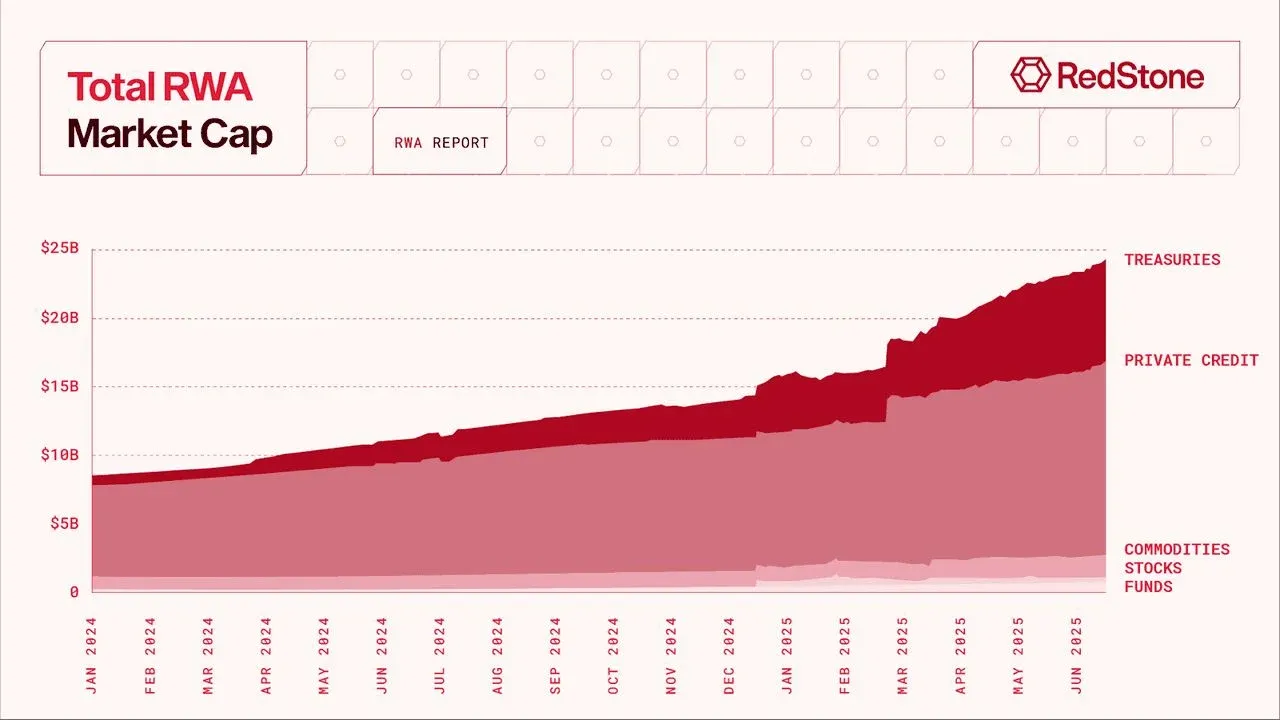
RWA market total value | Source: Redstone
---
In this article we compile the most promising RWA tokenization projects of 2025, dissecting their underlying logic, compliance pathways, and real‑world implementations to help readers quickly grasp the latest trends of bringing physical assets on‑chain. We also provide an in‑depth assessment of each project’s technology stack, ecosystem partnerships, and potential risks, offering a comprehensive reference.

What is Real‑World Asset (RWA) Tokenization, and How Does It Work?
RWA tokenization refers to converting a physical or financial asset into a tradable digital credential on a blockchain. Such tokens directly represent ownership or usage rights of the underlying asset, with common targets including real estate, commodities, bonds, and artworks. After tokenization, the asset can be divided into smaller fractions, facilitating cross‑border transactions and lowering entry barriers.
The basic workflow is as follows:
- Asset Identification and Compliance Preparation – Conduct legal due diligence on the underlying asset to ensure it meets the regulatory requirements of the relevant jurisdiction.
- Smart‑Contract Deployment – Write and publish a contract on a blockchain that mints tokens corresponding to the asset’s value.
- On‑Chain Trading – List the tokens on a blockchain platform where investors can buy, sell, or transfer them. For example, after tokenizing an office building, hundreds of token holders can share rental income, and the proceeds are deposited directly into their digital wallets.
This on‑chain/off‑chain bridge enables high‑value traditional financial assets to enter the blockchain ecosystem at lower cost and higher transparency, attracting both institutional and retail participation.
---
Why Is RWA Tokenization Gaining Momentum in 2025?
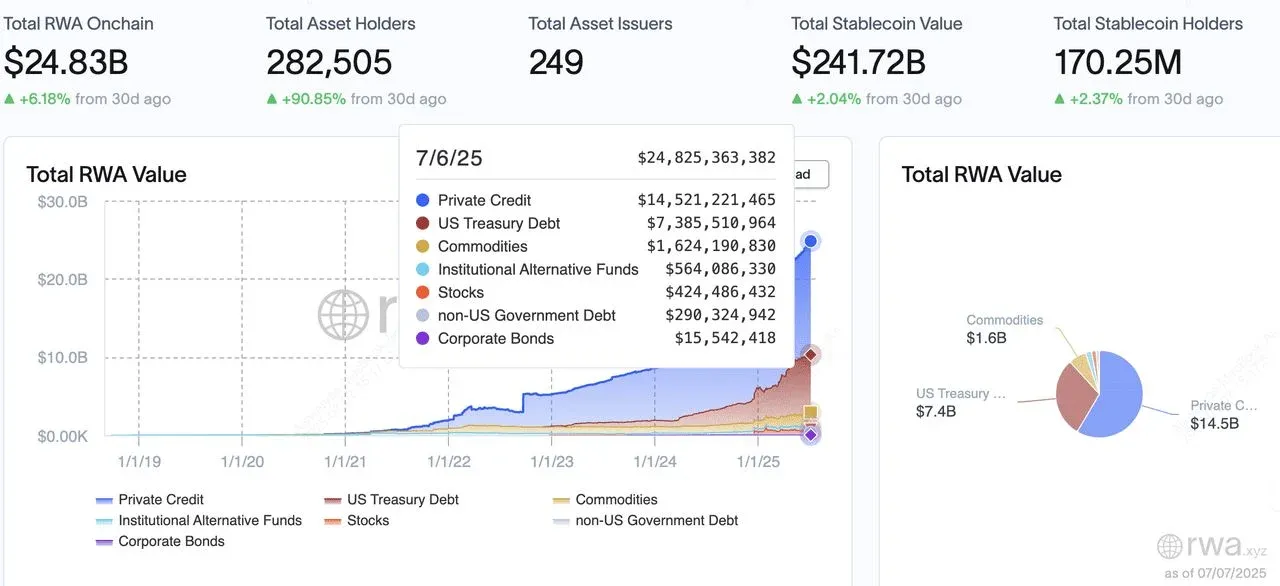
RWA market in July 2025 | Source: RWA.xyz
In 2025, the RWA tokenization market surpassed $23 billion, becoming the fastest‑growing blockchain sub‑sector. The main drivers of this boom are:
- Accelerated institutional rollout – Global asset managers such as BlackRock and Fidelity have launched tokenized money‑market funds and sovereign‑bond products, showcasing blockchain’s potential to revamp traditional financial instruments.
- Inclusive partial ownership – Tokenization allows everyday investors to participate in high‑value assets like real estate and private credit with relatively small capital, broadening financial inclusion.
- Maturing underlying technology – High‑throughput networks like Solana and Plume provide faster, cheaper transaction environments, giving large‑scale RWA projects the technical foundation they need.
- Gradually clearer regulatory landscape – The United States, Singapore, the European Union and other regions have issued compliance guidelines for tokenized assets, delivering institutional‑grade regulatory support.
Overall, these trends make 2025 a pivotal year for RWA projects to enter a rapid‑growth trajectory, positioning them as a bridge between blockchain innovation and financial inclusion.
---
Which Blockchains Are Suitable for Tokenizing RWAs?
Tokenizing real‑world assets is more than issuing a simple token; it requires a blockchain to deliver compliance, performance, and security in tandem. When selecting a chain, consider the following six dimensions:
1. Regulatory friendliness and identity‑verification capabilities
RWA projects often involve regulated asset classes, so the chain must embed KYC, AML, and permissioned‑token mechanisms. Ethereum’s ERC‑3643 standard and Algorand’s ASA framework both provide such compliance tools.
2. High throughput and low fees
Many RWA projects handle numerous micro‑transactions (e.g., rent, interest payouts), making TPS and transaction‑costs critical. Solana can process up to 50,000 TPS with near‑zero fees; XRPL and Stellar offer similar advantages.
3. Smart‑contract programmability
Tokenized assets need complex logic for revenue distribution, voting rights, and transfer restrictions. Platforms like Ethereum and Tezos support sophisticated contract languages that meet these needs.
4. Security and decentralization level
High‑value assets demand rigorous security. Consensus mechanisms used by Algorand, Hedera Hashgraph, etc., provide strong protection while maintaining decentralization.
5. Ecosystem maturity
A robust developer community, abundant DeFi infrastructure, and active liquidity providers can dramatically shorten time‑to‑market. Ethereum hosts thousands of developers and over $70 billion in DeFi lock‑up value; Polygon and Solana are rapidly catching up.
6. Cross‑chain interoperability
The value of RWAs lies in their ability to move freely across chains. Plume’s SkyLink protocol already supports revenue transfers across 18 chains, and Chainlink’s CCIP supplies the underlying secure multi‑chain communication layer.
---
The Ten Most Noteworthy RWA Blockchains in 2025
The following ten networks stand out in the RWA space, each offering distinct compliance, scaling, or cross‑chain advantages. Each entry briefly outlines its core features and flagship projects.
1. Ethereum
As the earliest public chain to support security tokens, Ethereum uses Proof‑of‑Stake consensus, delivering roughly 15 TPS and currently scaling via Layer‑2 solutions (Optimism, Arbitrum, ZKsync Era) to boost throughput and cut fees. Standards such as ERC‑1400 and ERC‑3643 are purpose‑built for compliant assets. Flagship projects include Centrifuge (over $300 million tokenized), Ondo Finance (US Treasury and corporate bond tokenization), as well as institutional platforms Securitize and Ethena.
2. Solana
Combining Proof‑of‑History with PoS, Solana can handle 50,000+ TPS with an average fee of only $0.013. The platform includes permissioned‑token and KYC extensions, has custodialized $413 million of RWAs, and boasts more than 51,000 holders—a growth rate exceeding 600 % in a 30‑day window. SPYx and Credix illustrate successful use cases in ETF transfers and Brazilian loan markets.
3. Chainlink
While not a blockchain itself, Chainlink is a decentralized oracle network that supplies real‑time price feeds, reserve audits, and cross‑chain data for RWA projects. Over 80 % of tokenized platforms rely on its services. In June 2025, Chainlink enabled a cross‑chain settlement between JPMorgan and the Ondo Chain via its CRE solution, and its CCIP is being explored by institutions such as SWIFT and DTCC for large‑scale RWA interoperability.
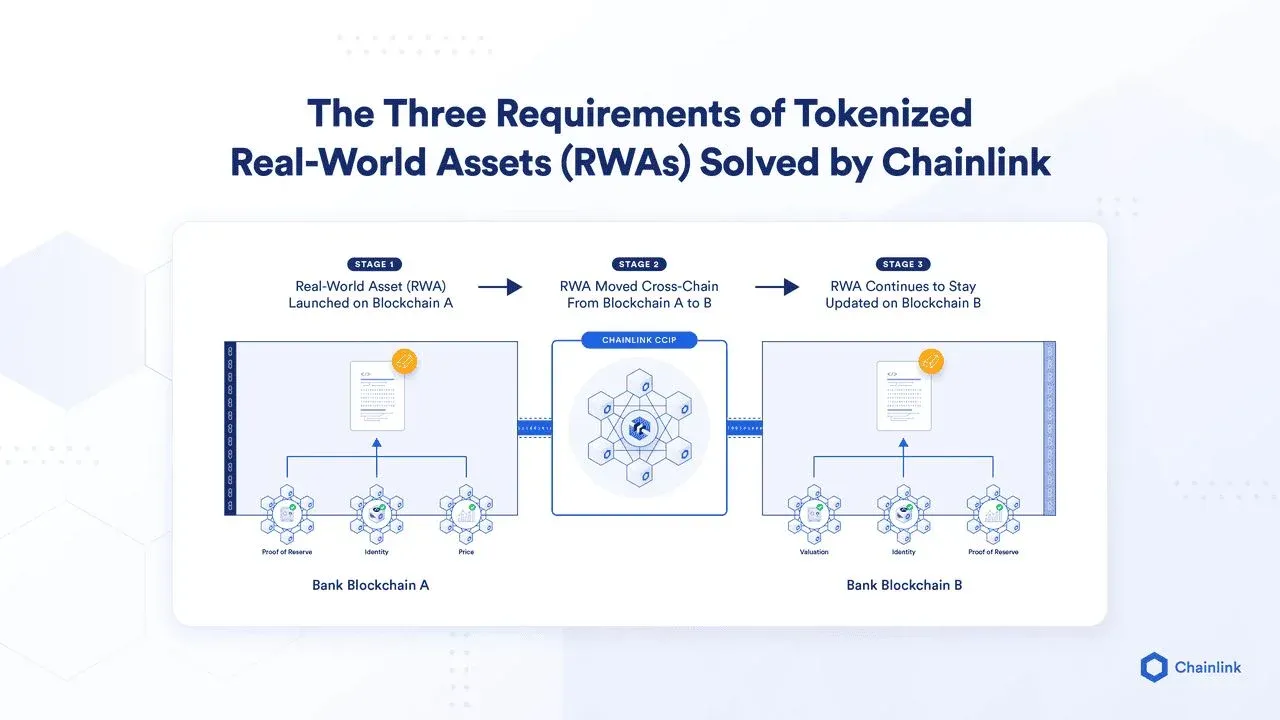
Chainlink’s role in real‑world asset tokenization | Source: Chainlink
4. Plume
An EVM‑compatible Layer‑1 built specifically for RWAs, Plume offers around 1,000 TPS, low fees, and built‑in KYC/AML and tax modules. By July 2025 it had custodialized $128 million of assets, with 128,000 token holders and a 30‑day TVL growth of 87 %. Its SkyLink cross‑chain yield protocol spans more than 18 chains and partners with World Liberty Financial to launch the pUSD stablecoin.
5. XRP Ledger (XRPL)
Utilizing a federated consensus model, XRPL processes roughly 1,500 TPS with virtually no fees. It natively supports permissioned tokens and on‑chain compliance metadata. Mercado Bitcoin tokenized $200 million of fixed‑income and equity assets on XRPL; Ondo Finance issued a $693 million OUSG treasury token; Guggenheim Partners launched a U.S. commercial‑paper tokenization project. By mid‑2025 XRPL’s RWA transaction volume exceeded $157 million, up 34 % month‑over‑month.
6. Stellar
Operating on the Stellar Consensus Protocol (SCP), Stellar delivers about 1,000 TPS with negligible transaction costs. Its KYC anchor framework bridges fiat and crypto assets. As of mid‑2025 the network had custodialized $590 million of tokenized assets and processed over $30 billion in RWA transactions. Notable projects include Franklin Templeton’s Benji fund and WisdomTree Prime’s tokenized fund.
7. Algorand
With Pure Proof‑of‑Stake (PPoS) consensus, Algorand achieves roughly 1,000 TPS and sub‑5‑second finality. The ASA framework facilitates compliant asset issuance. By mid‑2025 Algorand accounted for around 70 % of the RWA market, with tokenized assets surpassing $425 million. Flagship initiatives comprise Lofty.ai (U.S. real‑estate tokenization), Midas (U.S. Treasury tokenization), and Mitsui OSK Lines’ carbon credit token.
8. XDC Network
Designed for enterprise use, XDC employs delegated PoS (dPoS) to deliver near‑zero fees and millisecond‑level finality. It includes a compliance layer compatible with ISO 20022, MLETR and other standards. The network has executed LIQI’s $500 million RWA project and partnered with custodial firm Utila, showcasing its bridging capability for trade finance and asset tokenization.
9. Aptos
A PoS Layer‑1 that runs Move smart contracts, Aptos emphasizes compliance and identity verification. It has attracted institutions such as BlackRock and Franklin Templeton to deploy U.S. Treasury fund products on‑chain. The platform now custodializes over $540 million of RWA assets across 13 tokenized products and has been selected as the preferred technology for Wyoming’s WYST stablecoin pilot.
10. Sei
Built for financial use cases, Sei is an EVM‑compatible Layer‑1 that uses Twin Turbo consensus with optimistic parallelization, delivering 12,500 TPS, sub‑400 ms finality, and virtually zero fees. It has provided settlement services for fintech firms like Zero Hash, set record‑high transaction volume and TVL in early 2025, and also appears in Wyoming’s WYST stablecoin pilot.
---
Emerging Trends in Real‑World Asset (RWA) Tokenization
RWA tokenization is entering a rapid‑iteration phase, with two particularly notable trends:
- Rise of cross‑chain yield flows – Protocols such as Plume’s SkyLink and Chainlink’s CCIP enable tokenized assets to move freely among Ethereum, Solana, Polygon and other chains. According to rwa.xyz, cross‑chain RWAs now account for more than 15 % of the tokenized‑asset market (approximately $24 billion), underscoring the importance of interoperability.
- Oracles as a critical component – Chainlink supplies off‑chain data, price feeds, and reserve audits to over 80 % of RWA projects, ensuring that tokenized assets reflect real‑world value and remain compliant. Chainlink’s 2025 report further confirmed the indispensable role of oracles in financial‑regulatory compliance.
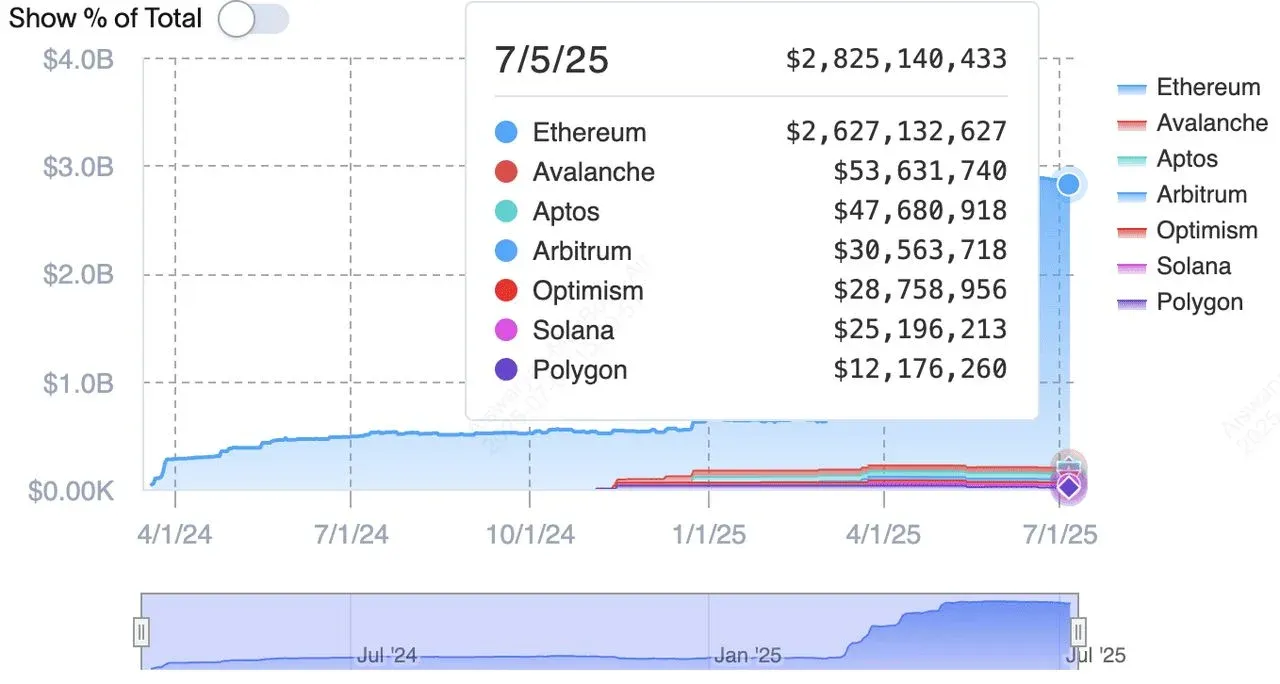
BlackRock’s BUIDL fund | Source: RWA.xyz
Institutional acceleration is equally evident: BlackRock’s $2.9 billion BUIDL fund operating on Ethereum and Franklin Templeton’s Benji money‑market fund on Stellar both demonstrate traditional finance’s confidence in RWA viability. Dedicated chains such as XRPL, XDC Network, and Plume provide permissioned tokens and built‑in compliance frameworks, delivering the technical backbone needed for enterprise‑scale adoption.
---
Conclusion
RWA tokenization is redefining how assets are stored, transferred, and accessed. In 2025 the market size has broken the $23 billion barrier, drawing attention from startups to global financial institutions alike. Choosing the right blockchain platform directly determines a project’s scalability, compliance pathway, and user‑adoption speed. Ethereum and Solana stand out thanks to their mature ecosystems and strong developer communities; Chainlink remains the cornerstone for off‑chain data; while purpose‑built chains like Plume, XRPL, and XDC Network offer built‑in compliance and cross‑chain capabilities that give them a unique edge for institutional use cases.
A word of caution: RWA tokenization is still evolving rapidly, regulatory frameworks continue to shift, and technical risks (e.g., smart‑contract bugs, oracle failures) persist. Participants should conduct thorough due diligence, prioritize solutions that have undergone comprehensive security audits, and ensure alignment with local regulations—crypto gains may be taxable under the applicable jurisdiction. Only by precisely matching blockchain technical attributes with project requirements can a safe, compliant, and long‑lasting tokenized ecosystem be built.
This concludes the article. For more information on 2025 RWA blockchains, you can search for past Bitaigen (比特根) articles or follow the related links below. We look forward to your continued interest and support for Bitaigen (比特根)!
Related Reading
- Real-World Asset Tokenization: Redefining Global Ownership
- Real‑World Asset Tokenization: Concepts, Asset Classes & Top 10 Projects
- Mantra (OM) Token: RWA Tokenization, Staking & Governance
💡 Register on Binance with referral code B2345 for the maximum trading fee discount. See Binance complete guide.



