
 Bitaigen Research
 In this article we outline the core differences between the two major token standards TRC20 and ERC20, focusing on transfer efficiency and fees, and analyzing their security and applicable scenarios on the Tron and Ethereum networks. To learn the details, keep reading.
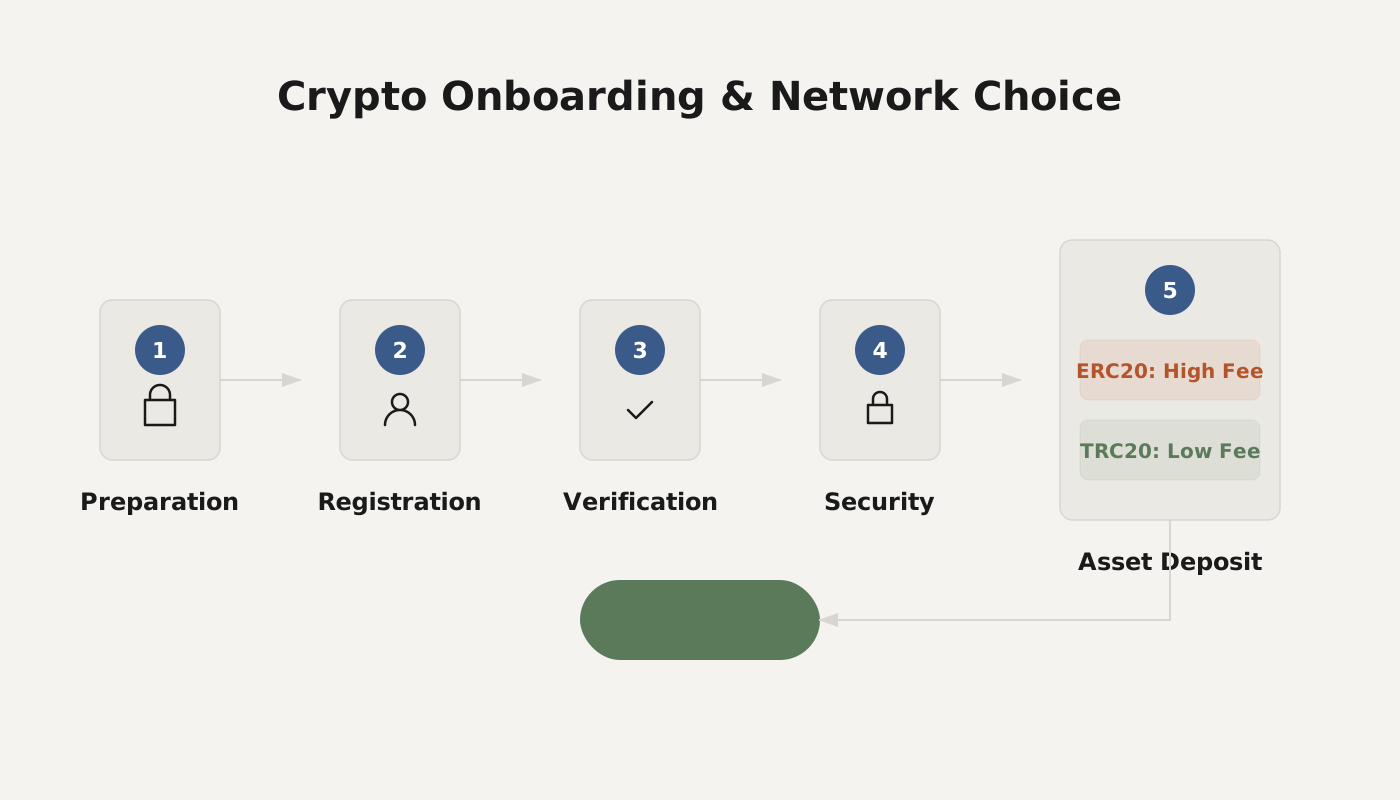
Differences Between TRC20 and ERC20 (Transfer Efficiency and Fees)
TRC20 is built on the Tron network, offering transfer speeds that can be measured in seconds and fees that are virtually zero; ERC20 is built on the Ethereum network, where transfers typically take several minutes up to tens of minutes, and fees are comparable to Ethereum gas costs.
USDT‑TRC20 addresses start with T, while USDT‑ERC20 addresses start with 0x. They operate on two distinct blockchains—Tron and Ethereum—so their security characteristics and use cases differ.
---
Basic Concept of USDT
USDT is a stablecoin issued by Tether that is pegged to the US dollar (USD), with 1 USDT ≈ 1 USD, allowing users to exchange at a 1:1 ratio at any time. The inherent properties of blockchain—immutability, full traceability, transparency, and collective maintenance—provide the technical foundation for USDT’s issuance and circulation.
---
Overview of Blockchain Networks
| Project | Launch Date | Supply Cap | Main Features |
|---|---|---|---|
| **Bitcoin (Bitcoin)** | January 3, 2009 | 21 million BTC | Decentralized, globally circulated, low transaction fees |
| **Ethereum (Ethereum)** | July 30, 2015 | No hard cap | Supports smart contracts, rich ecosystem |
| **Tron (Tron)** | September 1, 2017 | No hard cap | High throughput, low fees, fast confirmations |
Note: Domestic regulations currently do not permit buying or selling Bitcoin.
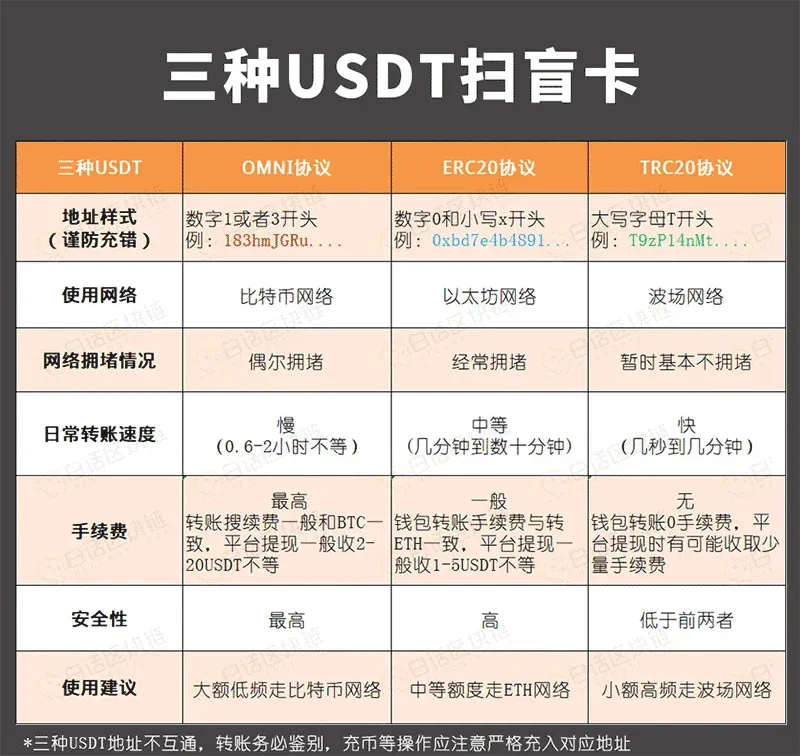
Comparison of Transfer Performance Across USDT Protocols
1. OMNI Protocol (Bitcoin‑based)
- Address format: starts with numeric 1 or 3 (e.g., `183hmJGRu...`)
- Network congestion: occasional
- Transfer speed: slow, typically 0.6–2 hours
- Fees: highest, usually equal to Bitcoin transaction fees; platform withdrawal fees 2–20 USDT
- Security: highest
- Recommendation: suitable for large‑amount, low‑frequency transactions on the Bitcoin network
2. ERC20 Protocol (Ethereum‑based)
- Address format: a 42‑character hexadecimal string starting with `0x` (e.g., `0xbd7e4b4891...`)
- Network congestion: frequent
- Transfer speed: moderate, ranging from a few minutes to tens of minutes
- Fees: moderate, comparable to the gas cost for transferring ETH; platform withdrawal fees 1–5 USDT
- Security: high
- Recommendation: suitable for medium‑size transactions on the Ethereum network
3. TRC20 Protocol (Tron‑based)
- Address format: starts with the uppercase letter T (e.g., `T9zP14nMt...`); ensure you do not send to the wrong chain
- Network congestion: virtually none
- Transfer speed: fast, completed in seconds to a few minutes
- Fees: nearly zero; wallet‑to‑wallet transfers are free, though platforms may charge a small fee for withdrawals
- Security: lower than the previous two
- Recommendation: ideal for small‑amount, high‑frequency transactions on the Tron network
Remedies for Deposit Mistakes
- Accidentally sending to an address on a different chain (e.g., depositing TRC20 USDT to a BTC, ETH, or TRX address)
- You can only contact the customer support of the respective platform; some platforms may be able to assist with recovery.
- Depositing to an address that does not support the chosen protocol (e.g., sending ERC20 USDT to a platform that only supports TRC20)
- You must wait until the platform adds support for the relevant protocol before you can withdraw; during this period the funds may be inaccessible.
Summary
- Transfer efficiency: TRC20 > ERC20 > OMNI.
- Fees: TRC20 ≈ 0 < ERC20 < OMNI.
- Security: OMNI > ERC20 > TRC20.
Choosing the appropriate protocol based on transaction size, frequency, and security requirements can significantly improve the user experience.
Note: For U.S. residents, transactions should be conducted on Binance.US rather than the global Binance platform. Crypto gains may be subject to taxes according to the regulations of your local jurisdiction.
Related Reading
- Token Transfer Gas Savings: ERC20 vs ERC777, ERC1363
- Ethereum Mining Explained: How to Earn ETH Rewards
- AXS Review: Governance Token, Ecosystem & Industry Trends
💡 Register on Binance with referral code B2345 for the maximum trading fee discount. See Binance complete guide.



