
 Bitaigen Research
 What Is a Smart Contract?
It is deterministic code that runs on a blockchain and automatically executes the agreed‑upon actions once predefined conditions are met, eliminating the need for intermediaries while enhancing transparency and security.
In this article we outline the core concepts, evolutionary timeline, and the execution mechanism of smart contracts within the Ethereum Virtual Machine (EVM), helping readers quickly grasp their decentralised advantages and real‑world use cases. After a thorough read you will have a more complete understanding of a contract’s safety, transparency and future potential, making it well worth a careful study.
Definition and Origin of Smart Contracts
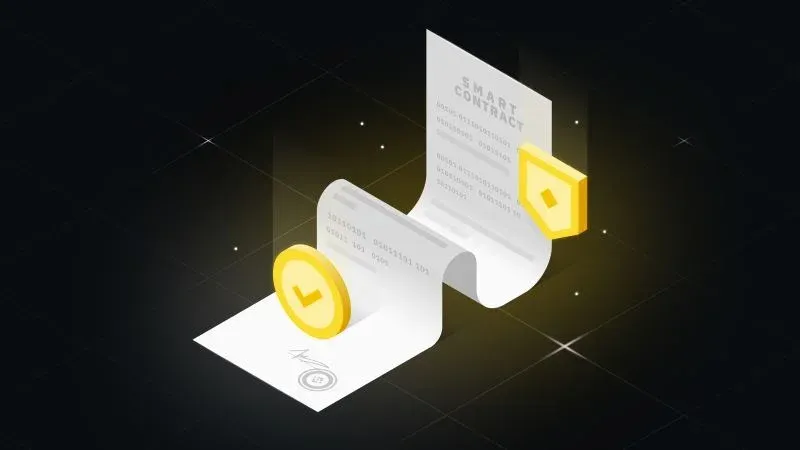
The smart contract concept was first introduced by Nick Szabo in the 1990s. He described it as a tool that combines protocol logic with a user interface to protect the security of computer networks. Szabo imagined applications ranging from credit systems and payment workflows to content‑rights management.
In the cryptocurrency space, a smart contract refers to an application or code fragment that runs on a blockchain. The contract’s rules are hard‑coded in computer language and are copied and executed on every node of the network, thereby achieving a trust‑less protocol. The parties only need to make commitments on the blockchain; they do not have to know or trust each other. If the stipulated conditions are not satisfied, the contract simply does not trigger.
Although Bitcoin already supported rudimentary smart‑contract functionality, widespread adoption was truly ignited by Vitalik Buterin’s Ethereum Virtual Machine (EVM). Different blockchains implement smart contracts in various ways; this article focuses on contracts that execute inside the EVM.
How Do Smart Contracts Run?
A smart contract is a deterministic program that follows “if … then …” logic. When the preset conditions are satisfied, it automatically carries out a specific task. It is important to note that a smart contract is not a contract in the legal sense, nor does it possess true “intelligence”; it is merely code executing on a distributed blockchain system.
On the Ethereum network, smart contracts manage interactions between users (addresses). Addresses that are not contracts are called externally owned accounts (EOAs) and are controlled by private keys; a smart contract, by contrast, is controlled by its own code. Each contract has two public identifiers: one supplied by the creator and another that serves as the contract’s unique numerical identifier on the chain.
All contract deployments are performed via blockchain transactions, and a contract becomes active only when called by an EOA or another contract. The initial trigger almost always originates from an EOA.
History and Evolution of Smart Contracts
Ethereum was designed to extend Bitcoin’s limited contract capabilities, turning the network into a Turing‑complete state machine—an open, shared computing platform for anyone. In theory, any computation that can be performed on a conventional computer can be replicated on Ethereum, supporting messaging apps, games, social platforms and a wide variety of DApps (decentralised applications).
Current decentralised networks still face constraints in transaction speed and cost, which hampers the deployment of more complex applications. Ethereum is just one of many blockchains striving to build a shared computing platform.
Why Are Smart Contracts Important?
Smart contracts enable developers to build decentralised applications (dApps) and tokens that span finance, logistics, gaming and numerous other sectors. Once a contract is written to the blockchain, it is, in principle, irrevocable and immutable (unless an upgrade mechanism is deliberately built in). This provides tamper‑proof assurances for business processes.
Typical dApps built on smart contracts include:
- Uniswap – a decentralised exchange that uses contracts to automatically match buyers and sellers without a central quoting entity.
- Compound – a lending platform where investors earn interest via contracts and borrowers receive loans instantly.
- USDC – a stablecoin pegged 1:1 to the US Dollar; issuance and transfers are executed entirely by contracts. (US users should use Binance.US or other compliant platforms; fiat on‑ramps often rely on USD transfers via SEPA or SWIFT.)
When using these tools, a user simply sends tokens to the relevant platform address, and the contract autonomously handles rate matching, asset transfers, interest calculations and other logic, without any bank or intermediary involvement.
Key Characteristics
| Feature | Meaning |
|---|---|
| **Distributed** | Contract code is replicated across all Ethereum nodes, eliminating a single point of failure. |
| **Deterministic** | Identical inputs always produce identical outputs; execution results are consistent. |
| **Autonomous** | The contract self‑executes when triggered and remains dormant otherwise. |
| **Immutable** | Once deployed the code cannot be changed; it can only be destroyed via a pre‑programmed `SELFDESTRUCT`. |
| **Customisable** | Different business logic can be implemented by writing Solidity code in various ways. |
| **Trust‑less** | Participants do not need to trust each other; the blockchain guarantees execution. |
| **Transparent** | Source code is publicly viewable and all transactions are traceable. |
Can a Contract Be Modified or Deleted?
After deployment, a standard contract cannot have new functions added. If the source includes a `SELFDESTRUCT` (self‑destruct) function, the contract can be destroyed under certain conditions and replaced by a new one. Contracts lacking this function remain on‑chain forever.
Upgradeable contracts achieve functional updates through proxy patterns or layered architectures. A common approach is to split business logic into multiple sub‑contracts and apply self‑destruct or upgrade mechanisms only to the parts that need change.
Why Use Smart Contracts on Decentralised Networks?
Compared with centralized cloud services such as AWS, decentralised networks provide higher security and transparency. Anyone can verify on‑chain data, reducing reliance on banks or other central authorities and consequently lowering the risk of fraud, hacking and human error.
In scenarios involving funds or assets—such as digital card games or asset‑trading platforms—this trust‑less property is especially critical.
How Smart Contracts Work in Practice
Think of Ethereum as a shared computer. Developers write contracts in Solidity (or another compatible language), deploy them to the network, and receive a unique address. Users simply send native tokens (e.g., ETH) to that address to invoke the contract’s code. The contract then follows its pre‑defined “if … then …” rules to perform the required actions automatically.
Example: a simple contract could receive 1 ETH, split it into 12 equal portions, and automatically transfer one portion each month to a designated beneficiary, effectively acting as a trust fund. The code execution removes the need for lawyers or custodians.
Advantages and Typical Use Cases
- Highly programmable – custom business logic can satisfy diverse requirements.
- Cost‑reducing – decentralised execution eliminates many intermediary fees.
- Efficiency‑boosting – automated processes shorten transaction times.
Common applications include:
- Token issuance (ERC‑20, ERC‑721)
- Voting and governance systems
- Crypto wallets and decentralised exchanges
- In‑game asset ownership
- Supply‑chain traceability, charitable donations, medical‑record management and other cross‑industry scenarios
ERC‑20 Standard
ERC‑20 is the universal technical standard for tokens on Ethereum, defining basic token functionalities. Most projects issue ERC‑20 tokens through smart contracts and use trust‑less contract logic during initial coin offerings (ICOs) or other fundraising events to allocate tokens.
Limitations and Risks
Smart‑contract code is written by humans and may contain bugs. Ideally, contracts—especially those handling large sums—should be audited by experienced programmers before deployment.
Moreover, immutability can become a hindrance when errors are discovered. In 2016 the DAO hack resulted in the loss of a substantial amount of ETH; because the contract code could not be patched directly, the community performed a hard fork, splitting the chain into Ethereum (which restored the lost funds) and Ethereum Classic (which upheld strict immutability).
From a legal perspective, many jurisdictions have not yet established clear regulatory frameworks for smart contracts, and their pseudonymous nature may clash with Know‑Your‑Customer (KYC), age‑verification or other compliance requirements. Users should be aware that crypto gains may be taxable in their local jurisdiction, and they should consult a tax professional for guidance.
Drawbacks and Real‑World Challenges
Although smart contracts are touted as a technology that can replace parts of traditional business processes, their distributed, deterministic, transparent and immutable nature sometimes limits flexibility. Centralised servers still hold advantages in maintenance cost, processing speed and cross‑network interoperability.
Consequently, enterprises often perform a cost‑benefit analysis, selecting the most appropriate technology stack—whether fully on‑chain, hybrid, or entirely off‑chain—based on the specific use case.
Token Sales and Smart Contracts
Token sales (ICOs) represent one of the most common applications of smart contracts. The contract pre‑defines token price, total supply and distribution schedule, ensuring a fair and transparent process.
- Distribution – tokens are allocated to supporters.
- Community building – users rally around the project’s goals.
- Fundraising – capital is raised to finance development.
Airdrops and Smart Contracts
An airdrop is a method by which a project distributes free tokens to users who meet certain criteria. Smart contracts can automatically verify eligibility and execute the distribution, guaranteeing that the rules are public and tamper‑proof.
Future Outlook for Smart Contracts
As the technology matures, smart contracts are expected to play a larger role in:
- Supply‑chain management – tracking product movement and verifying authenticity.
- Voting and governance – building secure, transparent voting mechanisms.
- Decentralised identity – managing identity information without relying on central authorities.
These innovations could redefine industry operations and empower individuals and organisations in unprecedented ways.
Conclusion
Smart contracts have profoundly reshaped the cryptocurrency ecosystem and are now permeating finance, supply‑chain, governance and many other sectors. While the average user may not interact directly with a contract, the underlying automation and decentralisation are gradually entering everyday life. Whether smart contracts can overcome technical and regulatory hurdles to achieve mass adoption remains to be seen, but their trajectory is unmistakably upward.
*This comprehensive overview of smart contracts was prepared by the editorial team at Bitaigen. Thank you for reading!*
Related Reading
- Ethereum PoS vs PoW: Why the Shift Matters
- 以太坊与Rollup生态系统的长期趋势:ZK‑Rollup 与新一代虚拟机
- Based Money DeFi Game: Ethereum, Ampleforth Elastic Supply
💡 Register on Binance with referral code B2345 for the maximum trading fee discount. See Binance complete guide.



