
 Bitaigen Research
 Overview of the XRP Ledger (XRPL)
The XRPL is an open‑source distributed ledger technology designed to provide financial institutions, payment service providers, and developers with a low‑cost, high‑speed transaction infrastructure. Thanks to its decentralized network architecture, the ability to process thousands of transactions per second, and an energy‑friendly consensus mechanism, the XRPL has earned broad recognition in the industry.
---
In this article we systematically outline XRPL’s technical framework, development history, and ecosystem role, helping readers quickly grasp its core advantages in cross‑border payments and decentralized finance, and offering practical onboarding guidance worth a thorough read. Whether you are a technologist or a business decision‑maker, you will find useful insights here.
Origin and Key Figures
In 2011, Ryan Fugger first introduced a novel vision for cross‑border payments in his RipplePay project. The following year, Jed McCaleb, Arthur Britto, David Schwartz, and Chris Larsen turned the concept into reality by building the XRP Ledger network.
- Jed McCaleb: Co‑founder, later created Stellar.
- Chris Larsen: Co‑founder of e‑Loan and Prosper Marketplace, Ripple CEO from 2012‑2016.
- David Schwartz: Chief cryptographer, one of the original XRPL architects, now Ripple CTO.
- Arthur Britto: Low‑profile co‑founder and early network development advisor.
The XRP Ledger Foundation, an independent nonprofit, is responsible for steering the long‑term evolution of the technology; Ripple Labs is a fintech company that has raised over $300 million from investors such as a16z and Digital Ventures.
---
Core Technical Components
Consensus Protocol
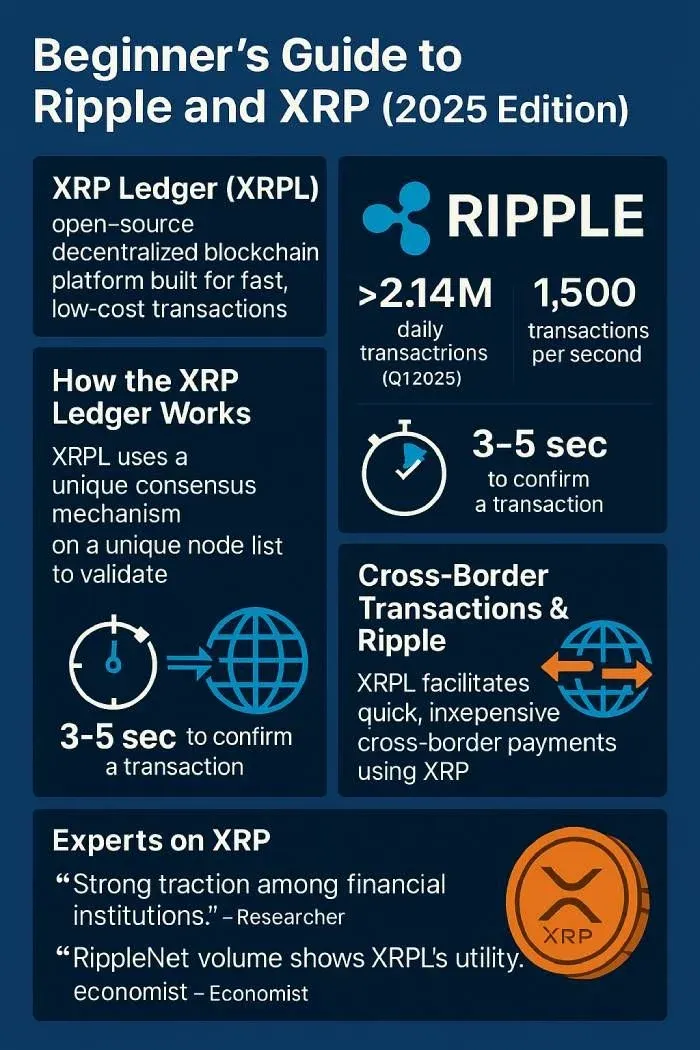
XRPL uses a proprietary consensus mechanism in which independent validators reach agreement every 3‑5 seconds on which transactions can be written to the ledger. Compared with Bitcoin’s proof‑of‑work (PoW) or Ethereum’s proof‑of‑stake (PoS), this protocol offers significant advantages in speed and energy consumption.
Nodes and Validators
As of mid‑2025, the network hosts over 1,000 active nodes. Validators are selected from a unique node list and are responsible for verifying transactions, making it difficult for any single entity to control the entire network.
Transaction Flow
- Proposal: A user initiates a transaction and broadcasts it to the network.
- Validation: Validators check the transaction’s legality (e.g., sufficient balance).
- Consensus: The consensus protocol collectively confirms the set of transactions to be written.
- Finality: The transaction is permanently recorded in the ledger and cannot be altered.
Expert View: Blockchain analyst Marta Rodríguez notes, “XRPL’s consensus model demonstrates that a blockchain can operate without the high‑energy demands of PoW; its efficiency makes it one of the most viable networks for real‑world financial use cases.”
---
Key Innovations and Industry Advantages
- Developer‑friendly: Rich SDKs and APIs make it easy to build decentralized finance (DeFi) applications.
- Extremely low fees: A single transaction costs roughly 0.000012 XRP (less than $0.0002), effectively negligible.
- High throughput: XRPL’s TPS ceiling is about 1,500, far exceeding traditional payment systems such as SWIFT (5‑7 messages per second).
- Green consensus: No massive computational power is required, dramatically reducing energy usage.
Industry Insight: Fintech researcher David Kim points out, “In 2025, XRPL can scale transaction volume exponentially while keeping fees near zero, a factor that is critical for institutional adoption.”
---
Ripple’s Cross‑Border Payment Solution
Traditional cross‑border remittances rely on slow, costly centralized channels. Ripple’s On‑Demand Liquidity (ODL) eliminates the need for pre‑funded nostro accounts, allowing enterprises to settle cross‑border transfers in seconds with minimal fees.
In the first half of 2025, RippleNet facilitated more than $1.3 trillion in global payments, indicating rapidly growing institutional acceptance of the network.
Market Commentary: Economist Lila Srinivasan observes, “RippleNet’s transaction volume surpassing the trillion‑dollar mark this year signals that cross‑border settlement is entering the early stage of decentralised finance, making the limitations of traditional SWIFT increasingly apparent.”
---
XRP Token Economics
XRP has a fixed total supply of 100 billion tokens, all of which were pre‑mined in January 2013. The distribution breakdown is as follows:
- Founding team holds 20 % (≈ 20 billion)
- Ripple Labs holds 80 % (≈ 80 billion)
In 2017, Ripple Labs placed 55 billion XRP into a custodial account, releasing 1 billion each month to the market. Unused portions remain in the custodial reserve to ensure predictable supply and mitigate market‑manipulation risk.
Analyst Opinion: Crypto researcher Julian Becker states, “The custodial mechanism is a point of debate, but its transparency and predictability give XRP a relatively robust accountability framework that many crypto projects lack.”
As of early 2025, the circulating supply is about 59.5 billion XRP, giving a market cap of roughly $178 billion. The network processes an average of 2.14 million transactions per day, with fees still hovering around 0.000012 XRP per transaction.
---
Reasons to Hold or Use XRP
- dApp ecosystem: Many XRPL‑based decentralized applications require XRP to invoke functionality.
- Peer‑to‑peer payments: Users can send XRP directly to merchants or individuals who accept it.
- Network security: Paying a tiny amount of XRP as a transaction fee helps deter spam attacks and keeps the ledger healthy.
Strategist View: Crypto strategist Elena Popov remarks, “XRP is one of the few digital assets with clear use‑cases; its practical role in liquidity and payments pushes it beyond pure speculation.”
---
Practical Uses of XRP
- Transaction fees: Each transaction consumes a minuscule amount of XRP to prevent network abuse.
- Bridge currency: In cross‑border payment pathways, XRP acts as an intermediary, enabling faster and cheaper conversion between fiat currencies.
---
2025 XRPL Data Snapshot
| Metric | Value |
|---|---|
| Circulating supply | ≈ 59.5 billion XRP |
| Total supply | 100 billion XRP |
| Market cap (Q1 2025) | ≈ $178 billion |
| Daily transaction count | ≈ 2.14 million |
| Cumulative 2024 transactions | 642 million |
| Per‑transaction fee | 0.000012 XRP (< $0.0002) |
| TPS ceiling | ≈ 1,500 |
| Active nodes (mid‑2025) | > 1,000 |
| RippleNet H1 2025 transaction volume | > $1.3 trillion |
---
Conclusion
This article has outlined XRPL’s technical foundation, ecosystem innovations, and Ripple’s real‑world implementation in cross‑border payments. To explore the full XRP Ledger ecosystem further, you can search Bitaigen’s (BitGen) archive of in‑depth reports or continue reading the related articles below. Thank you for reading, and we look forward to your continued follow‑up with Bitaigen’s latest content!
Related Reading
- Top XRP Blockchain Explorers: Features, Use‑Cases & Guides
- XRPL EVM: Ethereum-Compatible Sidechain for DeFi, NFTs
- Vitalik Buterin提出以太坊超级扩展方案:状态分层与执行提效
💡 Register on Binance with referral code B2345 for the maximum trading fee discount. See Binance complete guide.



