
 Bitaigen Research
 Litecoin (LTC) Overview
Litecoin (LTC) is a peer‑to‑peer digital currency built on the Scrypt algorithm, designed to deliver faster transaction confirmations and lower fees than Bitcoin.
Litecoin (LTC) is a long‑standing cryptocurrency with a rich history. Although it is not classified among the “mainstream” blockchains and its ecosystem applications are relatively limited, the market’s high level of trust has kept it consistently within the top 20 by market‑cap for many years.
This article systematically explains Litecoin from basic concepts, technical evolution, differences from Bitcoin, purchasing methods, price forecasts, and risk factors, helping readers quickly build a complete understanding.
In the industry, the term Litecoin is used without distinguishing “coin” or “blockchain” (just as Bitcoin refers to both the Bitcoin blockchain and its native token BTC). For readability, the following notation is used throughout this article:
- Blockchain = Litecoin (refers to the technical/protocol layer)
- Native token = Litecoin LTC, LTC (refers to the token used for price quotes, payments, and transactions)
In this article we outline Litecoin’s core concepts and technical features, dissect its key differences from Bitcoin, and provide safe purchasing guidance, price‑trend outlooks, and risk assessments. The goal is to help investors form a comprehensive, objective view. Subsequent sections will expand on each detail—please continue reading.
Basic Introduction to Litecoin
Litecoin Key Data
| Item | Details |
|---|---|
| Token Symbol | LTC |
| Launch Date | 2011‑10‑07 |
| Maximum Supply | 84,000,000 coins |
| Circulating Supply (2025‑09‑15) | Approximately 76,000,000 coins |
| Market Capitalization (2025‑09‑15) | About **US $880 million**, rank #19 |
| Block Time | 2.5 minutes per block |
| Reward Halving | Every 840,000 blocks (≈ 3 years 8 months) |
| Next Halving | Around 2027‑08‑02 |
| Official Website | https://litecoin.org/ |
Source: CoinMarketCap (as of 2025‑09‑15)
Core Vision
Litecoin’s official slogan is “Litecoin is decentralized money for the modern world.” It positions itself as a “lighter version of Bitcoin,” aiming to provide faster, cheaper, and somewhat more private daily payment capabilities. Because it arrived early, it has often been dubbed “digital silver.”
Major Similarities with Bitcoin
- Both are Layer‑1 public blockchains that use a Proof‑of‑Work (PoW) consensus mechanism.
- White‑paper structure, block‑reward halving schedule, and many other design elements are closely aligned.
- Both aim to be decentralized, inflation‑resistant digital money.
Key Differences from Bitcoin
| Aspect | Litecoin | Bitcoin |
|---|---|---|
| **Block time** | 2.5 minutes (≈ 4× faster) | 10 minutes |
| **Total supply** | 84 million (4× Bitcoin’s 21 million) | 21 million |
| **Mining algorithm** | **Scrypt** (lower entry barrier) | SHA‑256 (higher security) |
Although technically similar to Bitcoin, Litecoin’s ecosystem remains comparatively thin, and it has not fully realized its original vision of widespread everyday payments.
Evolution and Technical Innovations of Litecoin
1. Original Goal: Faster Transactions and Lower Fees
Litecoin was created in 2011 by former Google engineer Charlie Lee. It is a fork of the Bitcoin codebase that retains decentralization and security while shortening block time and reducing fees, with the ambition to become the backbone of global online payments. Early market commentary often referred to it as “digital silver” because of its perceived advantage over Bitcoin.
2. Technical Upgrades
| Year | Upgrade | Significance |
|---|---|---|
| 2014 | Merged mining with **DOGE** | Boosted network hash power and security |
| 2017 | Activation of **SegWit** (Segregated Witness) | Reduced transaction size, enabled Lightning‑Network cross‑chain atomic swaps |
| 2022 | Launch of **MWEB** (MimbleWimble Extension Block) | Optional confidential transactions, modestly improves block efficiency |
These upgrades have increased network performance, but compared with newer high‑throughput blockchains and purpose‑built payment chains, Litecoin’s real‑world adoption breakthroughs remain limited.
3. Shift in Value Drivers
Today, Litecoin’s market recognition stems more from long‑term trust and historical depth than from pure speed or fee advantages. Its price trajectory has begun to diverge from Bitcoin: Bitcoin continues a strong upward trend, while Litecoin generally oscillates within a relatively stable range.
Litecoin vs. Bitcoin: Comparative Table
| Comparison Item | Litecoin (Litecoin) | Bitcoin (Bitcoin) |
|---|---|---|
| Market Position | “Digital silver,” focused on fast payments | “Digital gold,” store of value |
| Block Speed | ~2.5 minutes | ~10 minutes |
| Max Supply | 84 million coins | 21 million coins |
| Mining Algorithm | **Scrypt** (lower barrier) | SHA‑256 (higher security) |
| DeFi Ecosystem | Limited | Growing (Layer‑2, Ordinals, etc.) |
| Market‑Cap Rank | #19 (≈ US $880 M) | #1 |
| Financialisation | Few spot ETFs, few futures | Multiple ETFs, futures, derivatives |
| Launch Year | 2011 | 2009 |
| Founder | Charlie Lee | Satoshi Nakamoto |
Key Takeaways
- Positioning – Bitcoin emphasizes long‑term value storage; Litecoin stresses transaction efficiency.
- Supply – Litecoin’s four‑times larger supply reduces scarcity relative to Bitcoin.
- Mining Accessibility – Scrypt makes mining more approachable for average users, potentially lowering centralisation risk.
- Ecosystem Depth – Both native chains host few applications, but Bitcoin’s larger market cap attracts more Layer‑2 developers.
Risk Analysis for Litecoin
1. Privacy Features Trigger Regulatory & Delisting Risks
The MWEB upgrade enhances anonymous transaction capability, which may clash with anti‑money‑laundering (AML) and know‑your‑customer (KYC) regulations in various jurisdictions. Some Korean exchanges (e.g., Upbit, Bithumb) have already delisted Litecoin because of this feature.
2. Competitive Pressure
The rise of high‑speed, low‑fee chains such as Solana, Avalanche, Polygon further erodes Litecoin’s comparative advantage in speed and cost. Its borderline position in the top 20 market‑cap list also makes exchange listings more susceptible to privacy‑related scrutiny.
3. Sparse Ecosystem Applications
Litecoin is primarily used for payments and transfers, lacking native DeFi, NFT, or smart‑contract ecosystems. While wrapped LTC (WLTC) can access DeFi on other chains, the overall ecosystem remains thin.
4. Historical Large‑Scale Sell‑off by the Founder
In 2017, Charlie Lee publicly disclosed that he had sold or donated most of his LTC holdings to avoid a conflict of interest. Although the move sparked debate at the time, no similar large‑scale sell‑offs have occurred since, reducing that particular risk.
5. Price Volatility
Like most crypto assets, LTC’s price is highly sensitive to market sentiment, macro‑policy shifts, and speculative demand. Its capped supply and halving schedule can amplify price swings during bull or bear cycles.
Long‑Term Litecoin Price Forecast (Reference)
The following projections are for illustration only and do not constitute investment advice.
| Year | Forecast Low (USD) | Forecast Mean (USD) | Forecast High (USD) |
|---|---|---|---|
| 2026 | 27.55 | 55.00 | 82.24 |
| 2027 | 26.52 | 48.10 | 69.68 |
| 2028 | 47.87 | 82.55 | 117.24 |
| 2029 | 105.15 | 225.53 | 345.92 |
| 2030 | 89.43 | 174.00 | 258.57 |
| 2031 | 105.73 | 170.89 | 236.04 |
| 2032 | 161.39 | 299.62 | 437.85 |
| 2033 | 375.05 | 770.67 | 1,166.29 |
| 2034 | 301.52 | 488.49 | 675.45 |
| 2035 | 356.49 | 576.17 | 795.85 |
| 2036 | 590.11 | 1,118.35 | 1,646.60 |
| 2037 | 1,532.50 | 2,732.37 | 3,932.24 |
How to Purchase Litecoin (LTC)
Below are common acquisition channels for reference only; they do not constitute any form of recommendation.
1. Centralized Exchanges (CEX)
Centralized platforms provide fiat on‑ramps, liquidity guarantees, and relatively mature security measures. Popular choices include Binance, Coinbase, Kraken, among others. For U.S. residents, the appropriate platform is Binance.US (the U.S.-registered entity) rather than the global Binance site.
Example: Buying LTC on Binance (global) – steps
- Download and register the Binance app (official download link: https://www.bitaigen.com/binance/download).
- Complete identity verification (KYC).
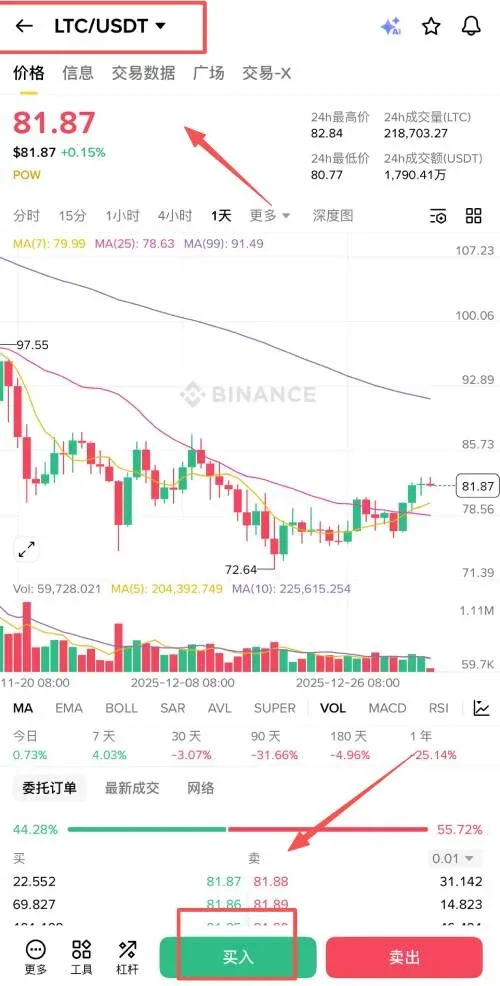
- In the search bar, type LTC and select the LTC/USDT spot pair.
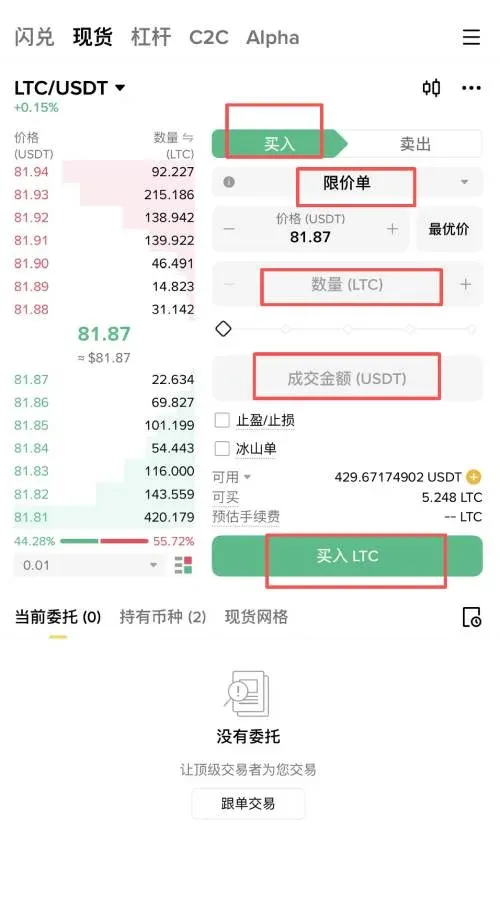
- Click Buy, choose a limit order, set your desired price and amount, then confirm to place the order.
Note for U.S. users: Use Binance.US or another U.S.-compliant exchange such as Coinbase or Kraken. These platforms support SEPA/SWIFT fiat deposits and withdrawals in USD.
2. Decentralized Exchanges (DEX)
On DEXs that support Litecoin (e.g., Uniswap V3 via a cross‑chain bridge, SushiSwap), the process is:
- Connect a compatible crypto wallet (MetaMask, Trust Wallet, etc.).
- Switch to the appropriate Litecoin network (either the native Litecoin mainnet or a bridged version).
- Ensure you have enough native gas token (LTC on the Litecoin network, or the bridge’s native token) to cover transaction fees.
- Enter the desired trading pair and amount, then confirm the swap.
Litecoin Key Takeaways
- Historical Role – As one of the earliest altcoins, Litecoin earned the nickname “digital silver.”
- Technical Traits – Uses Scrypt, 2.5‑minute block time, and the optional MWEB privacy layer.
- Ecosystem Status – Few native applications; primarily used for payments and transfers.
- Value Drivers – Long‑term trust and market recognition rather than pure technical superiority.
- Risk Considerations – Regulatory pressure on privacy features, intense competition, limited ecosystem, and inherent price volatility.
- Financialisation – By 2025, spot ETFs such as the Canary Litecoin ETF (ticker: LTCC) have launched in the United States, indicating a gradually more permissive regulatory environment.
Litecoin remains one of the top 20 crypto assets worldwide as of 2025. Whether it can sustain its competitiveness will depend on future technical innovation, regulatory developments, and the market’s continued appetite for the “digital silver” narrative.
This article is provided for informational purposes only. Readers should conduct their own risk assessment and consider local tax obligations—crypto gains may be taxable in many jurisdictions—before making any decisions.
---
For deeper coverage of Litecoin, you can search the Bitaigen (比特根) archive or continue exploring the related links below. Thank you for reading, and we hope you keep following Bitaigen for more insights!
Related Reading
- Litecoin Review: Scrypt Mining, Supply & Ecosystem
- Litecoin (LTC) Price Sep 2025 - Leading Crypto Payment Method
- Litecoin Price Decline: Key Drivers & Future Outlook
💡 Register on Binance with referral code B2345 for the maximum trading fee discount. See Binance complete guide.



