 Bitaigen Research
 As the momentum behind Real World Assets (RWA) continues to surge, MANTRA has emerged as a focal point in the industry as a Layer 1 protocol specifically designed for regulatory compliance. This article provides an in-depth analysis of how MANTRA utilizes modular solutions and identity verification systems to dismantle the barriers between traditional finance (TradFi) and the on-chain ecosystem. Our goal is to dissect its technical advantages and institutional-grade security logic, offering readers a comprehensive understanding of this critical infrastructure within the RWA sector.
What Are the Core Features of MANTRA Chain?
MANTRA Chain’s competitive edge lies in its suite of features specifically tailored to institutional requirements, aimed at bridging the gap between traditional finance (TradFi) and blockchain technology. Global investors looking to bridge fiat currencies like USD via SEPA or SWIFT transfers into the digital asset space often require the level of certainty that MANTRA provides.
- On-Chain Compliance Framework: The platform provides native support for KYC (Know Your Customer), AML (Anti-Money Laundering), and various securities regulatory requirements. Powered by a Decentralized Identity (DID) system, users can obtain secure, reusable identity verification credentials.
- Modular Tokenization Solutions: MANTRA offers "plug-and-play" tokenization tools that simplify the deployment process for Real World Assets (RWA), ensuring they meet rigorous traditional financial standards.
- Risk Control Mechanisms: Through the integrated DID system, the protocol ensures that assets only circulate among verified participants, effectively mitigating counterparty risk and enhancing overall network integrity.
- Robust Interoperability: Utilizing the native Inter-Blockchain Communication (IBC) protocol and cross-chain bridge technology, MANTRA enables seamless asset transfers across a Multi-Virtual Machine (MultiVM) environment.
- Institutional-Grade Security and Custody: The network’s security is maintained by a validator set that includes banks and professional custodians. It also offers specialized staking and custody service options for high-net-worth and institutional clients.
Furthermore, the chain boasts high throughput and exceptionally low transaction costs, significantly increasing the willingness of both retail users and institutional investors to participate. By integrating custody with regulated digital asset providers, MANTRA also simplifies regulatory reporting processes, making it an ideal choice for conducting compliant RWA business across multiple global jurisdictions.
The Wave of Real World Asset (RWA) Tokenization and MANTRA’s Positioning
The convergence of traditional financial assets and blockchain technology has become one of the most promising developmental directions in the current crypto industry. According to projections by the World Economic Forum (WEF), the market size for RWA tokenization is expected to surpass $10 trillion by 2027, potentially accounting for 10% of global GDP. Against this massive backdrop, MANTRA Chain stands out with its positioning as the world's first specialized Layer 1 blockchain dedicated to the RWA sector.
A Layer 1 (L1) blockchain refers to the foundational network capable of independently recording and finalizing transactions, similar to Ethereum, Solana, or TRON. On these networks, any operation requires the payment of a native token as a transaction fee. MANTRA has successfully enabled the digitization and compliance of assets such as real estate, commodities, and private credit by prioritizing regulatory adherence, supporting MultiVM functionality, and providing institutional-grade infrastructure.
What is MANTRA (MANTRA)?
MANTRA Chain is a modular L1 platform purpose-built for Decentralized Finance (DeFi) and RWA tokenization. It features full Ethereum Virtual Machine (EVM) compatibility and native support for CosmWasm, making it a true MultiVM platform. This allows developers from both the Ethereum and Cosmos ecosystems to build and deploy applications with ease.
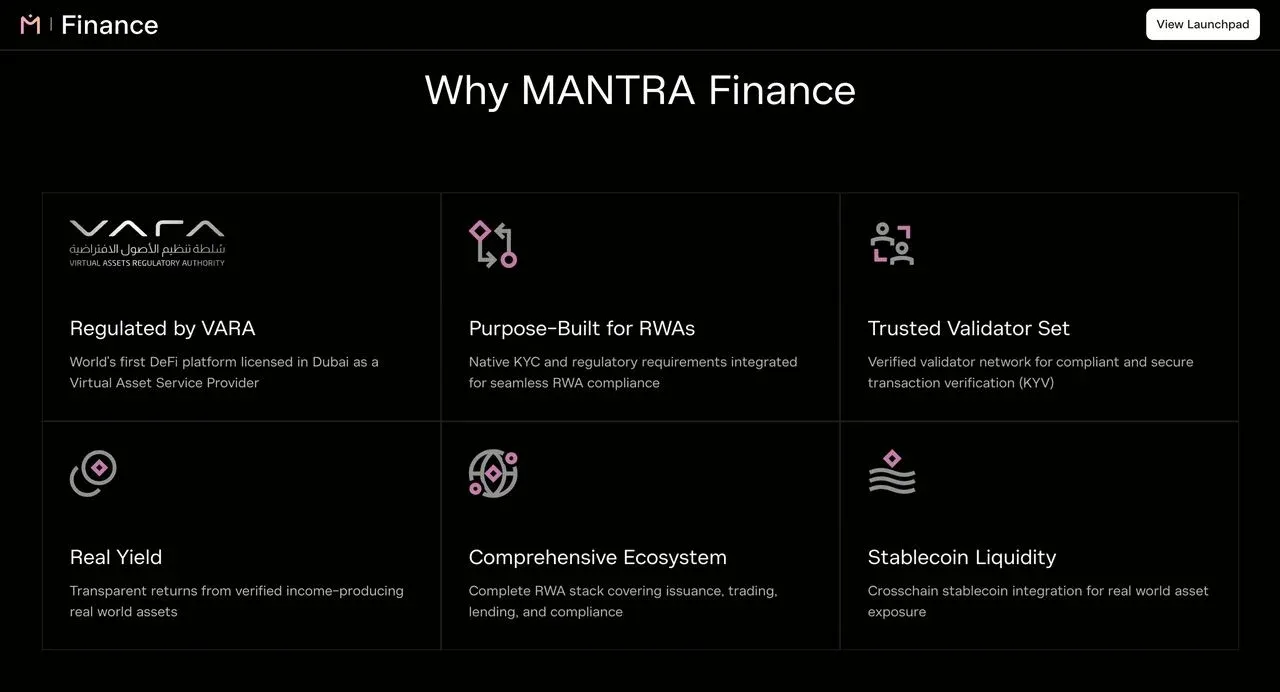
As a permissionless blockchain, it simultaneously allows for the operation of permissioned applications. Developers can embed compliance logic at either the chain level or the contract level. Notably, MANTRA Finance within this ecosystem is currently the only on-chain portal holding a DeFi license from Dubai’s Virtual Assets Regulatory Authority (VARA). It operates as a regulated virtual asset exchange and provides multiple regulatory pathways, including brokerage and management services.
MANTRA’s development journey dates back to the launch of its first RWA-specific testnet in November 2023, with its mainnet officially going live in October 2024. Currently, it is focused on building a comprehensive ecosystem that includes NFTs, vaults, and decentralized exchanges. Its core vision is to become the authoritative ledger of record for RWAs globally.
Team Background and the Evolution of MANTRA
The origins of MANTRA can be traced back to a DeFi project launched in 2020, which initially introduced the ERC-20 standard token, OM. As the team deepened its collaboration with regulatory bodies, they realized the critical need for dedicated infrastructure. In September 2022, the project underwent a formal transition to begin constructing a dedicated Layer 1 blockchain for RWAs.
In February 2024, driven by a community proposal, the original OM token was established as the native staking asset for MANTRA Chain. On October 10, 2024, the mainnet was officially initiated, followed by its public opening on October 23. Through several key upgrades, such as the v5.0.0 Abunnati update, MANTRA introduced native EVM support, solidifying its leading position in the compliant RWA infrastructure space.
MANTRA Tokenomics Analysis
The MANTRA token (formerly OM) is the core component for maintaining network security, governance, and ecosystem operations. The token's economic model has undergone a significant transformation from an ERC-20 token to a native mainnet asset.
- Supply Evolution: The initial cap for the OM token was approximately 888 million. Upon the mainnet launch, the total supply was adjusted to 1.78 billion OM.
- Key Upgrade and Split: Around March 2, 2026, the project executed a major non-dilutive token split (1:4), and the token ticker was officially changed to MANTRA. Consequently, the maximum supply cap was expanded to 10 billion tokens.
- Allocation Ratios: 67.5% is allocated for the OM upgrade (including mirroring and incentives), 12.8% belongs to the MANTRA Chain Association, 16.9% is allocated to core contributors (subject to a 5-year vesting period), and the remainder is used for ecosystem development and early investors.
- Real-Time Data: As of early March 2026, MANTRA has a circulating supply of approximately 4.76 billion tokens. The real-time market price is approximately $0.023 USD, with a total market capitalization exceeding $110 million USD.
5 Key Points to Note Before Trading MANTRA
Before participating in MANTRA trading or investment, investors should gain a deep understanding of its unique compliance attributes and economic mechanisms:
- Regulatory and Compliance Advantage: With its VARA license in Dubai, MANTRA has become a preferred pathway for institutions entering the RWA space. Mandatory KYC/AML verification is a core feature that distinguishes it from purely anonymous protocols.
- Token Migration and Split Details: Investors must be aware of the 1:4 split and rebranding event that occurred in March 2026. When reviewing historical price data or contract information, always ensure the data is updated to the latest MANTRA standard to avoid confusion.
- RWA Sector Growth Dividends: The long-term value of MANTRA is closely tied to the overall explosion of the RWA market. Its ability to capture market share in a multi-trillion-dollar industry will be the key factor in its success.
- Low Inflation and Staking Yields: The network currently maintains a low inflation rate of approximately 3%. As a native staking token, holders can participate in governance and offset the effects of inflation through staking rewards.
- MultiVM Developer Appeal: Simultaneous support for EVM and CosmWasm means it can attract developers from both the Ethereum and Cosmos ecosystems. This is crucial for increasing on-chain liquidity and the diversity of applications.
For users based in the United States, please note that access to certain global platforms may be restricted, and Binance.US is the designated platform for U.S. residents to access supported digital assets. Additionally, investors should be aware that capital gains from cryptocurrency transactions may be subject to taxation depending on local jurisdictional laws.
Conclusion: Outlook for MANTRA in 2026
MANTRA Chain demonstrates a highly forward-looking approach to RWA tokenization. It not only provides high-performance infrastructure but also successfully connects traditional financial markets with the on-chain world through MultiVM flexibility and a rigorous regulatory framework. With the stable operation of its mainnet and the optimization of its tokenomics, MANTRA has become a force that cannot be ignored in the RWA track. For users seeking an ecosystem that is compliant, secure, and supported by institutional-grade tools, MANTRA provides a highly attractive entry point.
💡 Register on Binance with referral code B2345 for the maximum trading fee discount. See Binance complete guide.



