
 Bitaigen Research
 Overview of the Stablecoin Market (2026)
As of early 2026, the total market capitalization of global stablecoins has surpassed USD 300 billion, reflecting continued demand from both institutions and retail participants for assets with low price volatility. The main drivers behind this growth include:
- A preference for instant, low‑cost settlement methods in cross‑border payments
- Deep integration of stablecoins into mainstream fintech platforms
- Expansion of the decentralized finance (DeFi) ecosystem
- Rising acceptance of digital currencies in emerging markets
These trends demonstrate that stablecoins are no longer niche toys; they have become an essential component of asset allocation for many investors and enterprises.
What Is a Stablecoin and How Does It Preserve Value?
A stablecoin is a token issued on a blockchain whose price is kept relatively constant by being pegged to an external reference asset such as the US dollar, euro, gold, or other commodities. The majority of products are dollar‑referenced, although a small number use other fiat currencies or commodities as anchors.
Its operation relies on two key components:
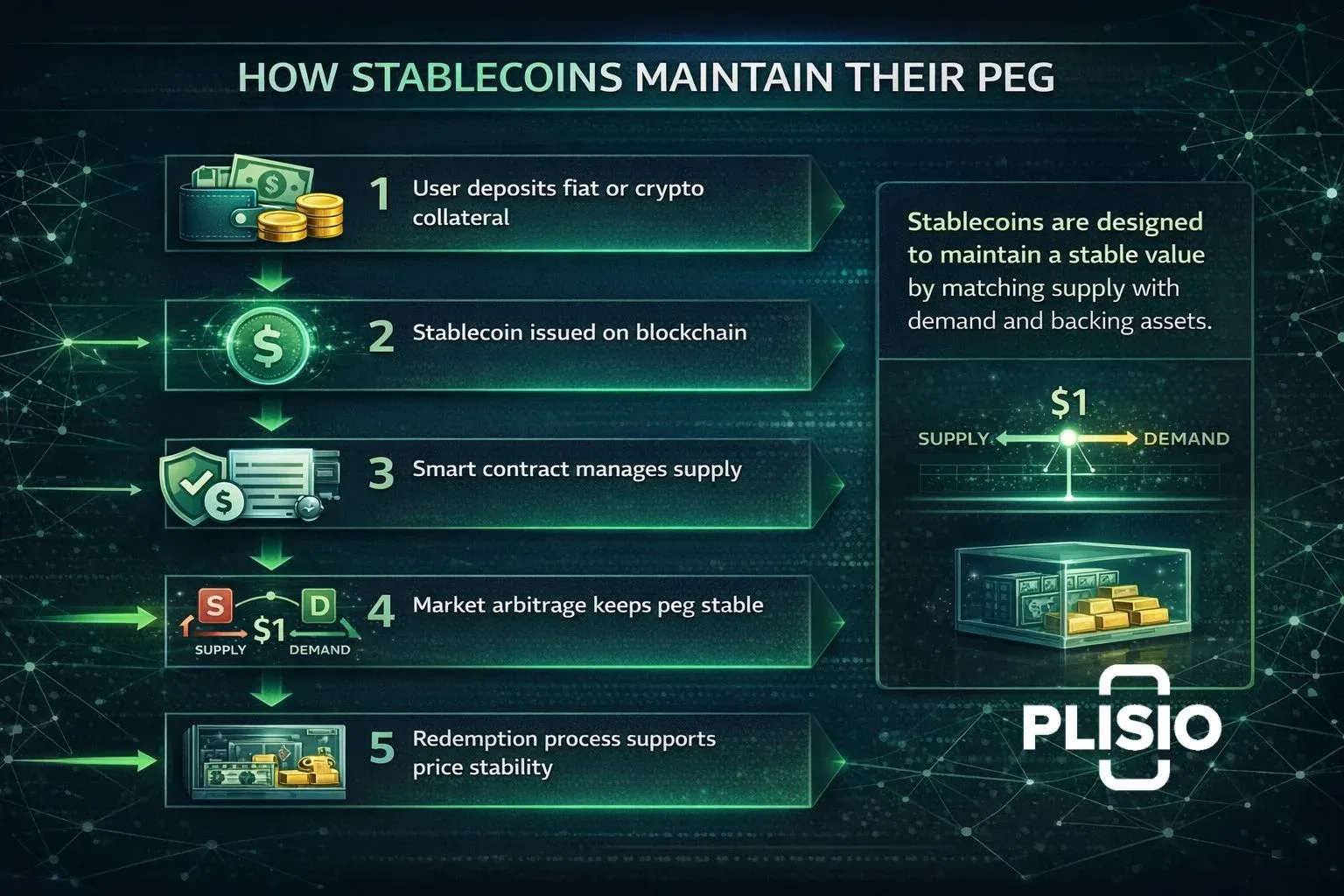
- Reserve assets – fiat cash, cryptocurrencies, or commodities held in custody to ensure that each token can be redeemed on a 1‑to‑1 basis (or according to a predefined ratio).
- Algorithmic or smart‑contract mechanisms – systems that automatically adjust the circulating supply in order to keep the market price close to the peg.
Different technical approaches have given rise to a variety of stablecoin models, each of which is described in the sections that follow.

Main Types of Stablecoins and Their Risk Profiles
| Type | Typical Collateral | Key Risks |
|---|---|---|
| Fiat‑backed stablecoins | Legal tender (USD, EUR) or short‑term sovereign bonds | Reserve transparency, regulatory compliance |
| Crypto‑backed stablecoins | Other digital assets (e.g., ETH, BTC) | Over‑collateralization, smart‑contract security |
| Algorithmic stablecoins | Supply‑adjusting algorithms | Detachment (de‑pegging) under market stress |
| Commodity‑backed stablecoins | Physical gold or other precious metals | Storage and audit costs for the underlying assets |
Fiat‑Backed Stablecoins
These tokens usually hold reserves in bank deposits or government securities at a 1:1 ratio, making them the most conservative option.
Crypto‑Backed Stablecoins
They employ over‑collateralization to absorb price swings of the underlying assets, relying heavily on the automatic execution of smart contracts.
Algorithmic Stablecoins
Supply is regulated by code rather than by holding external assets, which improves capital efficiency but can lead to instability during extreme market conditions.
Commodity‑Backed Stablecoins
Backed by tangible assets such as gold, token holders indirectly own a share of the physical reserve’s value.
Because each model differs in transparency, liquidity, and exposure, investors should match the characteristics to their own risk tolerance and use‑case requirements.
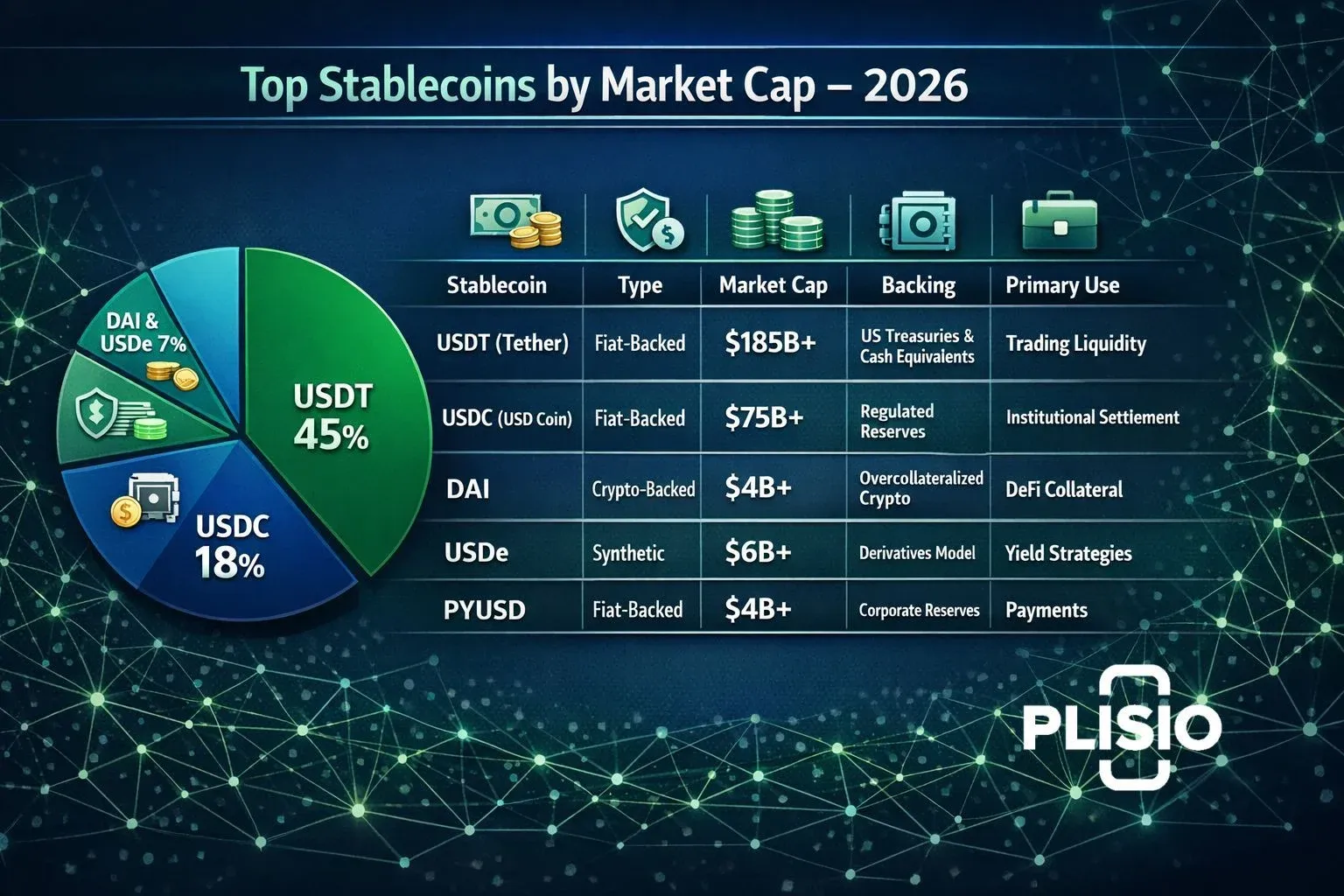
The Top Five Stablecoins by Market Capitalization (2026)
| Rank | Name | Type | Approx. Market Cap | Notes |
|---|---|---|---|---|
| 1 | Tether (USDT) | Fiat‑backed stablecoin | **USD > 185 billion** | Widest market liquidity |
| 2 | USD Coin (USDC) | Fiat‑backed stablecoin | **USD > 75 billion** | High regulatory transparency |
| 3 | Dai (DAI) | Crypto‑backed stablecoin | **USD > 4 billion** | Decentralized collateral model |
| 4 | Binance USD (BUSD) | Hybrid model | **USD > 6 billion** | Derivatives‑based structure |
| 5 | PayPal USD (PYUSD) | Fiat‑backed stablecoin | **USD > 4 billion** | Enterprise version issued by PayPal |
Together, these five tokens account for the overwhelming majority of total stablecoin market value.
Tether (USDT)
USDT’s deep liquidity and multi‑chain deployment make it the default choice on both centralized exchanges and over‑the‑counter (OTC) desks. Nearly every major exchange lists USDT, providing users with a highly convenient hedge against volatility.
USD Coin (USDC)
USDC is renowned for rigorous reserve audits and strict regulatory compliance, earning strong trust among institutional participants. Its integration with payment processors and corporate settlement systems is also among the most advanced in the industry.
Dai and Other Decentralized Solutions
DAI exemplifies the “decentralized collateral” route, with all collateral managed entirely by smart contracts, appealing to users who favor on‑chain governance. While new projects continue to emerge, only a handful have breached the high‑market‑cap barrier.
Key Feature Comparison of Leading Stablecoins
| Feature | USDT | USDC | DAI | Others |
|---|---|---|---|---|
| Backing Reserve | Fiat reserves | Fiat reserves | Crypto collateral | Varied |
| Transparency | Medium | High | Fully on‑chain | Project‑dependent |
| Primary Use Cases | Trading liquidity | Institutional settlement | DeFi lending | Payments, remittances |
| Blockchain Support | Multi‑chain | Multi‑chain | Primarily Ethereum | Multi‑chain |
The table above helps readers quickly assess the practical advantages and limitations of each token from an operational perspective.
Why Investors Pay Attention to Stablecoins
Compared with high‑volatility assets such as Bitcoin or Ethereum, stablecoins offer several attractive qualities:
- Value anchoring – they act as a price‑stable hedge during turbulent market phases.
- Instant liquidity – tokens can be moved in seconds, facilitating rapid trading or settlement.
- Cross‑border settlement benefits – low fees and near‑instant finality make them ideal for global payment scenarios.
During periods of macro‑economic uncertainty, some market participants treat stablecoins as a “digital safe haven,” avoiding the delays often associated with traditional bank conversions.
The Regulatory Landscape in 2026
The United States, the European Union, and major Asian economies have each released clearer regulatory guidance throughout 2026, providing a legal basis for compliant stablecoin operations. Strengthened oversight boosts user confidence but also raises compliance costs. Financial institutions are progressively embedding compliant stablecoins into internal settlement pipelines, bridging digital assets with conventional finance.
Note for U.S. readers: When accessing global crypto platforms, U.S. residents must use Binance.US or other U.S.-registered exchanges rather than the worldwide Binance site.
Tax reminder: Gains or losses realized from converting stablecoins to fiat or other cryptocurrencies may be taxable under the taxpayer’s local jurisdiction. Consult a qualified tax professional for guidance.
How to Choose the Stablecoin That Fits Your Needs
When deciding which stablecoin to allocate, consider evaluating the following dimensions:
- Reserve transparency – Availability of third‑party audit reports or on‑chain proof of assets.
- Market cap and liquidity – Larger, deeper markets enable easier entry and exit.
- Blockchain compatibility – Support for the specific chain(s) or cross‑chain bridges you require.
- Counterparty risk – Creditworthiness and regulatory standing of the issuing entity.
Understanding redemption procedures and any associated fees is also essential for practical usage.
Primary Risks Associated with Stablecoins
Even though they are marketed as low‑volatility assets, stablecoins still face several potential hazards:
- Poor reserve management – could limit redemption capability.
- Extreme market pressure – may trigger a de‑pegging event.
- Regulatory surprises – new rules could restrict usage or increase operational costs.
- Smart‑contract vulnerabilities – especially relevant for crypto‑backed or algorithmic designs.
Algorithmic stablecoins, lacking tangible collateral, carry heightened structural risk during market shocks and therefore require extra caution before deployment.
The Functional Role of Stablecoins in the Crypto Economy
Stablecoins do more than serve as a medium of exchange. They play irreplaceable roles in:
- Supplying a benchmark asset for liquidity pools across DeFi protocols.
- Enabling cross‑border salaries, remittances, and other real‑world economic activities.
- Acting as a bridge between traditional fiat and blockchain networks, fostering inclusive digital finance.
Long‑term sustainability hinges on transparent governance and robust audit mechanisms.
Outlook on the Stability of Crypto‑Based Money
Looking ahead, the credibility of stablecoins will increasingly depend on ample reserve backing and a harmonized global regulatory framework. Continued inflows of institutional capital and rising digital‑currency demand in emerging economies will broaden use cases further. Investors seeking optimal opportunities should monitor reserve transparency, regulatory developments, and on‑chain activity metrics.
Conclusion
Compared with traditional high‑volatility crypto assets, stablecoins place a stronger emphasis on value preservation and liquidity. The top performers in 2026 generally feature ample reserves, transparent audits, and multi‑chain compatibility. Whether used for everyday payments, asset hedging, or providing liquidity in DeFi, a deep understanding of each token’s underlying mechanics and risk profile is the prerequisite for safe operation.
For more detailed information on promising stablecoin projects, you can search for past articles from Bitaigen or continue browsing the subsequent sections of this site. We appreciate your ongoing interest and support.
Related Reading
- What Is Dollar Reserve (ADR) on Solana? Price Forecast 2026‑2030
- Ethena USDE Stablecoin: Tech, Governance, Yield & Risk
- What Are Stablecoins? Understanding Crypto-Backed Fiat Pegs
💡 Register on Binance with referral code B2345 for the maximum trading fee discount. See Binance complete guide.



