
 Bitaigen Research
 The appeal of Bitcoin futures trading lies in the ability to earn profits whether the market moves up or down, by “going long” (buying rise) or “going short” (buying fall). However, high leverage also magnifies losses and can even trigger a liquidation. Using Binance as an example, this guide systematically explains the basic principles of futures trading and offers a safe, repeatable workflow that helps newcomers master the core concepts before stepping into live trading.

In this article we methodically outline the key points of Binance’s Bitcoin futures, helping beginners understand the fundamental logic of leverage, position sizing, and margin, and we provide a safe, repeatable operating process so you can take the first step with risk under control. Please read carefully.
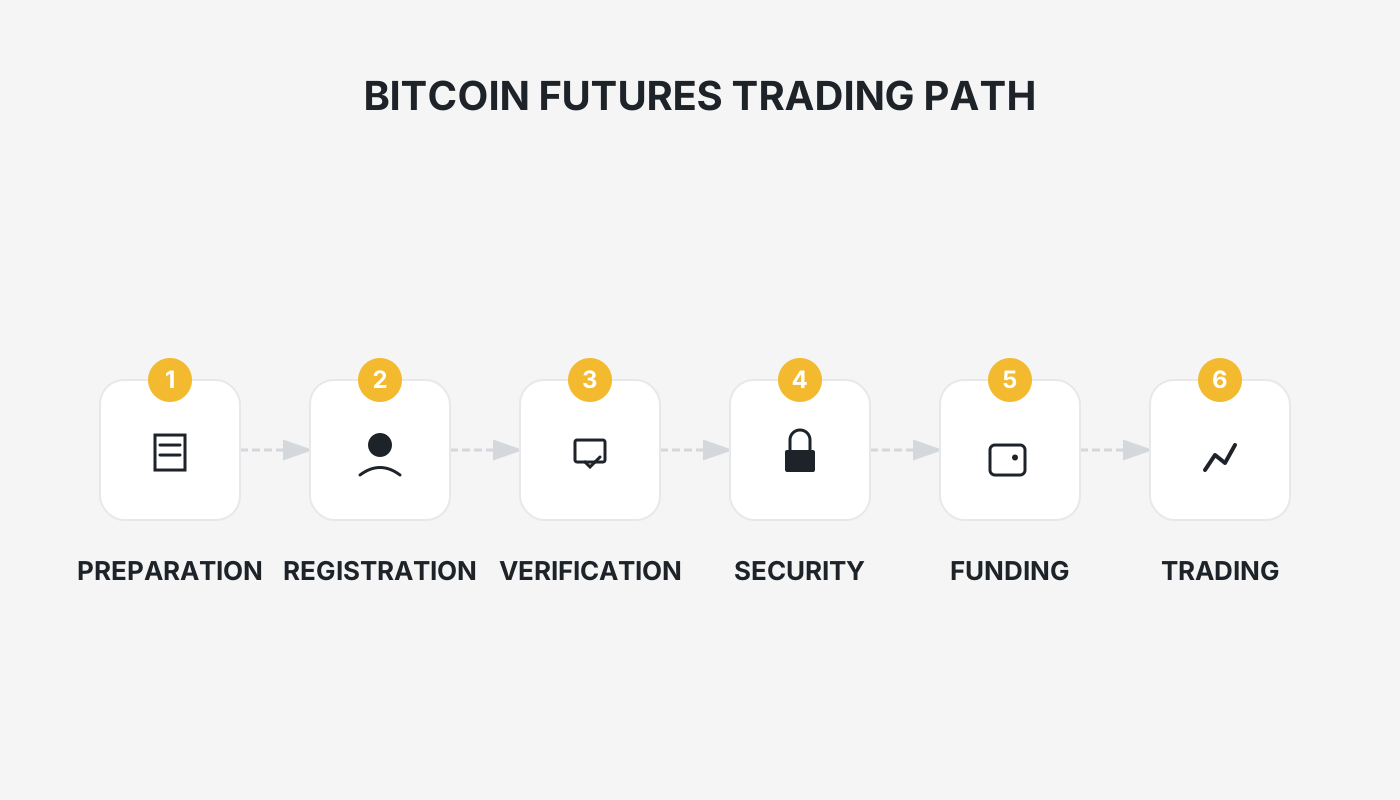
1. Core Concepts of Futures Trading (Essential for Beginners)
- Leverage trading: Uses a small amount of margin to control a larger position. For example, with 5× leverage, a deposit of 100 USD allows you to open a 500 USD position, and both profit and loss are amplified five‑fold. The higher the leverage, the greater the risk; beginners are advised to keep leverage below 5×.
- Long position / Short position: When you are bullish you “buy long” (buy low, sell high); when you are bearish you “sell short” (sell high, buy low). If your market view is wrong, the position will generate a direct loss.
- Margin: The collateral you must deposit to open a position. Higher leverage requires a lower margin ratio. If the margin becomes insufficient, the system will trigger a liquidation, forcibly closing the position.
- Isolated margin vs. Cross margin: In isolated‑margin mode each position’s margin is independent, so a liquidation only affects the funds allocated to that specific trade. In cross‑margin mode the entire account balance is used as collateral. Beginners are generally better off with isolated margin to achieve risk isolation.
- Perpetual futures: Contracts without a fixed expiry date, allowing you to hold them indefinitely. Binance’s BTC/USDT perpetual contract has the deepest liquidity and is the recommended instrument for newcomers.
- Funding rate: A unique fee mechanism for perpetual contracts that settles every 8 hours between long and short sides. When the rate is positive, longs pay shorts; when negative, shorts pay longs.
- Liquidation: When losses reach the margin threshold, the platform automatically closes the position, which can result in the loss of the entire capital allocated to that trade. Setting a stop‑loss in advance is the only reliable way to avoid liquidation.
2. Preparation Steps for Binance Futures Trading in 2026
- Complete account registration and KYC: Follow existing tutorials to finish identity verification, then enable Google Authenticator, a withdrawal password, and any other security layers offered.
- Fund the account: Deposit USDT through a compliant channel (e.g., SEPA or SWIFT). Do not use mainland Chinese bank cards, as they are not supported for Binance’s global platform.
- Download the latest Binance app: Make sure you are running the 2026‑latest version so that all features, including futures, are available. U.S. users must use Binance.US (the regulated U.S. platform) instead of the global Binance site.
- Familiarize yourself with the demo (paper‑trading) environment: Binance provides a futures demo that requires no real funds. New traders should spend 3–7 days practicing here to learn order entry and basic risk‑management procedures.
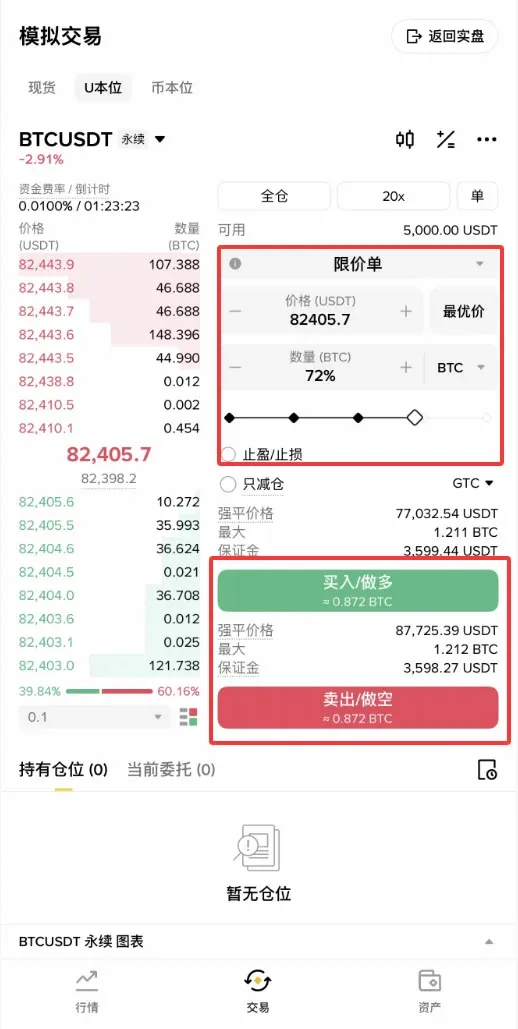
3. Step‑by‑Step Live Procedure: Trading Bitcoin Futures on Binance (2026 Edition)
1️⃣ Open the Futures Page and Complete Initial Settings
- Access the futures entry point: In the Binance app’s bottom navigation bar tap Futures, then select USDT‑Margined Futures. USDT‑margined contracts are quoted and settled in USDT, so both profit and loss are measured in USD.
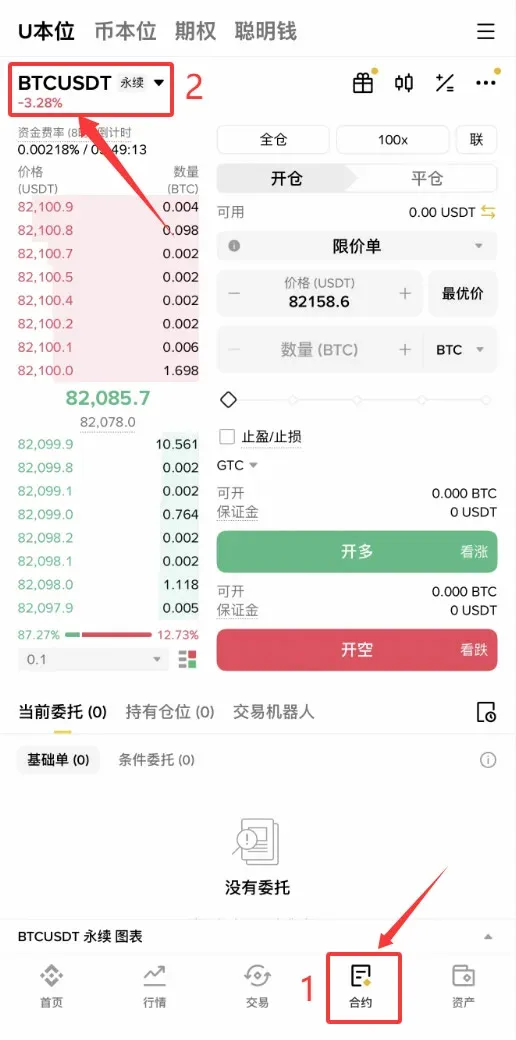
- Choose the trading pair: Use the search box at the top‑left to type “BTC”, then pick the BTC/USDT Perpetual contract from the list.
!Step 1: Enter futures interface and select contract type
- Select margin mode: For beginners we strongly recommend Isolated Margin. In this mode the loss on a single position is limited to the margin you allocate to that trade and cannot affect the rest of your account balance.
!Step 2: Core risk control – margin mode selection
- Adjust the leverage: Tap the leverage button (e.g., “10X”) to change the multiplier. Binance supports up to 125× leverage, but newcomers should start with 5–10×.
!Step 3: Set leverage multiplier
2️⃣ Transfer Funds and Prepare the Order
- Transfer margin: If the “Available USDT” field shows 0, click the yellow double‑arrow icon to move USDT from your Spot or Funding wallet into the USDT‑Margined Futures wallet. This transferred amount will serve as the margin for your trade.
!Bitcoin futures beginner practical guide (2026 Binance version)
- Select order type: You can place a Market Order or a Limit Order. Market orders are executed instantly at the best available price and are usually preferred when you want quick entry.
!Bitcoin futures beginner practical guide (2026 Binance version)
3️⃣ Analyse, Place the Order, and Implement Risk Management
- Market analysis: Tap the “K‑line” (candlestick) icon at the top‑right to view charts on different timeframes—15 minutes, 1 hour, 4 hours, etc.—and form a view of the short‑term and medium‑term trend.
!Bitcoin futures beginner practical guide (2026 Binance version)
- Determine direction: Based on your analysis decide whether to “Buy/Long” or “Sell/Short”. For instance, if you expect the price to fall, you would select “Sell/Short”.
!Bitcoin futures beginner practical guide (2026 Binance version)
- Set take‑profit and stop‑loss (critical step):
- Take‑profit: When the price reaches your predefined profit level, the system automatically closes the position and locks in the gain.
- Stop‑loss: If the market moves against you and hits the stop‑loss price, the platform forcibly closes the position to prevent further loss.
!Binance set take‑profit and stop‑loss
- Choosing the stop‑loss price: A common method is to reference the most recent technical support level (the prior low). Press and hold on the candlestick chart to view detailed price points, locate the nearest prior low—e.g., 91,400 USD—and consider it a trigger for exiting if the price breaks below it, as this may signal a reversal.
!Binance set take‑profit and stop‑loss
- Enter the stop‑loss and confirm: Return to the settings screen, type 91,400 into the “Stop‑Loss Price” field, then tap Confirm.
!Binance set take‑profit and stop‑loss
- Configure take‑profit: If you wish to close the trade when the price rebounds to 95,000 USD, input that value into the “Take‑Profit Price” field and confirm.
!Binance set take‑profit and stop‑loss
- Execute the order: Enter the quantity you want to trade, then press the appropriate Buy/Long or Sell/Short button to submit. The new position will appear in the “Positions” list at the bottom of the screen.
!Binance set take‑profit and stop‑loss
- Real‑time monitoring and manual closing: The positions page continuously shows unrealized P&L and the percentage return. If you decide to exit before the preset targets, simply tap the Close button to manually settle the trade.
!Step 6: View positions and set take‑profit/stop‑loss
4. Risk‑Control Checklist for Futures (Beginner Survival Manual)
- Leverage discipline: Keep leverage at 5× or lower; avoid 20× or higher.
- Position sizing: No single trade should use more than 5 % of your total capital, and the aggregate exposure should stay under 20 % of the account.
- Mandatory stop‑loss: Set a stop‑loss the moment you enter, limiting each trade’s loss to 1 %–2 % of your principal.
- Risk‑reward ratio: Aim for a take‑profit target that is 2–3 times the stop‑loss distance (e.g., 1:2 or 1:3) to maintain a positive expectancy over time.
- Limit trading frequency: Do not exceed 2–3 trades per day to prevent impulsive, emotion‑driven decisions.
- Trade with the trend: Only place orders that align with the prevailing market direction; during ranging markets, stay on the sidelines.
- Protect floating profits: When a position’s unrealized profit reaches 50 % of the allocated margin, move the stop‑loss up to the break‑even price to lock in capital.
- Demo‑trading practice: Before committing real funds, spend at least 3–7 days on the demo platform to master every button and setting.
5. Frequently Asked Questions & Pitfall‑Avoidance Tips
| Question | Countermeasure |
|---|---|
| **Liquidation risk** | Reduce leverage, set stop‑losses early, keep position size modest, and never go “full‑margin” (all‑in). |
| **Funding‑rate loss** | Avoid opening large positions during periods of high positive funding rates, or consider switching to delivery (expiry) futures where funding does not apply. |
| **Excessive slippage** | Use limit orders for sizable orders; market orders are acceptable for small amounts where slippage is minimal. |
| **Operational mistakes** | Practice repeatedly on the demo, and double‑check order details (price, quantity, direction) before confirming a live trade. |
| **Account security** | Enable Google Authenticator, set a withdrawal password, activate device‑login verification, and rotate passwords regularly. |
Closing Thoughts
Bitcoin futures are a double‑edged sword: leverage can magnify gains, but it also magnifies losses. Newcomers should first internalize the core concepts, spend ample time on the demo environment, and strictly adhere to risk‑management rules. Start with small positions and low leverage, then gradually build experience. Remember, the goal of futures trading is not “overnight riches” but long‑term survivability in the market.
Note: Crypto trading profits may be subject to taxation in your local jurisdiction. Be sure to consult a tax professional and report any taxable gains in accordance with the laws applicable to you.
This concludes the *Bitcoin Futures Beginner Practical Guide (2026 Binance Edition)*. For more tutorials on Bitcoin futures, follow Bitaigen and explore the other articles on the site!
Related Reading
- Beginner’s Guide: Register, Top‑Up & Buy Bitcoin on Binance
- Superp DEX: $37B Volume, 1.4M Users & 10,000x Leverage
- Cryptocurrency and Blockchain Basics: A Beginner's Guide
💡 Register on Binance with referral code B2345 for the maximum trading fee discount. See Binance complete guide.



