
 Bitaigen Research
In this article we systematically explain the principle of the Dollar‑Cost Averaging (DCA) method and walk you through the entire process of configuring and running Binance’s DCA trading bot, from setup to live execution. The goal is to help investors reduce volatility risk and develop a disciplined investing habit. If you want to master automated DCA techniques, keep reading.
What is DCA?
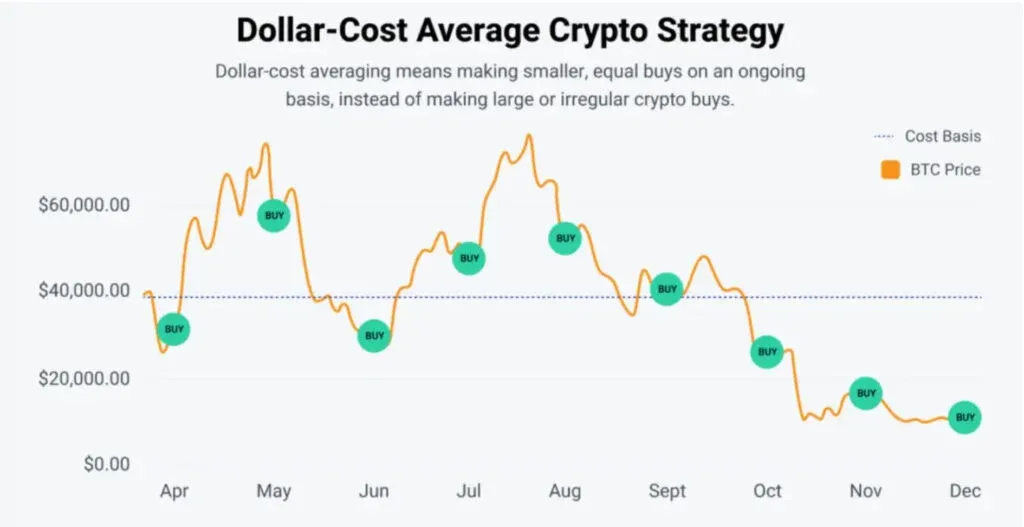
Dollar‑Cost Averaging (DCA) is an investment strategy that involves investing a fixed amount of money at regular intervals to smooth out the purchase price, reduce the impact of price swings, and help investors stick to a long‑term plan.
How DCA Works
- Regular investment: Choose a fixed time interval (e.g., weekly, monthly) and buy the target asset with the same amount of money at each interval.
- Effect of price volatility: When the price is low you acquire more units; when the price is high you acquire fewer units. Over the long run the average purchase price converges toward the market’s average price.
- Emotion management: A fixed‑frequency contribution helps investors avoid short‑term emotional swings, stay disciplined, and focus on long‑term goals.
DCA Example
Assume an investor deposits 1,000 USD (USDT) on the 5th day of each month from September 2023 to November 2023 to buy BTC, using the opening price of each day:
| Date | BTC price (USD per coin) | Quantity bought (coins) |
|---|---|---|
| 2023/09/05 | 25,826 | 0.0387 |
| 2023/10/05 | 27,778 | 0.0359 |
| 2023/11/05 | 35,062 | 0.0285 |
After three months the total investment is 3,000 USD, holding roughly 0.1031 BTC, yielding an average purchase price of about 29,097 USD per BTC. If the investor continues the same schedule until January 2025, the average cost would rise to roughly 50,684 USD per BTC, illustrating how DCA smooths out volatility and avoids a single lump‑sum purchase at a market peak.
Five Major Advantages of Dollar‑Cost Averaging
- Reduces market‑volatility risk
Staggered purchases prevent a one‑time buy at a high level, which is especially useful in the highly volatile crypto market.
- Eliminates emotional trading
Buying on a fixed schedule blocks impulsive actions driven by panic or FOMO.
- Lowers the risk of a single large investment
Even if the market dips shortly after a purchase, later contributions can be made at lower prices, flattening the overall cost basis.
- Suited for long‑term investing
Consistent, prolonged participation allows assets to accumulate returns despite short‑term fluctuations.
- Friendly for beginners
The process is simple: set the amount and frequency, and the system handles the rest—no need to forecast market direction.
Disadvantages of Dollar‑Cost Averaging
- Opportunity cost: During a bull market, continuously buying at increasingly higher average prices may forfeit the larger gains that a single lump‑sum investment could capture.
- No profit guarantee: In a sustained downtrend, DCA can still result in losses; it does not eliminate all risk.
- Requires long‑term patience: The strategy must be followed continuously. Exiting early or selling prematurely can prevent the intended cost‑averaging effect.
How to Calculate the Average Cost of a DCA Position?
Average cost = Total invested amount ÷ Total number of coins held
Calculation Steps
- Determine the total invested amount: For example, 100 USD per month for 12 months equals 1,200 USD.
- Accumulate the total number of coins purchased: Suppose the 12 purchases sum to 35 coins.
- Plug into the formula: Average cost = 1,200 ÷ 35 ≈ 34.29 USD per coin.
DCA vs. Lump‑Sum Investing
| Aspect | DCA | Lump‑Sum |
|---|---|---|
| Risk management | Staggered purchases lower single‑point risk | One‑time purchase can be costly if made near a market peak |
| Ideal investors | Beginners, low risk‑tolerance individuals | Those who can identify lows and have strong judgment |
| Operational difficulty | Simple, can be automated | Requires timing judgment |
| Return potential | Steady, less sensitive to short‑term swings | Higher upside when the market rallies sharply |
In short, if you lack confidence in market timing or cannot tolerate short‑term volatility, DCA offers a more conservative path; if you can reliably spot dips, a lump‑sum approach may generate higher returns.
Is DCA Suitable for the Cryptocurrency Market?
Three key characteristics of crypto make DCA especially appealing:
- High price volatility – Buying in installments reduces the risk of a single purchase at a peak.
- Long‑term appreciation potential – Major coins such as BTC and ETH have shown upward trends over extended periods, making them good candidates for regular contributions.
- Mitigates emotional trading – News spikes and celebrity endorsements often cause sharp price moves; a fixed‑frequency DCA helps investors stay rational.
Sample DCA Return Simulation for Bitcoin
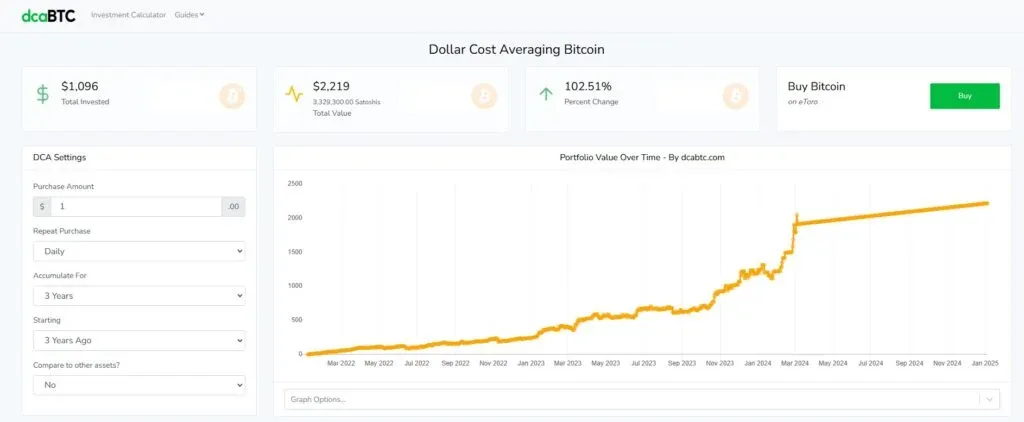
Using the DCABTC website, we simulated a daily contribution of 1 USD over three years (1,096 days):
- Total invested: 1,096 USD
- Total return: approximately 2,219 USD
- Return on investment: about 102 %
Note: The figures above are based on historical price data and do not guarantee future performance. Tax authorities in many jurisdictions treat cryptocurrency gains as taxable events, so be sure to consult local tax regulations (e.g., reporting gains via SEPA/SWIFT‑compatible fiat conversions where applicable).
How to Use Binance’s DCA Trading Bot
Binance (global platform) offers a built‑in DCA feature. U.S. residents must use Binance.US (the separate platform) instead of the global site. The official registration and download links are:
- Register: Official Binance registration (or Binance.US registration for U.S. users)
- Download client: Official Binance download
Follow the illustrated steps below:
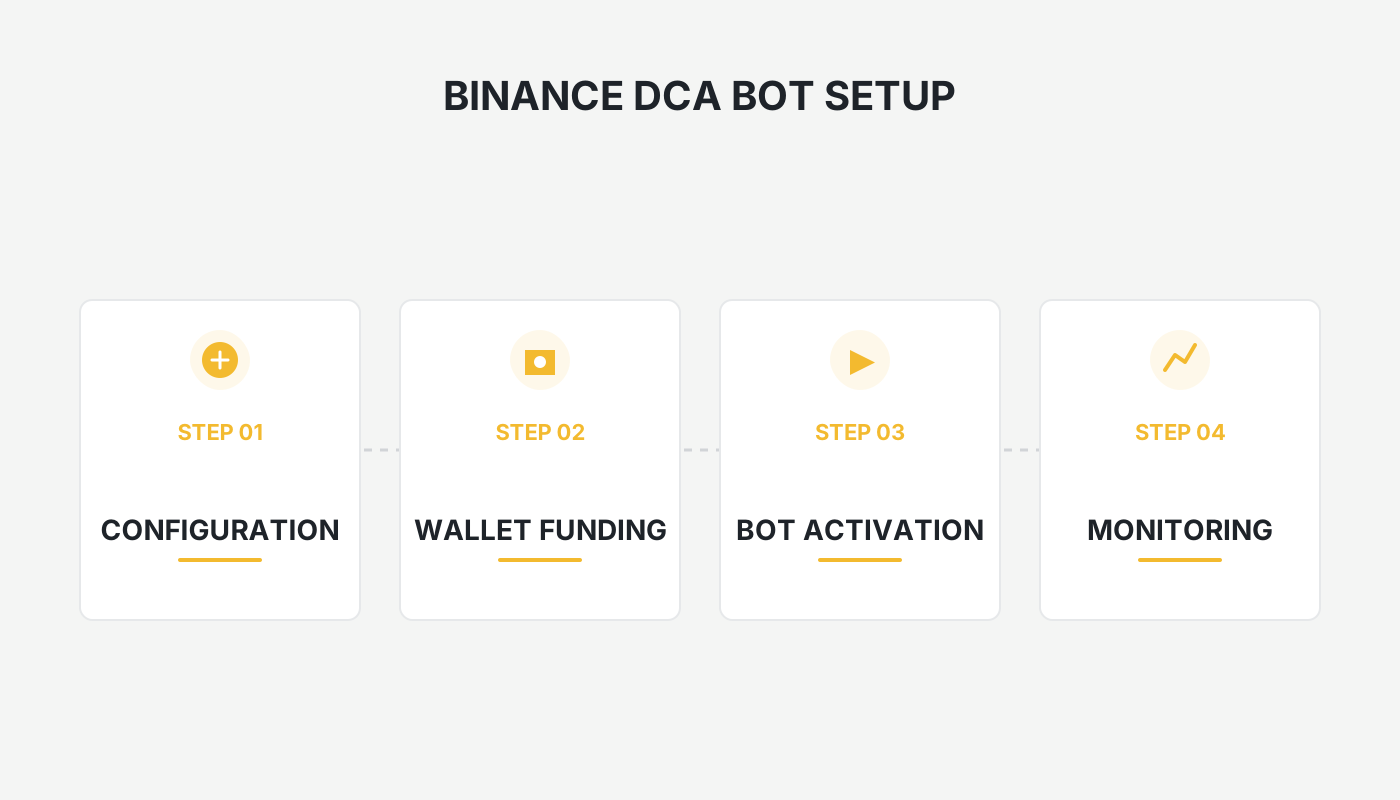
- On the Binance homepage click “More” → “Trading Bot” → select “DCA”.
- Choose a target asset; for example, click “Bitcoin (BTC)”.
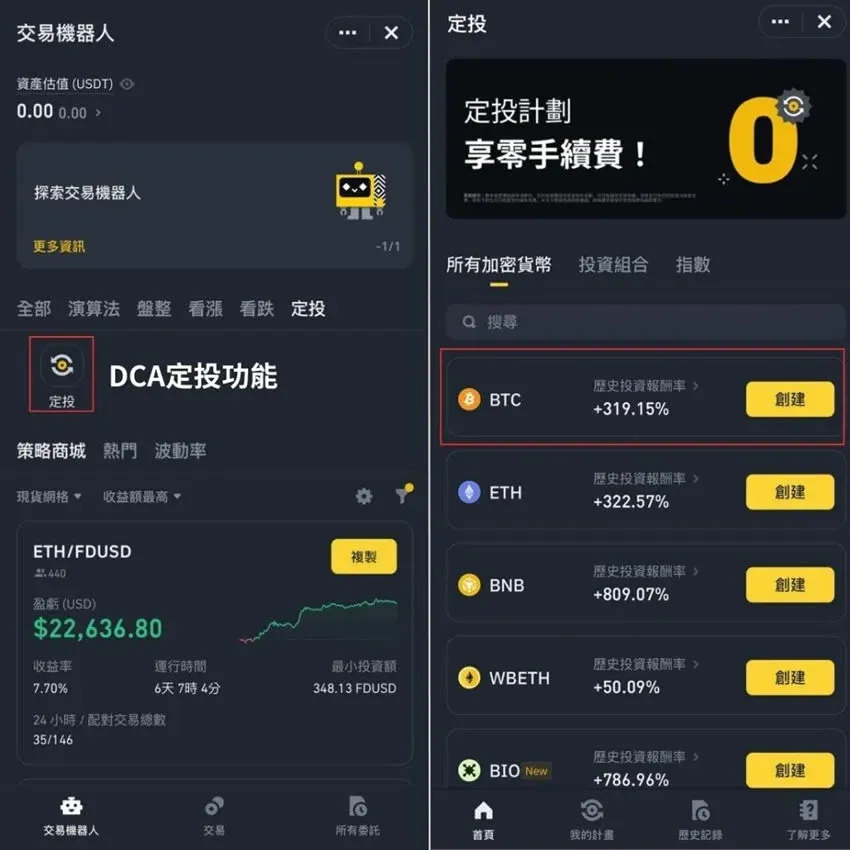
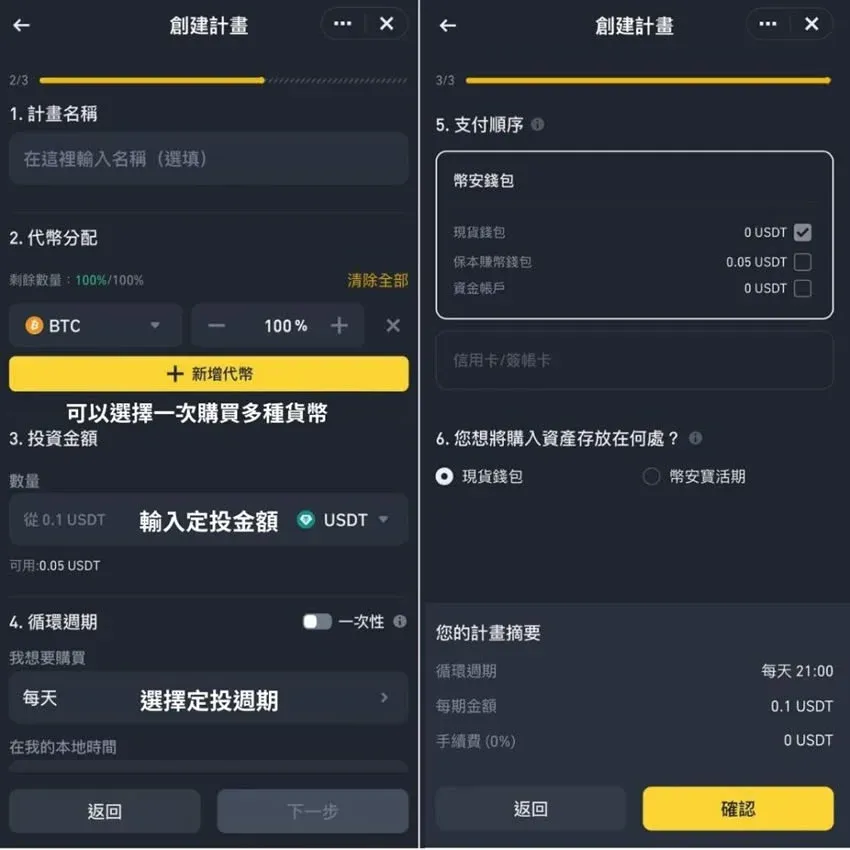
- Enter the amount for each DCA order (minimum 0.1 USD).
- Choose the repetition interval: 1 hour, 4 hours, 8 hours, 12 hours, daily, weekly, bi‑weekly, or monthly.
- Set the execution time (e.g., every day at 09:00 UTC).
- Review the details and activate the DCA Trading Bot.
Frequently Asked Questions
Is DCA appropriate for all cryptocurrencies?
It works best with large‑cap, technically mature coins that have a clear long‑term use case (e.g., BTC, ETH). Using DCA on meme tokens lacking fundamental support is generally not recommended.
What is the optimal DCA frequency—daily, weekly, or monthly?
The ideal interval depends on your cash‑flow situation and the volatility profile of the chosen asset. We recommend back‑testing with DCABTC first, then selecting a cadence that matches your personal circumstances.
How does DCA perform in bear versus bull markets?
In a bear market, DCA lets you accumulate more units at lower prices, smoothing the cost basis. In a bull market, the overall return may lag behind a well‑timed lump‑sum purchase, but the approach remains comparatively conservative.
Do I need a large initial capital to start DCA?
No. DCA can be started with any amount; the key is consistent, periodic contributions.
Should I adjust my DCA strategy over time?
Periodically review the underlying asset’s technical upgrades, market environment, and your own investment objectives. Adjustments may be warranted as conditions evolve.
Can I DCA multiple assets simultaneously?
Yes. Diversifying across several promising cryptocurrencies can further spread risk, provided each asset exhibits long‑term growth potential.
Closing Thoughts
Dollar‑Cost Averaging smooths the purchase price curve by committing a fixed amount at regular intervals, thereby reducing the risk of buying a large position at a market high. It is not a “guaranteed profit” device; the underlying assets still need to possess upside potential for the strategy to be profitable. Investors should assess their own risk tolerance, financial goals, and tax obligations before employing DCA.
This article is for informational purposes only and does not constitute investment advice. All data are sourced from publicly available channels and may change with market conditions. Always consider your personal situation and, if necessary, seek professional counsel before making financial decisions.
Related Reading
- Ethereum DCA Strategy: Reduce Timing Risk
- BNB Dollar‑Cost Averaging: Long‑Term Returns & Risk
- Bitcoin DCA Strategy: Safe Long‑Term Returns Backed by Data
💡 Register on Binance with referral code B2345 for the maximum trading fee discount. See Binance complete guide.



