
 Bitaigen Research
 At the Bitaigen editorial team, we have noticed that many newcomers still have doubts about Bitcoin’s core concepts. This article systematically outlines how wallets, private keys, and accounts operate, helping you clarify the essential elements of asset control and offering practical security recommendations. If you want to learn how to manage Bitcoin safely, please continue reading. *(For acquiring Bitcoin with fiat, platforms that support USD via SEPA or SWIFT can be used, and U.S. residents should use Binance.US rather than the global Binance service.)*
Bitcoin Wallet
A wallet is essentially a software interface that assists users in managing keys, checking balances, and creating and signing transactions. It does not directly store Bitcoin; instead, it stores the private keys that control ownership of Bitcoin. As long as the private key remains secure, the wallet can “see” your Bitcoin by monitoring the unspent transaction outputs (UTXOs) associated with the corresponding addresses. For example, if address A receives 1 BTC and address B receives 9 BTC, and those outputs have not yet been spent, the wallet adds the two UTXOs together and displays a total of 10 BTC.
When you initiate a transfer, the wallet selects appropriate UTXOs to serve as transaction inputs, fills in the recipient’s address and the amount to be sent, signs the transaction with the private key, and then broadcasts the signed transaction to the Bitcoin network. Once the network confirms the transaction, the transfer is complete.
Private Key
In the Bitcoin system, a private key is simply a randomly generated 256‑bit number. It is the sole credential that grants control over the assets linked to the corresponding Bitcoin address. Possessing the private key means you have full authority over all unspent outputs tied to that address. The private key is used during transaction signing to prove that the initiator owns the Bitcoin being spent.
If a private key is exposed, anyone can spend the Bitcoin associated with that address. Conversely, if the private key is lost and not backed up, the related assets become permanently unrecoverable. Private keys are typically generated using high‑quality random number generators; the technical details are beyond the scope of this article.

Bitcoin Account
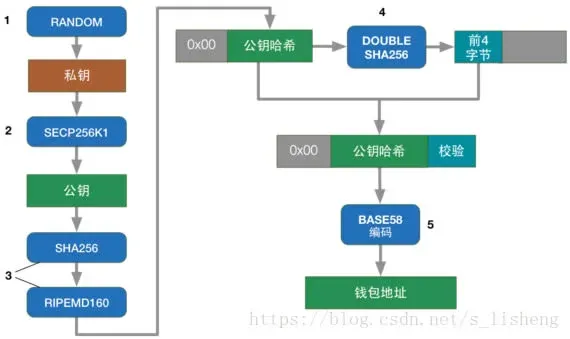
The generation process for a Bitcoin account (also called an address) can be summarized as “private key → public key → address.” The specific steps are:
- Generate a 256‑bit random number with a secure random number generator; this becomes the account’s private key.
- Perform an elliptic‑curve multiplication on the secp256k1 curve (used in the Elliptic Curve Digital Signature Algorithm, ECDSA) with the private key to obtain the corresponding public key.
- Apply SHA‑256 followed by RIPEMD‑160 hashing to the public key, producing a public‑key hash.
- Prepend the version prefix `0x00` to the public‑key hash, then hash the result twice with SHA‑256 and take the first 4 bytes as a checksum.
- Concatenate “version prefix + public‑key hash + checksum” and encode the result with Base58, yielding the final Bitcoin address.
| Type | Version Prefix (hex) | Base58 Prefix |
|---|---|---|
| Bitcoin Address | 0x00 | 1 |
| Pay‑to‑Script‑Hash (P2SH) Address | 0x05 | 3 |
| Bitcoin Testnet Address | 0x6F | m or n |
| Private Key WIF (Wallet Import Format) | 0x80 | 5 (uncompressed) / K or L (compressed) |
| BIP38 Encrypted Private Key | 0x0142 | 6P |
| BIP32 Extended Public Key | 0x0488B21E | xpub |
Base58 encoding is primarily used to improve readability and make manual entry more convenient.
Public‑Key Cryptography
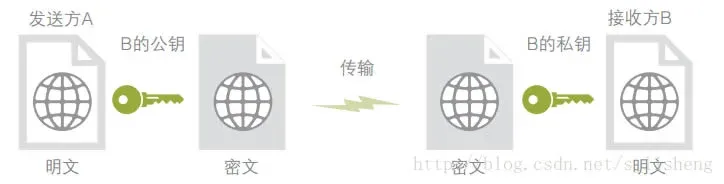
Public‑key cryptography consists of three components: a publicly known public key, a secret private key, and a set of algorithms for encryption and decryption. Because the public key and the algorithms are public, anyone can encrypt information using the public key; only the holder of the matching private key can decrypt it. Conversely, a signature generated with a private key can be verified by anyone possessing the public key, thereby providing authentication. The core capabilities of this system include:
- Encryption and decryption
- Digital signing and verification
- Key agreement
In the Bitcoin network, this mechanism is employed to generate key pairs that control the receipt and spending of Bitcoin. The public key serves as the receiving address, while the private key produces a unique signature for each transaction, proving that the current holder has the authority to spend the associated coins. Other nodes on the network verify the submitted public key and signature to confirm the transaction’s validity.
The above provides a complete exposition of Bitcoin private keys, accounts, and wallets. For more related knowledge, feel free to follow Bitaigen’s other topic articles!
*Note: Cryptocurrency gains may be subject to tax in your jurisdiction; consult a tax professional for guidance.*
Related Reading
- Understanding the IFO Concept: Forked Tokens Explained
- Crypto Wallet Disabled? Quick Recovery Steps
- Bitcoin Wallet Basics: Private Keys, Addresses & Transfers
💡 Register on Binance with referral code B2345 for the maximum trading fee discount. See Binance complete guide.



