
 Bitaigen Research
 In this article we outline the background, business scope, and regulatory compliance of BitNasdaq, and conduct an in‑depth assessment of its security mechanisms and user protection measures. By providing a comprehensive analysis of the platform’s features and risk controls, we help you determine whether the exchange can be trusted. Further discussion of its competitiveness and potential risks in the industry will follow, so please continue reading.
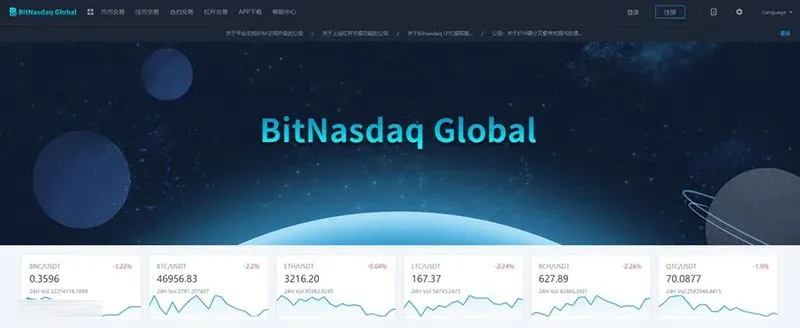
BitNasdaq Exchange was founded in October 2019 and is registered in the Netherlands. It is a comprehensive digital‑asset exchange offering multiple services. According to the latest market data, as of 09:31 UTC on 31 August 2021, BitNasdaq’s 24‑hour trading volume was US $709 million, placing it outside the global top 100. The platform currently supports 28 cryptocurrencies and 28 trading pairs; KYC verification status is not disclosed. It offers spot trading, futures, and over‑the‑counter (OTC) services. These figures indicate that BitNasdaq maintains a modest level of activity in the market. So, is BitNasdaq a legitimate exchange? How does its security compare with other exchanges? Below, the editor provides a detailed explanation.
Is BitNasdaq Exchange Legal?
BitNasdaq’s Asia‑Pacific headquarters are located in Seoul, South Korea. The project began development in June 2018 and launched officially in October 2019, aiming to create an integrated digital‑asset exchange that combines spot trading, fiat‑on‑ramp trading, margin trading, perpetual contracts, aggregated trading, IEOs, and wealth‑management products. BitNasdaq’s vision is to build a “ledger bank” for the blockchain world on top of a globally leading digital‑asset trading platform, providing secure, professional, and convenient digital‑asset conversion services to users worldwide, together with a rich suite of financial derivatives and diversified use cases.
Unlike traditional centralized exchanges, BitNasdaq emphasizes a user‑centric, community‑driven approach, handing governance rights to the community, assigning responsibilities to nodes, and returning profits to consensus holders. The BNC token serves as proof of authority, a responsibility badge, and a profit anchor.
Fee Structure:
- Deposits: No fee is charged for depositing funds.
- Withdrawal Fees (fees apply once the minimum withdrawal amount is reached):
- USDT (Omni) – minimum 200 USDT, fee 5‑10 USDT per transaction
- USDT (ERC‑20) – minimum 10 USDT, fee 3‑5 USDT per transaction
- USDT (TRC‑20) – minimum 10 USDT, fee 0 USDT per transaction
- USAT – minimum 10 USAT, fee 1 USAT per transaction
- BNC – minimum 100 BNC, fee 2 BNC per transaction
- BTC – minimum 0.001 BTC, fee 0.0005‑0.001 BTC per transaction
- ETH – minimum 0.05 ETH, fee 0.005‑0.01 ETH per transaction
- LTC – minimum 0.1 LTC, fee 0.001‑0.002 LTC per transaction
- BCH – minimum 0.01 BCH, fee 0.0001‑0.0002 BCH per transaction
- ETC – minimum 0.5 ETC, fee 0.05 ETC per transaction
- EOS – minimum 1 EOS, fee 0.01 EOS per transaction
- TRX – minimum 1,000 TRX, fee 1‑2 TRX per transaction
- GHP – minimum 1,000 GHP, fee 10 GHP per transaction
- MBTC – minimum 0.001 MBTC, fee 0.0005 MBTC per transaction
For other assets, withdrawal fees are calculated based on a range of CNY 1‑30 worth of the respective token, which may vary with market price.
- OTC Trading Fees
- User side: No fee is charged.
- Merchant side: A fee of 0.1 % of the order amount is applied.
Note for U.S. users: When accessing fiat‑on‑ramp services, use Binance.US or other U.S.-compliant platforms rather than the global Binance site. SEPA and SWIFT transfers are the typical methods for moving USD or other fiat currencies.
How Does BitNasdaq’s Security Compare with Other Exchanges?
BitNasdaq’s security advantages can be observed across several dimensions:
- Global Footprint – Localized service centers are established in multiple countries, delivering an integrated suite of products.
- Security Architecture – A dedicated security team implements multi‑layer defense mechanisms to protect user assets.
- Trading Infrastructure – High‑availability architecture enables rapid asset flow and smooth transaction execution.
- Scalability – The system is designed with strong extensibility, allowing it to accommodate growth in business volume and user demand.
The points above summarize the basic profile of BitNasdaq Exchange and its security assessment. For more information about BitNasdaq, feel free to follow Bitaigen (比特根) and related reports.
💡 Register on Binance with referral code B2345 for the maximum trading fee discount. See Binance complete guide.



