
 Bitaigen Research
When choosing a cryptocurrency trading platform, many people first focus on fees, the number of listed tokens, or UI design. While these surface‑level factors certainly affect the user experience, they are more like decorative elements of a building rather than its foundation. What truly determines the safety of your funds is the legal entity behind the platform, its regulatory licences, the custody method for assets, and the overall risk‑control framework. Relying solely on 2FA or an attractive interface is rarely sufficient; you must evaluate the “invisible” layers such as legal structure, regulatory oversight, fund segregation, and transparency. The framework below will help investors systematically examine these critical dimensions, enabling you to pick compliant and reliable exchanges from the crowded market.
In this article we outline the core elements for assessing the safety and compliance of cryptocurrency exchanges that serve users in mainland China, with a focus on regulatory licences, asset custody, and risk‑control mechanisms—those “hidden” dimensions that help investors quickly identify trustworthy entry points. Understanding the full screening framework is the only way to build a solid safety baseline before trading. Continue reading for practical guidance.
Regulatory Status: Primary Screening Criterion
Regulatory status is the first gate for judging whether an exchange provides a baseline level of security. As long as a platform operates under a recognized legal framework and is supervised by the appropriate regulator, it must obey stricter rules on fund management and information disclosure, offering institutional‑level protection to users. Ignoring this is akin to building a skyscraper on sand—it may collapse at any moment.
- Is the legal entity information publicly disclosed? Reputable exchanges list the exact corporate name and the jurisdiction of registration. Vague or missing information often signals an attempt to evade regulation or operate in a legal grey zone.
- Does the platform hold a valid financial licence? Simply claiming “regulated” is not enough. Investors should verify that the exchange has obtained a licence specifically covering crypto trading, custody or payments in its operating region or target market.
- Which regulator is named? Different regulators (e.g., FinCEN, SEC, CFTC, MAS, SFC, etc.) have distinct requirements for anti‑money‑laundering (AML), asset segregation, financial reporting, and cybersecurity. Knowing the supervisory body helps you gauge the strictness of oversight.
Transparency of Legal and Operational Structure
Beyond regulatory status, the legal and operational architecture determines which set of laws will protect you in case of a dispute.
- Relationship between place of incorporation and place of operation: Some exchanges are incorporated in the Cayman Islands but run their day‑to‑day business out of Singapore or elsewhere. If the connection between the two is opaque, regulatory reach may be absent, leaving legal protection uncertain.
- Geographic coverage: Does the website clearly state which countries/regions are supported, and does the exchange hold a local licence for each? This directly influences the applicability of local consumer‑protection statutes.
- Dispute‑resolution clauses: The user agreement should specify the governing law, the venue for dispute handling (arbitration or court), and the exact mechanism for resolution. Mismatches among “incorporation country – operating country – dispute country” can dramatically increase the cost of asserting your rights.
How Customer Assets Are Held and Segregated
Before depositing any cryptocurrency, you must understand how the exchange custodizes those assets.
- Is an asset‑segregation policy publicly disclosed? A legitimate platform will state whether customer assets are kept separate from operating capital—a crucial safeguard against misappropriation or bankruptcy contagion.
- Degree of segregation: Beyond account‑level separation, confirm that the exchange treats customer funds as distinct assets in its daily operations, preventing the company from moving them at will.
- Custody model: Does the exchange self‑custody, outsource to a licensed third‑party custodian, or employ a hybrid approach? The custodian’s credentials (e.g., a regulated trust bank or a licensed custodial institution) directly affect asset safety.
Transparency: A Signal Light for Structural Risk
The completeness of an exchange’s disclosures often provides an early warning of hidden risks.
- Company background and ultimate beneficial owners: If shareholder structure is kept anonymous, accountability mechanisms are weak and it becomes difficult to trace responsibility in a crisis.
- Management team visibility: An anonymous team cannot be easily vetted for expertise and integrity, raising trust concerns.
- Fee and risk disclosures: The platform should present a full fee schedule and proactively list the risks associated with trading, withdrawal, leverage, etc. Absence of this information creates information asymmetry that can prejudice users.
- Customer‑service and dispute channels: Is there a reachable live‑support team? Are dispute‑resolution procedures clearly defined? Vague pathways can leave users stranded when conflicts arise.
Frequently Overlooked Risk Red Flags
Convenience and marketing hype often mask structural deficiencies:
- Unclear legal entity information: Ambiguous company name, registration jurisdiction, or beneficiary details hint at operation in a legal grey area.
- Frequent re‑branding or entity changes: Common among platforms trying to dodge regulators or hide past violations.
- Exaggerated returns, minimal compliance talk: Over‑promotion of low fees or high yields without mentioning licences, custody, or governance.
- Missing dispute‑resolution mechanism: No specified governing law, arbitration venue, or accessible support contact.
Spotting these signals helps you avoid exchanges with weak underlying structures.
Structured Selection Framework
After completing a comprehensive assessment of regulatory status, legal structure, asset segregation, and transparency, prioritize exchanges that are clearly licensed, operate under a well‑defined legal entity, and employ a standardized custodial system. Such platforms usually publish corporate information, are subject to regulator oversight, and provide verifiable asset‑safety measures, offering users a higher tier of protection.
Exchanges Considered Safe for Users in Mainland China
1. Binance
- A globally leading digital‑asset platform serving more than 190 countries and regions.
- Referral code `B2345` (permanent 20 % fee discount after registration).
- Official website and app download links are provided below.
Important for U.S. users: Residents of the United States must use Binance.US rather than the global Binance platform.
2. Huobi (HTX)
- Founded in 2013, covering public chains, trading, wallets, mining pools and other parts of the ecosystem.
- Referral code `b6yq8223` (also grants a 20 % fee discount).
- Official website and app download links are listed below.
- HTX (Huobi) Official Website
- HTX (Huobi) App Download
3. OKX
- Built around a unified account system and a multi‑chain non‑custodial wallet, with extensions into NFT, DEX and DApp services.
- Referral code `B2345` (permanent 20 % fee discount).
- Website and app download links are the same as above.
- OKX Official Website
- OKX App Download
4. Gate.io
- Established in 2013 in the Cayman Islands, rebranded as “Gate.io” in 2020.
- Referral code `VLIWUGTFAA` (20 % fee discount).
- Official website and app download links are provided.
5. Bitget
- Supports more than 500 crypto assets and holds licences in Canada, the United States, Australia and other jurisdictions.
- Referral code `vxje` (permanent 20 % fee discount).
6. Bybit
- Offers spot, derivatives, and asset‑management modules for both beginners and professional traders.
- Referral code `B2345` (same 20 % fee discount).
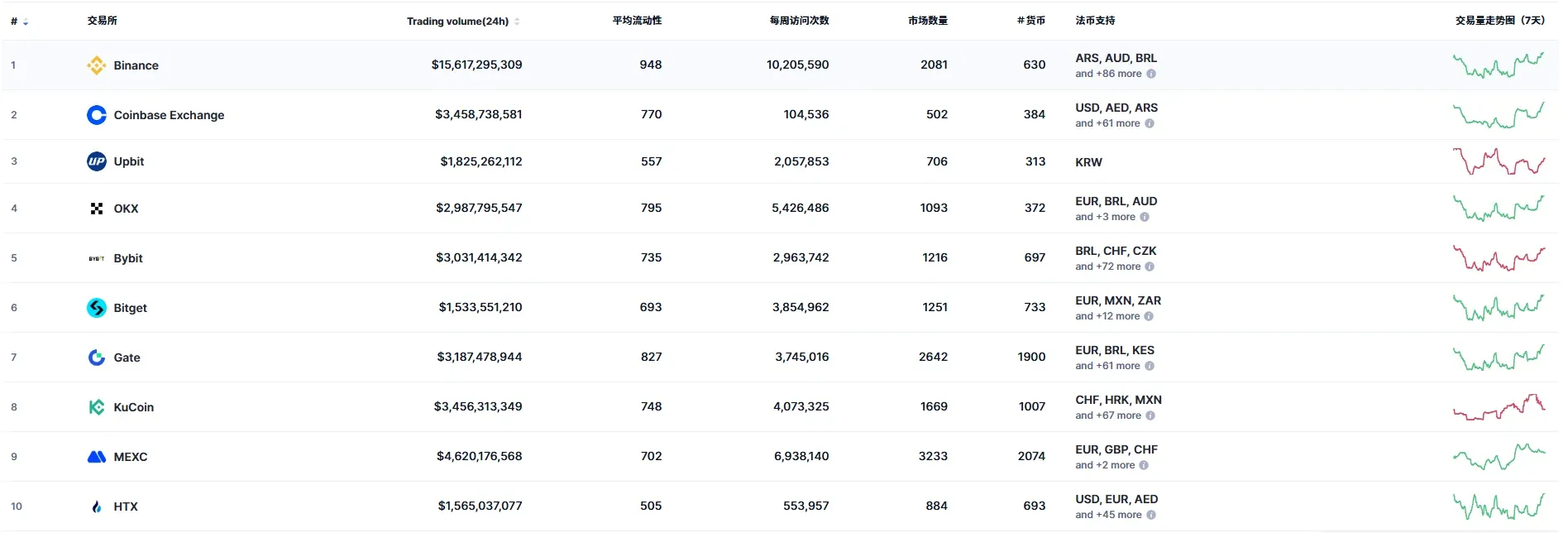
Global Legal‑Compliant Popular Exchange Rankings (Latest as of 2026‑03‑05)
After understanding the evaluation dimensions, the tables below present the most recent rankings and key metrics for several mainstream exchanges across spot and derivatives markets, helping you perform a side‑by‑side comparison.
Spot Exchange Rankings (Excerpt)
| Rank | Exchange | 24h Trading Volume (USD) | Avg. Liquidity | Weekly Visits | Number of Markets | Supports Fiat (USD, SEPA/SWIFT) |
|---|---|---|---|---|---|---|
| 1 | [Binance](https://www.bitaigen.com/binance) | $15,617,295,309 | 948 | 10,205,590 | 208 | 1,630 |
| 2 | Coinbase Exchange | $3,458,738,581 | 770 | 104,536 | 502 | 384 |
| … | … | … | … | … | … | … |
Derivatives Exchange Rankings (Excerpt)
| Rank | Exchange | Open Interest (USD) | 24h Trading Volume (USD) | Maker Fee | Taker Fee | Number of Markets |
|---|---|---|---|---|---|---|
| 1 | [Binance](https://www.bitaigen.com/binance) | $22,495,868,586 | $76,647,625,584 | 0.02 % | 0.04 % | 637 |
| 2 | OKX | $6,254,070,100 | $36,383,805,992 | 0.02 % | 0.05 % | 278 |
| … | … | … | … | … | … | … |
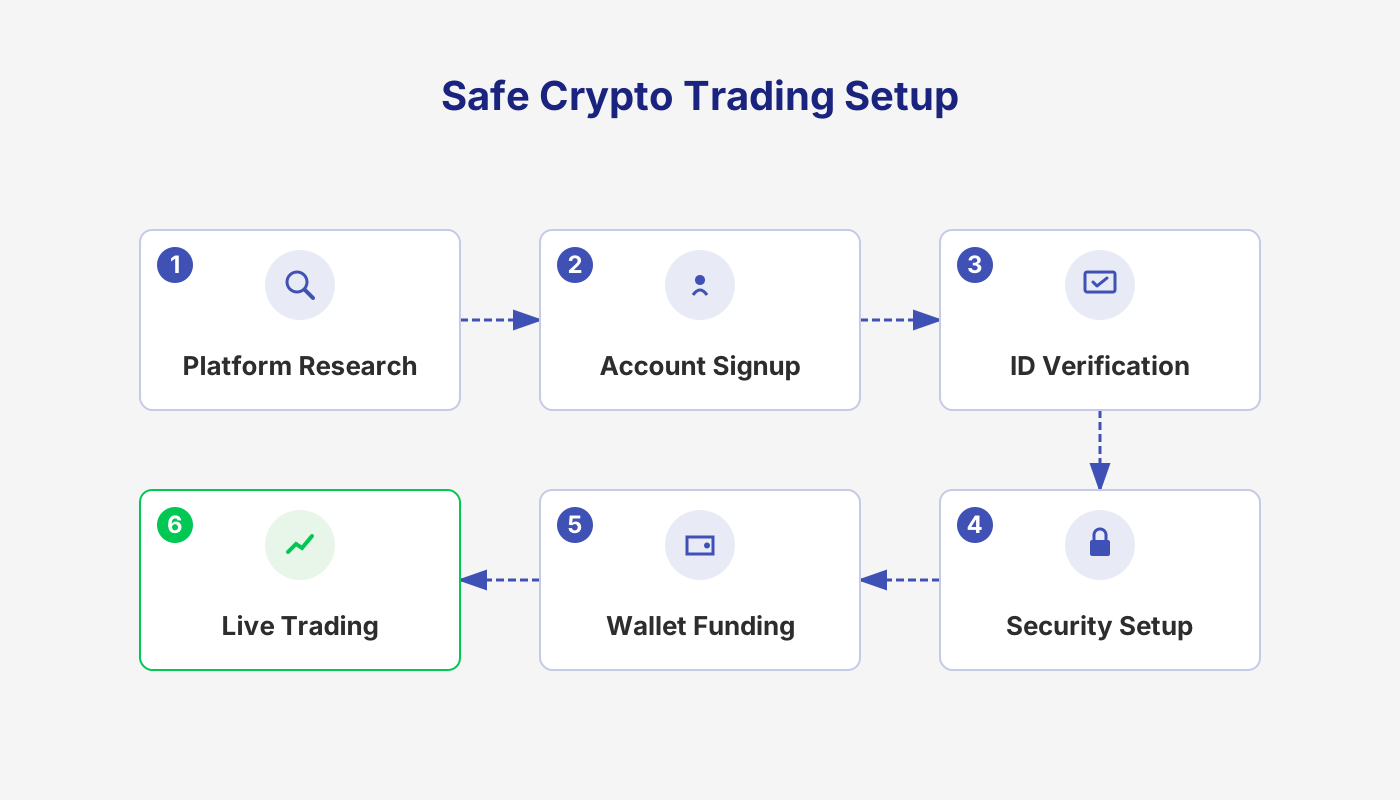
Essentials for Beginners Getting Onboard
1. Choose a top‑tier platform
Prioritize exchanges with the highest market capitalisation and trading volume (e.g., Binance, OKX). Large platforms typically have deeper liquidity pools and lower systemic‑failure risk than smaller, less‑established venues.
2. Stick to mainstream coins
Newcomers are advised to allocate roughly 90 % of their portfolio to established assets such as BTC, ETH, LTC, etc., to avoid severe drawdowns caused by extreme volatility in obscure tokens.
3. Spot trading first; approach derivatives with caution
If you are unfamiliar with hedging strategies, limit yourself to spot trading. Leveraged contracts amplify price swings and therefore carry higher risk.
Exchange Security Settings
- Enable two‑factor authentication (2FA): Whether you use Google Authenticator or SMS codes, 2FA markedly improves account security.
- Disable unnecessary API permissions: Most retail users do not need API access; turning it off prevents malicious actors from exploiting a compromised key.
Recent incidents have shown that accounts without 2FA can suffer large‑scale thefts. Do not overlook these security configurations.
Withdrawal Verification Differences: OKX vs. Binance
- OKX (version 6.71.1) switched to a dual verification model: email + authenticator. After changing the authenticator, withdrawals are locked for 24 hours.
- Binance requires additional facial verification when swapping authenticators, and also imposes a 24‑hour withdrawal hold after a change.
Mobile Security: Separate “Trading Device” and “Authentication Device”
Trading device: A phone dedicated to installing wallets and exchange apps. Prefer iOS devices obtained from official channels.
Authentication device: A second device used solely for receiving SMS, email, or Google Authenticator codes. Keeping trading and authentication on separate hardware reduces the attack surface.
Frequently Asked Questions (FAQ)
Q1: Why is regulatory status the first factor to consider?
Regulation imposes mandatory capital‑protection and risk‑control requirements. An exchange lacking regulatory oversight, even if it excels in other areas, cannot reliably guarantee asset safety.
Q2: How can I verify the security of an exchange’s custody arrangement?
Look for a publicly disclosed asset‑segregation policy, check whether the custodian is a licensed institution, and see if the custody structure involves a third‑party trust or insurance scheme.
Q3: Which legal/operational details are often ignored?
Mismatches between incorporation and operational locations, service coverage that does not include your country, and vague dispute‑resolution clauses can all increase the cost of defending your rights.
Q4: What signals indicate a higher‑risk platform?
Opaque legal entity data, frequent re‑branding, overstated profit promises while downplaying compliance, and the absence of a clear dispute‑resolution process.
Step‑by‑Step Secure Registration & Download (Using Binance as Example)
Preparations Before Registration
- Email address or mobile number: Required for login and receiving verification codes. Choose a strong password containing uppercase, lowercase, numbers and special characters.
- Identification documents: For KYC you’ll need a passport, national ID or driver’s licence. Corporate accounts also require a business licence.
- Secure network environment: Avoid public Wi‑Fi; use a personal router with a firewall and keep your operating system up‑to‑date.
Quick Binance Account Registration
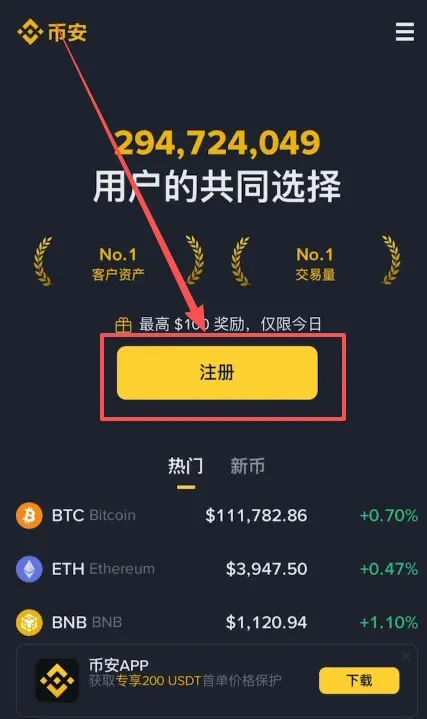
- Visit the Binance official website and click “Register”.
- Enter your preferred email or phone number and create a password that meets the strength requirements.
- Input the referral code B2345 to secure a 20 % fee discount on future trades.
- After completing the email verification step, you will be taken to the password‑setup page; finish the process to finish registration.
Be sure to enter the referral code during registration; it cannot be added later.
Download the Binance App
Android
- Click the Binance download link. When the download prompt appears, select “I understand the risks, continue”.
- Your device may display a “Potential risk detected” warning—tap “Continue download”.
- Once the file is downloaded, tap to install and follow the on‑screen permissions.
iOS
- In some jurisdictions the Binance app is not listed in the local App Store. Use an overseas Apple ID (e.g., Taiwan or Hong Kong) to log in.
- Search for “Binance” in the App Store, locate the official app, and download it.
Guide to Creating an Overseas Apple ID
- Generate a virtual address for Taiwan using an online address generator.
- Go to Apple’s official site and create a new Apple ID, selecting “Taiwan” as the country/region.
- Provide a real email, a strong password, and a phone number (you may use a mainland China number). Complete the email verification.
- In the account details, fill in the virtual street address, city, and postal code, then finish the creation process.
Using a separate Apple ID avoids conflicts with existing accounts and reduces the risk of a ban caused by shared credentials.


