
 Bitaigen Research
 In the 24‑hour nonstop trading environment of crypto assets, the market spends roughly 70‑80 % of the time in a consolidation (range‑bound) state. For most investors this type of market is the most frustrating: after buying the price falls instead of rising, after selling it rebounds, and frequent stop‑losses or chase‑buys drain capital and can easily unbalance one’s mindset. Grid Trading was created specifically to address this “oscillating dilemma.” It does not rely on forecasting future price moves or on luck; instead, by pre‑defining a price range and grid density, the system executes “buy low, sell high” on each price swing, much like a fishing net catching every moving fish.
In this article we systematically dissect the core mechanics and practical steps of grid trading, helping you achieve automatic low‑buy, high‑sell in ranging markets. By applying layered risk‑control techniques, readers can quickly get started while avoiding the pitfalls of unidirectional trends, thereby improving capital efficiency. If you want to master this lazy‑person profit strategy, keep reading.
Chapter 8: Risk Management – Dealing with Grid Breakouts and Unidirectional Markets
The greatest hidden danger of a grid strategy is not the ranging market itself, but a unidirectional (trend) market. Many newcomers get trapped when a ranging market turns into a trend, causing rapid account losses.
- Trigger‑price setting: Do not launch the grid the moment the market opens. First set a safer trigger price; the grid only starts executing when the price falls into that zone, preventing purchases at overly high levels.
- Mandatory stop‑loss: For low‑liquidity or small‑cap altcoins, always set a lower‑bound stop‑loss. It is preferable to exit with a 10 % loss than to watch a position evaporate to zero.
- Profit extraction: Surplus generated while the grid runs can be periodically withdrawn for regular investing or daily expenses, lowering the overall cost basis and helping maintain a rational mindset. *Note: Crypto gains may be taxable in your jurisdiction; consult a tax professional.*
Chapter 3: Advanced Strategies – From Spot Grids to Infinity Ranges
1. Spot Grid – A Stable Entry Point
Deposit USDT, and the system automatically performs low‑buy, high‑sell. If the coin price experiences a sustained decline, the grid will lower the average cost after each buy, but the total market value will still shrink with the underlying spot price. This approach suits long‑term bullish assets such as BTC, ETH, etc., where a sufficiently long holding period may allow recovery.
2. Coin‑Margined Grid – “Double‑Hit” Returns
Use BTC (or another digital asset) as margin, with profits also denominated in that asset. In a bull market you can achieve “price appreciation + increase in coin amount.” In a bear market the asset may depreciate more quickly.
3. Infinity Range – Wide‑range, No‑stop‑loss Long‑term Layout
Set an extremely wide range (e.g., BTC 15,000 – 150,000), use sparse grids, and omit stop‑losses. As long as Bitcoin does not go to zero and still has upside potential, the Infinity Range can keep buying and partially take profit on up‑moves. Because most capital remains in open orders, this method works better as a base‑position allocation rather than a quick‑rich scheme.
4. Futures Grid – Leverage Amplifies Returns
Leverage (5×, 10×, etc.) on perpetual contracts can magnify the profit per grid. Pay attention to:
- Liquidation risk: Losses on a futures grid may trigger forced liquidation; a stop‑loss must be defined.
- Funding rate: If your position direction opposes the funding‑rate direction, daily fees can erode the thin arbitrage profit. Reverse‑grid strategies are not recommended in trending markets.
Chapter 1: Underlying Logic and Visual Explanation of Grid Trading
The essence of grid trading can be summed up as a fully automated “batch‑build + batch‑close” process. It splits capital into equal slices and places buy or sell orders at each pre‑set price level.
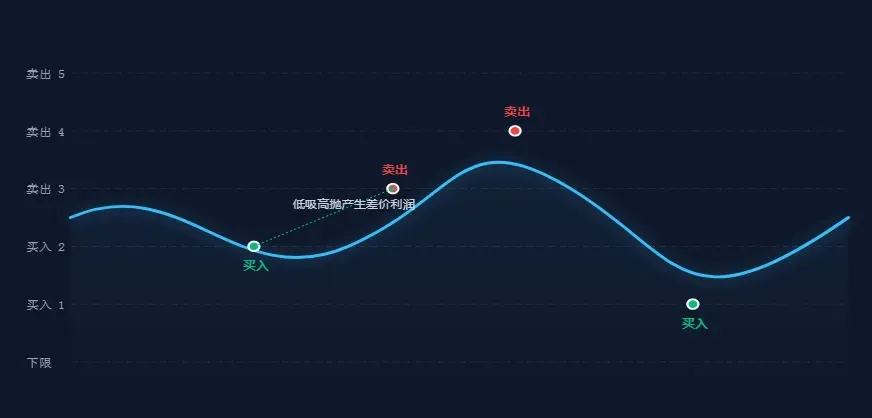
Illustration: Price oscillates between grid lines; when it falls below a lower line a buy order triggers, when it rises above an upper line a sell order triggers, repeating continuously.
Mechanism Example
Assume Bitcoin is currently trading at 50,000 USD, and the grid range is set from 40,000 USD to 60,000 USD:
- When the price drops to 49,000 USD, the system automatically buys one unit.
- When the price rebounds to 50,000 USD, the system sells the same amount.
- This round‑trip yields a 1,000 USD price difference (ignoring fees).
As long as the price remains within the defined band, the bot continuously captures similar spreads, akin to industrious ants hauling profit back to the nest.
Chapter 2: The Art of Parameter Setting – Avoiding “Ineffective Grids”
Reasonable parameters directly determine a grid’s success. Approximately 90 % of losses stem from poorly chosen ranges or overly dense grids.
1. Price Range
- Too narrow: Increases the chance of a “grid break,” where price escapes the set band, causing the bot to halt and exposing you to full‑position drawdown or missed opportunities.
- Too wide: Safer, but capital is spread across distant price levels, reducing trade frequency and potentially delivering lower returns than conventional bank products.
2. Grid Quantity and Density
Many beginners load a large number of grids (e.g., 100, 200), mistakenly believing that more frequent trades equal higher profit. The per‑grid profit rate is calculated as:
```
Per‑grid profit rate = (Upper bound – Lower bound) / Number of grids / Current price
```
If the per‑grid profit rate is only 0.05 %, while the exchange’s combined taker‑maker fees total 0.10 %, each trade loses money, potentially resulting in a negative net profit.
Golden rule: Ensure per‑grid profit rate > 2 × fees; a typical target is 0.3 %–1 %, balancing trade frequency with profit margin.
3. Arithmetic vs. Geometric Grids
| Mode | Price Difference per Grid | Percentage Change per Grid | Profit Characteristics | Suitable Scenarios | Recommendation |
|------|---------------------------|----------------------------|------------------------|--------------------|----------------|
| Arithmetic (fixed amount, e.g., 100 USD) | Constant monetary step | — | Buying more coins at lower prices yields higher absolute profit | Small ranges, lower‑priced assets | ⭐⭐⭐⭐ |
| Geometric (fixed percentage, e.g., 1 %) | Constant percentage step | — | Uniform per‑grid profit rate, clear compounding effect | Large ranges, high‑priced or widely spaced assets | ⭐⭐⭐⭐⭐ |
Chapter 4: Three Ways to Create Spot Grids on OKX
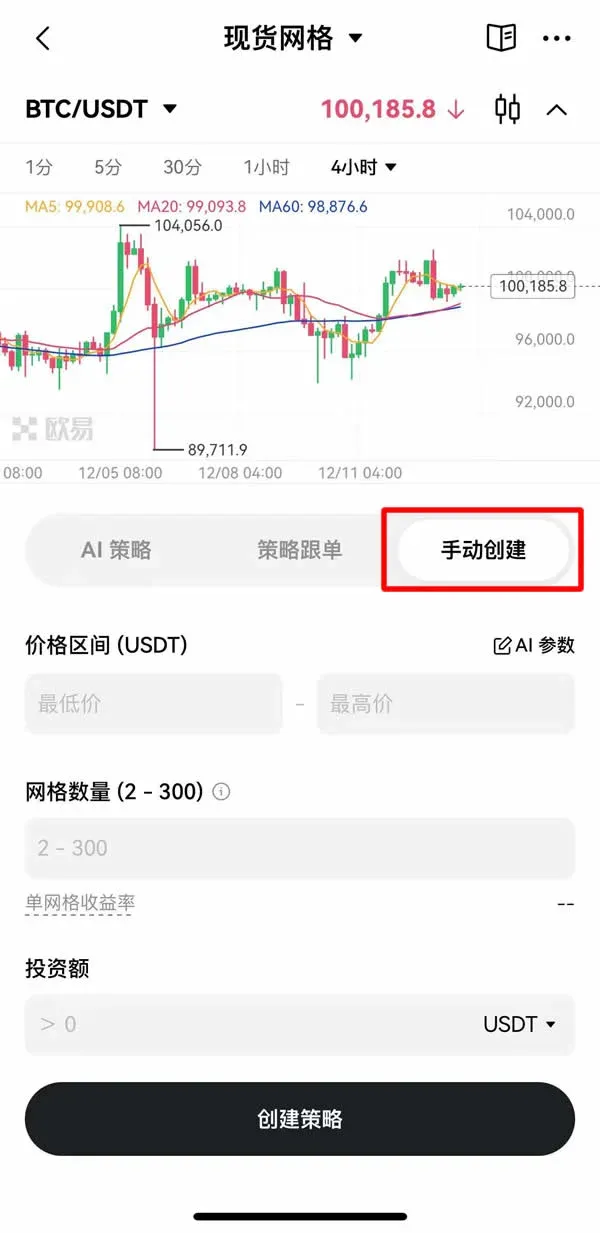
OKX offers AI Strategy, Strategy Copy‑Trading, and Manual Creation to meet users of varying experience levels.
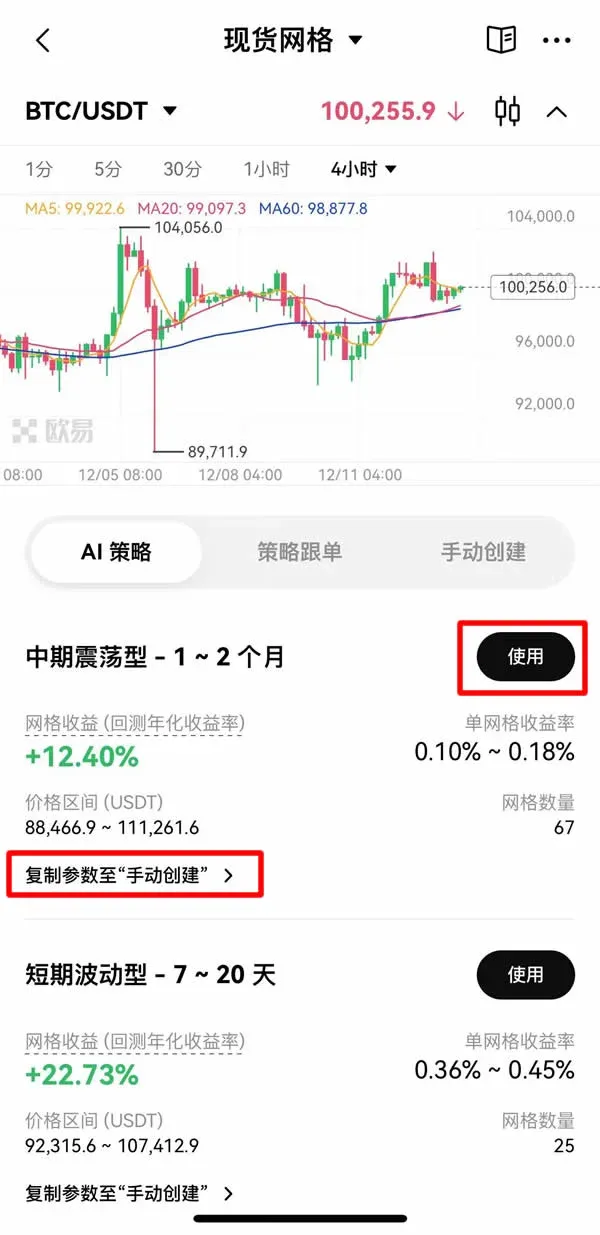
1. AI Strategy – One‑Click for Beginners
Simply input the amount you wish to allocate; the system analyses historical data and generates the most suitable grid parameters. After generation, you can copy the settings to manual mode for fine‑tuning.
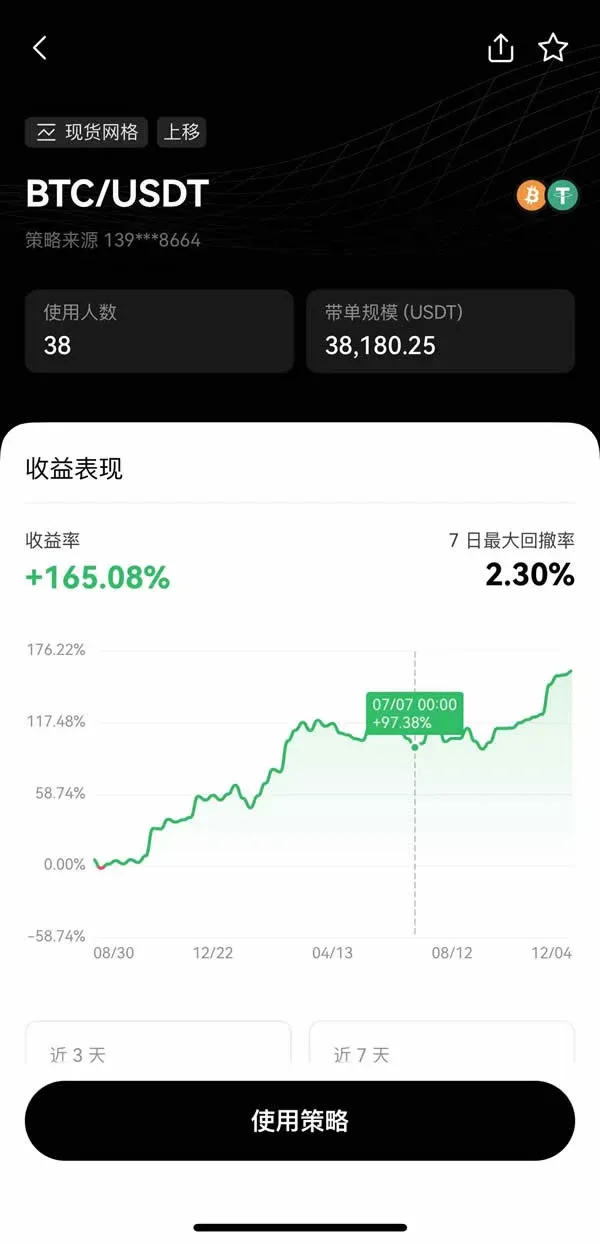
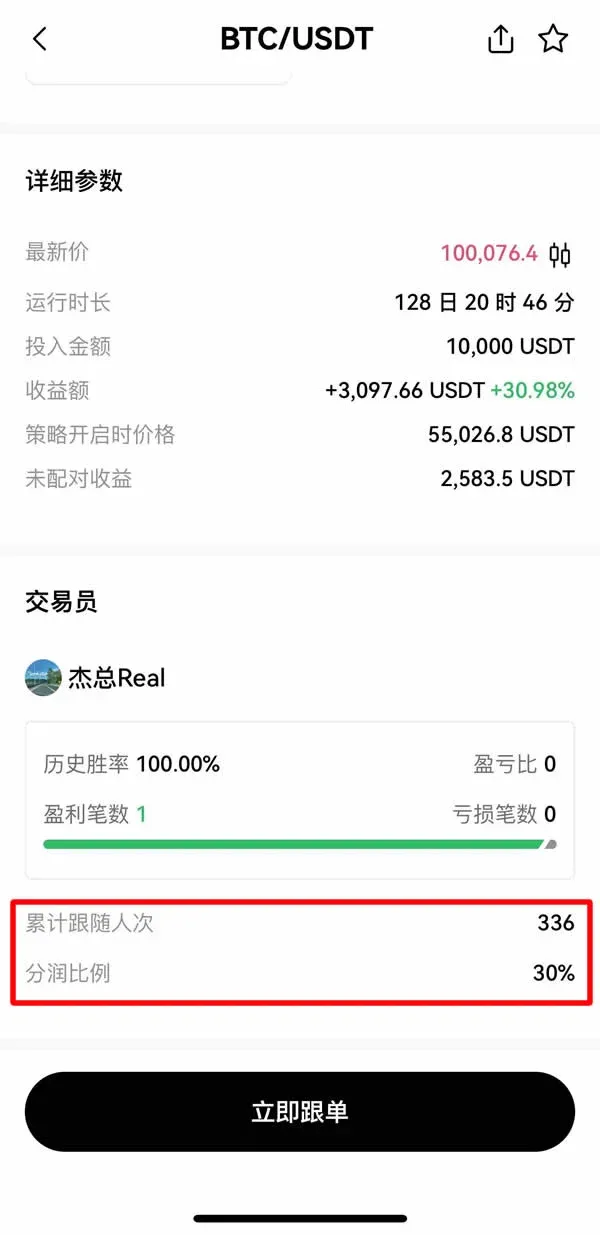
2. Strategy Copy‑Trading – Follow the Experts
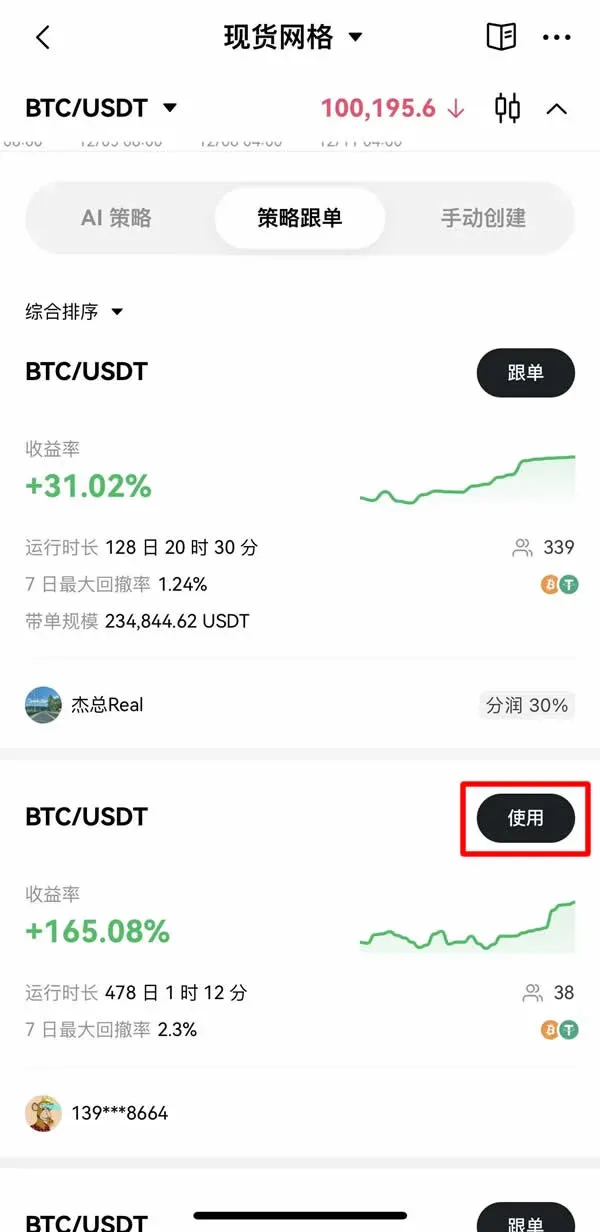
Experienced traders publicly share their grid configurations and performance records. Click Copy to view the metrics and replicate their parameters; after funding the same amount, the bot will execute in parallel. Some signal providers may charge a performance‑share fee (commonly 30 %); verify the “Profit‑share Ratio” before confirming.
3. Manual Creation – Freedom for Advanced Users
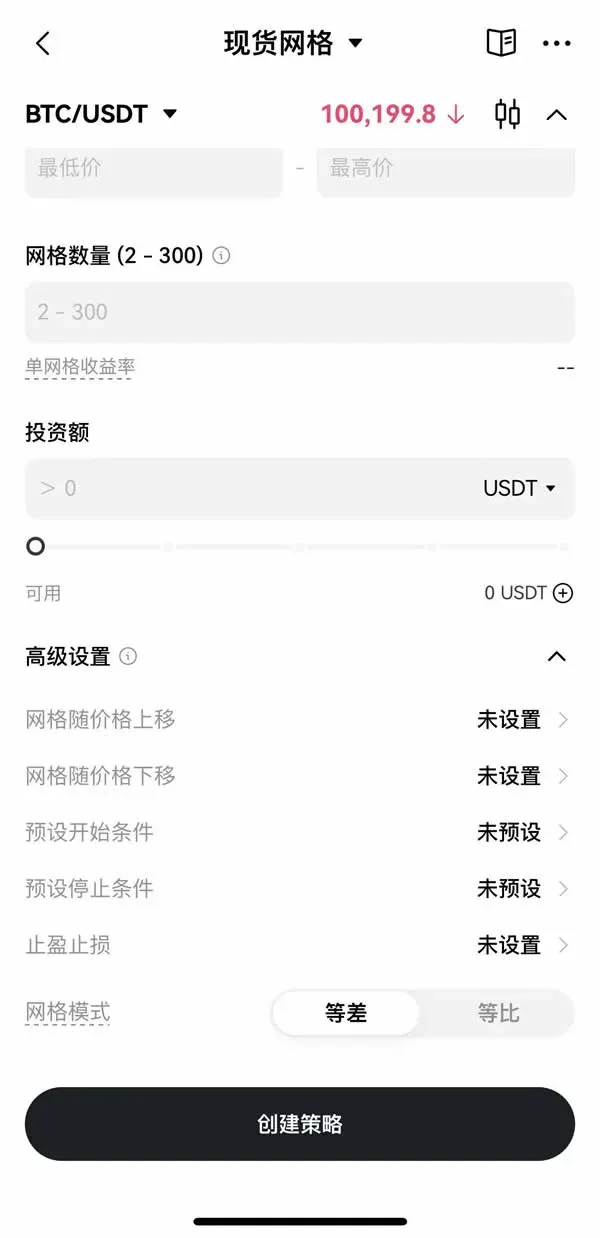
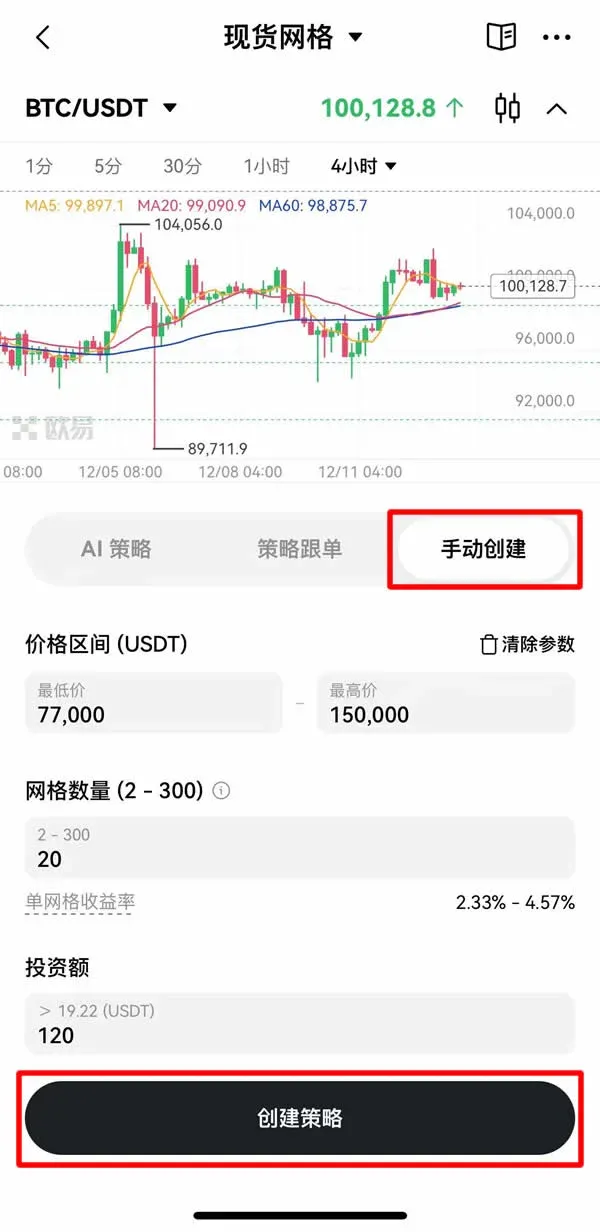
Manual mode lets you set the following key parameters:
- Price Range (USD): Upper and lower limits; the bot stops automatically once the price exits the band.
- Number of Grids: Determines how many trades can occur within the range.
- Investment Amount: Total capital you allocate to the grid.
In addition, OKX provides a proprietary Moving Grid feature:
- Move Up: When price breaks the upper limit, the entire grid shifts up one level, canceling the lowest buy order and adding a higher‑priced sell order.
- Move Down: When price falls below the lower limit, the grid shifts down, extending the buying range.
Optional settings include:
- Pre‑set start/stop conditions (immediate, price trigger, RSI, TradingView signals)
- Take‑profit / Stop‑loss
- Grid type (Arithmetic or Geometric)
Chapter 5: Step‑by‑Step Guide to Deploy a Spot Grid on OKX
Follow these three steps to quickly launch a spot grid:
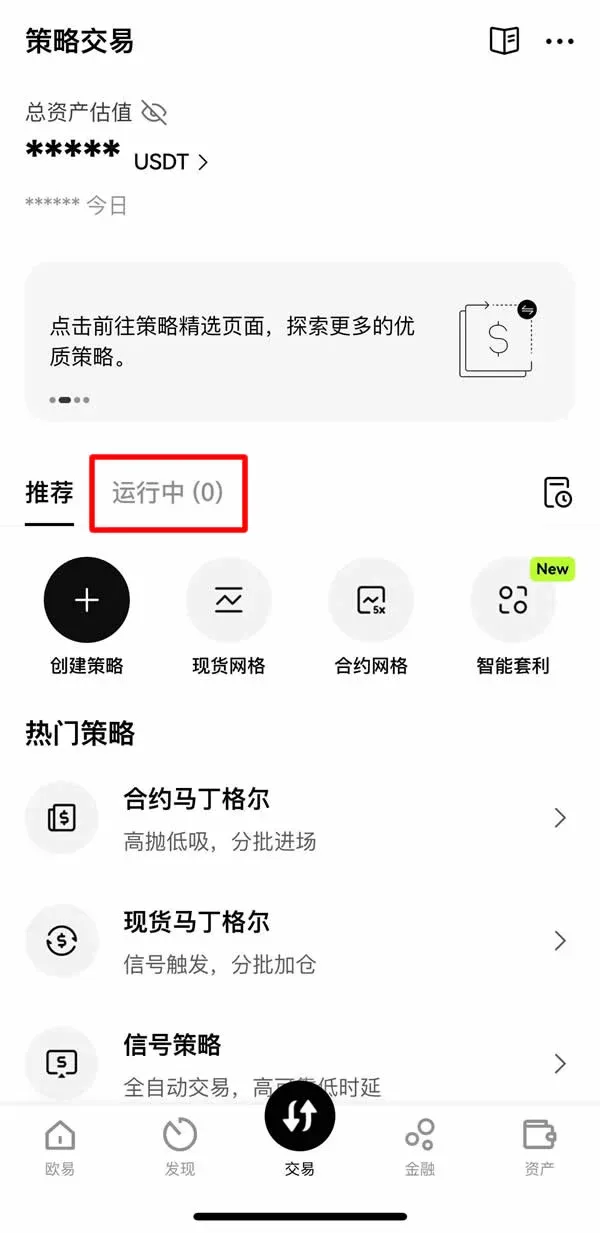
- Open the OKX App (official sign‑up: https://www.okx.com/zh-hans/join/B2345 | download: https://www.bitaigen.com/binance/download), navigate to Trade → Strategy → Spot Grid.
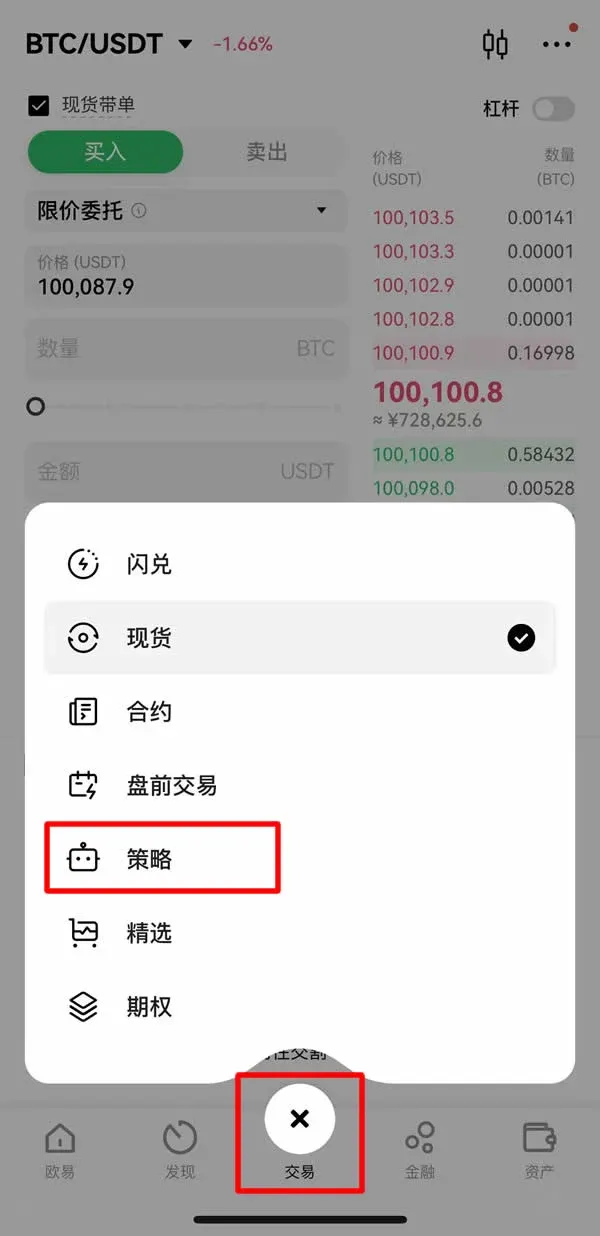
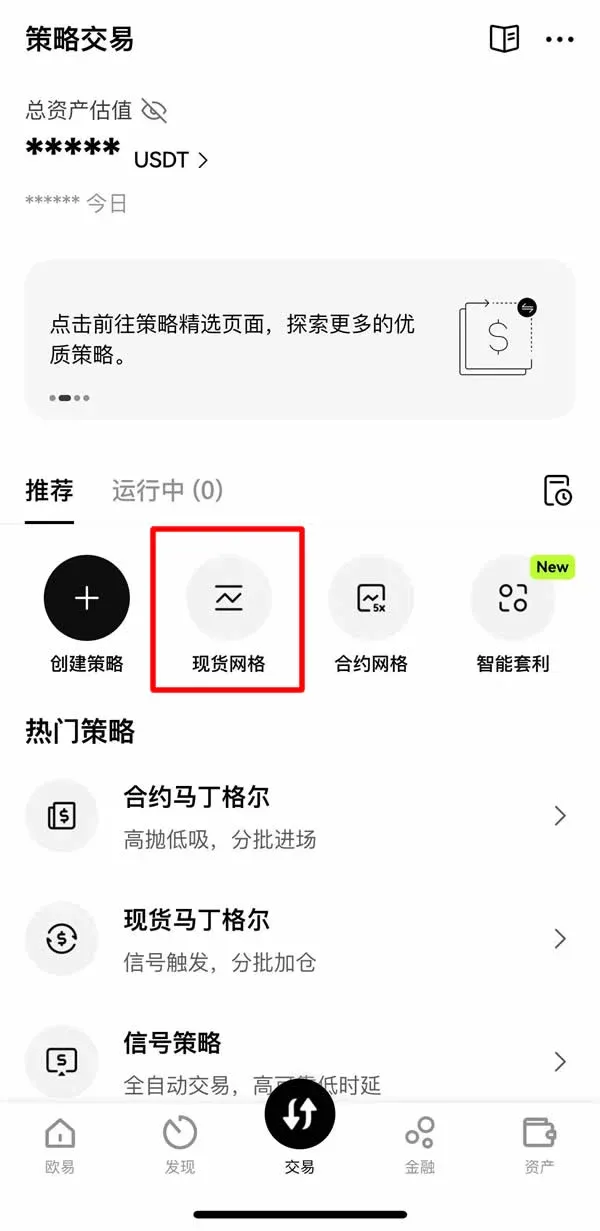
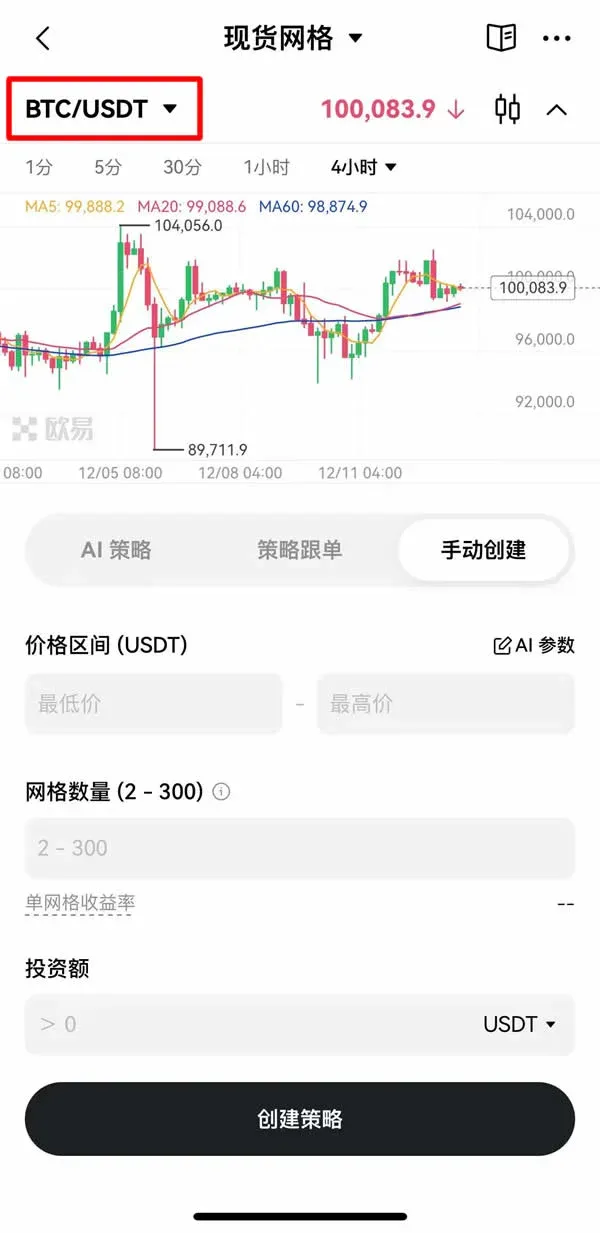
- Select the cryptocurrency you wish to trade in the upper‑left corner.
- Pick AI Strategy, Strategy Copy‑Trading, or Manual Creation, input the capital amount, adjust parameters as needed, and finally click Create Strategy to finish.
After creation, you can view the active grid and other bots under the Running section of the Strategy page.
Chapter 6: Configuration Guide for OKX Futures Grids
Futures grids add the choice of long, short, or neutral direction and allow leverage on perpetual contracts to boost capital efficiency. Below are the key steps for AI‑based and manual modes.
1. AI Strategy Mode (Beginner‑Friendly)
- Open the OKX App, go to Trade → Strategy Trading → Futures Grid.
- Choose the contract pair (e.g., BTC perpetual), switch to AI Strategy, and select the grid direction (long, short, or neutral).
- The system will propose three recommendations based on the past 7‑30 days: short‑term (10× leverage), medium‑term (5×), long‑term (3×). Pick the one that matches your intended holding period.
- Enter the capital amount, confirm the leverage (BTC supports up to 100×, but many jurisdictions restrict US users to Binance.US and may require SEPA/SWIFT for fiat deposits), then click Create Strategy.
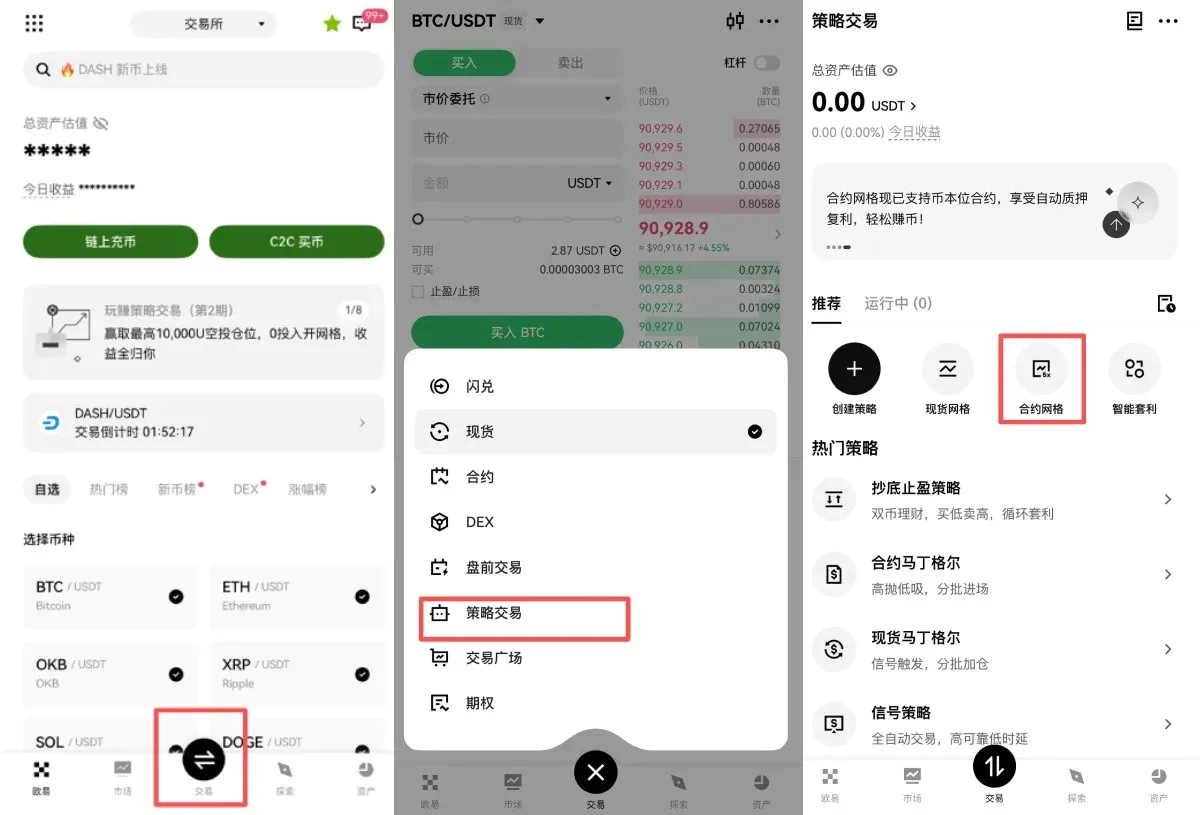
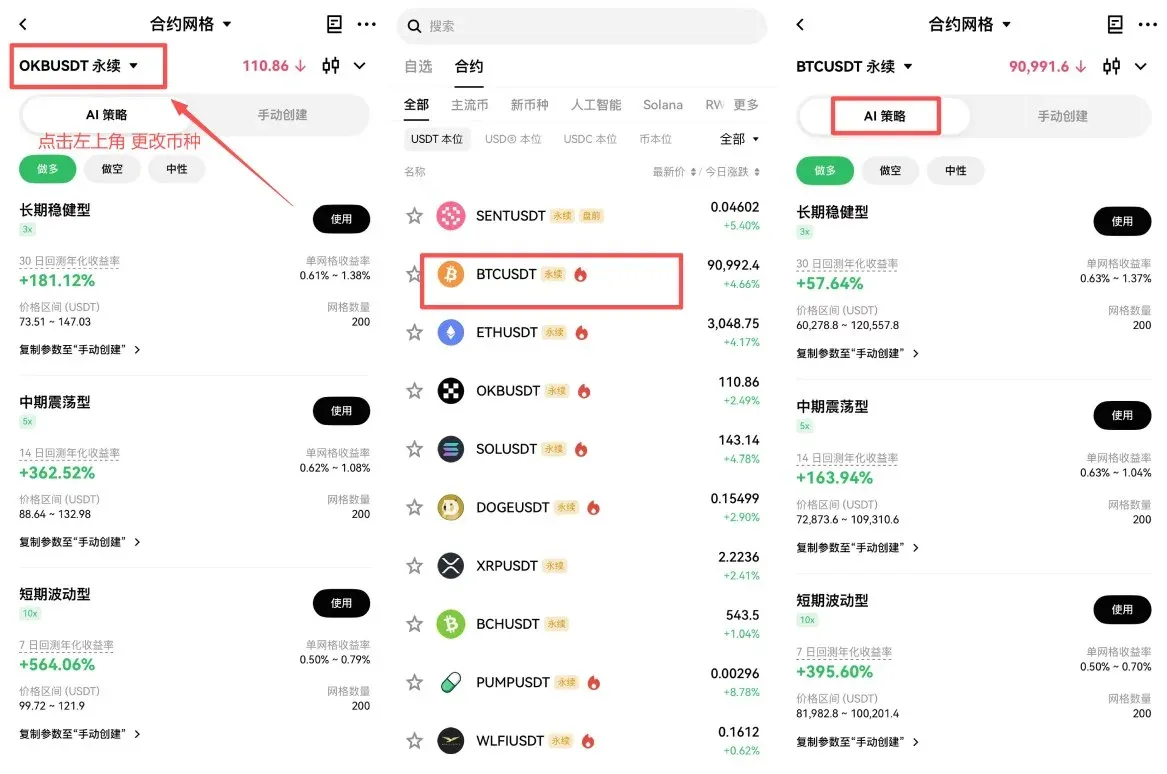
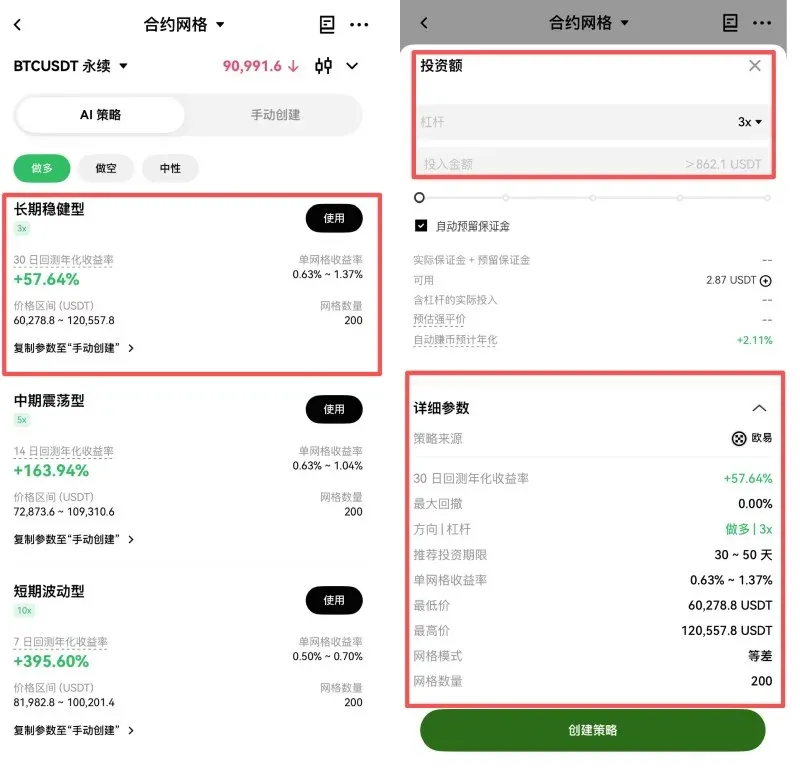
If you need finer adjustments, click Copy Parameters to Manual Creation for secondary editing.
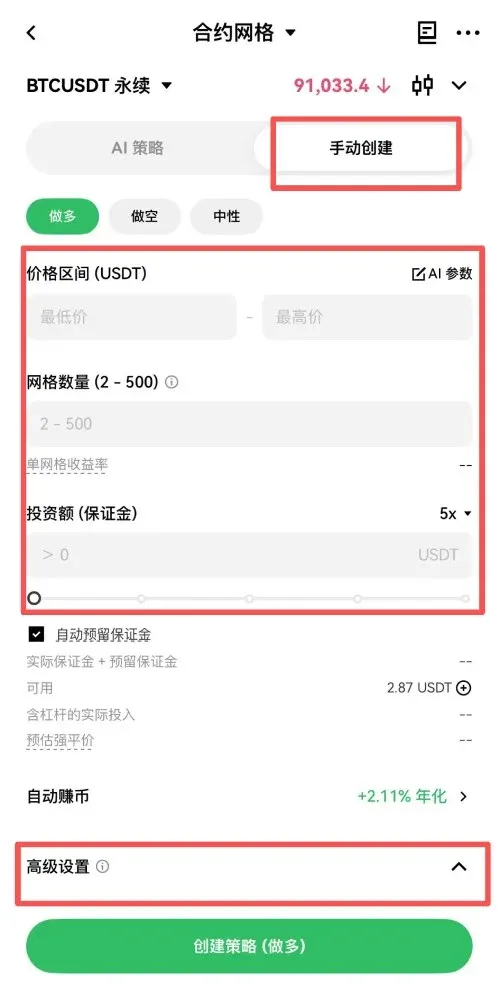
2. Manual Creation Mode (Experienced Traders)
- The layout mirrors the spot‑grid interface but adds auto‑reserve margin (reducing liquidation risk) and leverage selection.
- Beginners are advised to start with low leverage to avoid liquidation from modest price swings.
- Take‑profit and stop‑loss can be linked to the direction: for a long grid, move the stop‑loss above the entry price once profit accrues; for a short grid, do the opposite.
Chapter 7: Neutral Strategies
💡 Register on Binance with referral code B2345 for the maximum trading fee discount. See Binance complete guide.



