
 Bitaigen Research
 In this article we outline the core concepts and operating principles of DeFi price oracles, dissect their on‑chain and off‑chain implementation variants, and place particular emphasis on evaluating key attributes such as accuracy, resistance to manipulation, timeliness, and decentralisation. By providing a clear framework, readers can quickly grasp the essential criteria for selecting an oracle; subsequent sections will delve into concrete case studies and security risks, making a thorough read worthwhile. *(When dealing with fiat, USD is the predominant reference currency, and transfers can be executed via SEPA or SWIFT in the global market.)*
What Is an Oracle?
A DeFi price oracle is an intermediary service that links real‑world off‑chain data with on‑chain smart contracts, delivering accurate, timely, and manipulation‑resistant asset prices while establishing data trustworthiness through a decentralised network.
Oracles act as bridges between the real‑world (off‑chain) services and blockchain (on‑chain) protocols. They retrieve off‑chain information and write the results to the blockchain for smart contracts to consume; they can also forward contract‑issued commands to off‑chain systems. To ensure security, an oracle must provide high‑precision data and possess strong anti‑manipulation capabilities.
Desired Characteristics of an Ideal Oracle
- High Accuracy – The price oracle must faithfully reflect the current market conditions.
- Resistance to Manipulation – It should be able to withstand malicious attacks and data tampering.
- Timeliness – Data should be refreshed within each block to guarantee real‑time relevance.
- Decentralisation – Validation should occur in an open network without entry barriers, reducing single‑point‑of‑failure risk.
On‑Chain Oracles vs. Off‑Chain Oracles
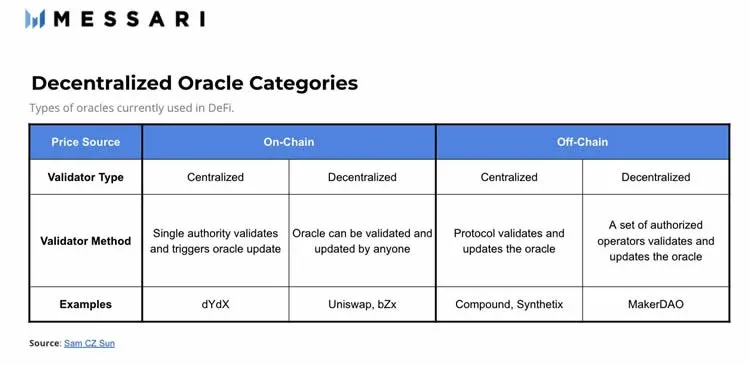
DeFi oracles can be categorised as on‑chain or off‑chain. On‑chain oracles derive prices from on‑chain protocols such as Uniswap, whereas off‑chain oracles rely on external exchanges or data providers. In addition, they can be further divided by the degree of centralisation:
- Centralised Oracles: Data is verified by a single operator (e.g., Compound).
- Decentralised Oracles: Data is verified collectively by multiple independent operators (e.g., MakerDAO).
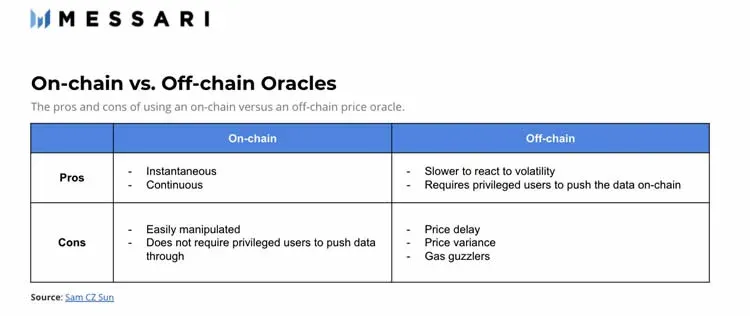
On‑chain and off‑chain oracles each have strengths and limitations. On‑chain oracles are vulnerable to flash‑loan attacks and similar exploits; notable incidents include the security events at Harvest Finance (October 2020), yVault (July 2020) and bZx (February 2020). To mitigate risk, many protocols adopt off‑chain or hybrid oracle solutions.
Top‑Tier Ethereum DeFi Oracles – Classification
Below is a non‑exhaustive list of the most widely used oracle types within the DeFi ecosystem. For a more granular taxonomy, refer to Linda Xie’s comprehensive classification on GitHub (click here to view).
Chainlink Oracle (Hybrid Decentralised)
- Operates as a decentralised network of at least seven independent node operators.
- Nodes provide off‑chain data via the Chainlink Standard API or the Origin Signed Data Model.
- Data is aggregated on‑chain by the FluxAggregator; if the deviation exceeds a contract‑specified threshold or a heartbeat timeout is triggered, an update occurs.
- Each node submits data using a public address, allowing reputation‑based assessment and realising the principle “transparency equals security”.
MakerDAO v2 Oracle (Off‑Chain Decentralised)
- Utilises the Medianizer contract to compute the median price of an asset.
- Prices are fetched from whitelisted exchanges using the Setzer tool, then propagated to the Scuttlebutt network for aggregation.
- The Medianizer refreshes its reference price when a new quote deviates by more than 1 % from the previous update or when no update has occurred for six hours.
- Adding or removing whitelisted Feeds requires a vote by MKR token holders, theoretically exposing the system to a 51 % attack vector.
On 12 March 2020, the “Black Thursday” episode saw gas fees spike dramatically, causing the Medianizer to lag in updating ETH prices. The price drop of roughly 43 % triggered massive liquidations; see the GlassNode report for detailed analysis.
Uniswap v3 Oracle (On‑Chain Decentralised)
- Based on a Time‑Weighted Average Price (TWAP), it records the cumulative sum of per‑second prices.
- v3 introduced internal checkpoints, enabling external contracts to compute the geometric‑average TWAP of the most recent interval without storing historical cumulative values.
- A new Liquidity Accumulator assists contracts in assessing the reliability of TWAPs across different pools.

- These enhancements lower the computational cost of moving‑average calculations and support outlier analysis, further bolstering the robustness of price oracles.
Compound Oracle (Hybrid Centralised)
- Employs a dual‑source pricing model that combines off‑chain and on‑chain data. Authorized reporters include centralised exchanges, DeFi protocols, and OTC platforms.
- The aggregator contract validates each submitted price before computing the median; prices falling outside the bounds set by a reference contract are discarded and do not update the reference price.
- Parameters such as the minimum number of reports, the reference contract address, and tolerance levels are governed by Compound token holders, allowing dynamic adjustment.
Synthetix Oracle (On‑Chain Centralised)
- All price feeds have been migrated on‑chain. Index prices are calculated off‑chain by Chainlink and then posted on‑chain.
- To prevent premature trades caused by delayed oracle updates, Synthetix implements a queue mechanism: Synth exchanges are only executed after the oracle has completed the latest price update.
Coinbase Oracle (Off‑Chain Decentralised)
- Sources data from the Coinbase Pro API, with prices signed using Coinbase’s private key; on‑chain users can verify authenticity via the corresponding public key.
- An off‑chain filter removes anomalous spikes, and the result is cross‑checked against Compound’s reference contract for a second layer of verification.
- Coinbase prices are also used as anchors for Uniswap, creating a stronger composite data source.
How Are Oracles Utilised Within DeFi?
The core function of an oracle extends well beyond loan liquidation; it is employed across a variety of scenarios:
- Collateral‑Shortfall Liquidations – Protocols such as Maker, Compound, Cream, and Aave trigger liquidations based on oracle‑derived prices.
- Derivative Pricing – Platforms like Synthetix, Perpetual, and Hegic rely on oracles to price options, futures, and synthetic assets.
- Index Valuation – Funds such as Set obtain real‑time component prices through oracles to calculate index values.
- Insurance Protocols – Nexus Mutual uses oracles to verify the occurrence of insured events before processing on‑chain claims.
- Prediction Markets – Decentralised prediction platforms including Augur and Gnosis depend on oracles to settle off‑chain outcomes.
Beyond Ethereum Oracles
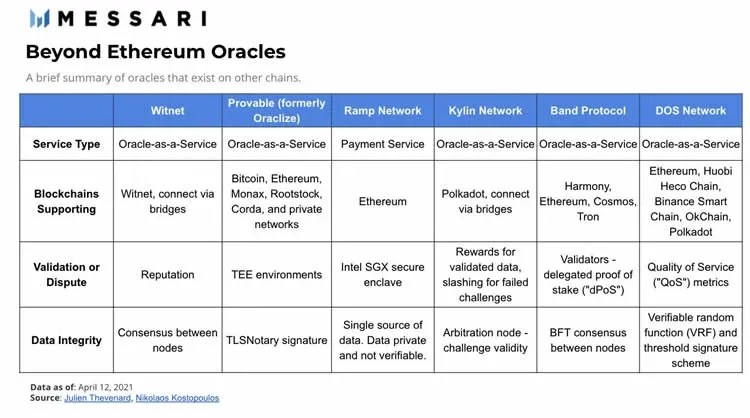
Outside the Ethereum ecosystem, numerous other blockchains are developing their own oracle solutions. Julien Thevenard and Nikolaos Kostopoulos provide a scholarly review of multi‑chain oracle architectures in their recent paper. The following quick‑look overview lists several notable oracles that fall outside the scope of this report.
Conclusion
Every oracle—whether on‑chain or off‑chain—brings a distinct set of advantages and constraints. Whether Ethereum price oracles will experience another “Black Thursday”‑style collapse remains to be seen. When assessing an oracle, consider the following attack vectors:
- 51 % Attack – A minority of nodes or organisations gaining control of the majority of the network, enabling price manipulation.
- Mirror Attack – Compromised nodes replicate falsified data to other controlled nodes, creating a cascade of misinformation.
- Data Tampering – If the external data source is compromised, on‑chain outcomes will be directly affected.
- Liveness Issues – Nodes that fail to push updates promptly can cause contract execution anomalies.
As protocols evolve, the precision of both on‑chain and off‑chain data becomes increasingly critical. Going forward, oracles will likely integrate deeply with the Internet of Things, external software services, and other real‑world information pipelines, driving sustained demand for trustworthy data transmission. Different business cases require tailored oracle designs; protocol developers should weigh the trade‑offs outlined above to select the solution that best aligns with their security and performance goals.
This completes the full analysis titled DeFi Knowledge: A Single Article to Understand DeFi Price Oracles. For additional resources, stay tuned to Bitaigen (比特根) and explore their other publications!
Related Reading
- Is the OKX Web3 Wallet Secure? In‑Depth Security Review
- DeFi Lending Basics: Core Concepts & Top Projects
- GameFi Explained: DeFi + NFTs, Top Tokens & Market Risks
💡 Register on Binance with referral code B2345 for the maximum trading fee discount. See Binance complete guide.



