
 Bitaigen Research
 We delve into the core advantages of blockchain‑based gaming economies in this article, examining five dimensions—asset ownership, decentralization, open protocols, incentive mechanisms, and global accessibility—to illustrate how they reshape player experiences and drive new industry growth. By citing authoritative data and case studies, readers can grasp emerging trends; we recommend continuing the read for the full insight.
Even those completely unaware of the outside world likely know that the gaming industry has been evolving at breakneck speed. It is one of the sectors that benefited from the COVID‑19 pandemic.
Blockchain‑powered gaming economies are touted as the future because of five key advantages: asset ownership, decentralization, open protocols, incentive mechanisms, and global accessibility, as well as the potential for player‑driven trading and cross‑platform interoperability.
The global gaming market is currently valued at USD 180 billion, making it the fastest‑growing form of entertainment worldwide. For comparison, the global film industry is worth about USD 100 billion, and the combined annual revenue of all North American sports leagues is roughly USD 73 billion.
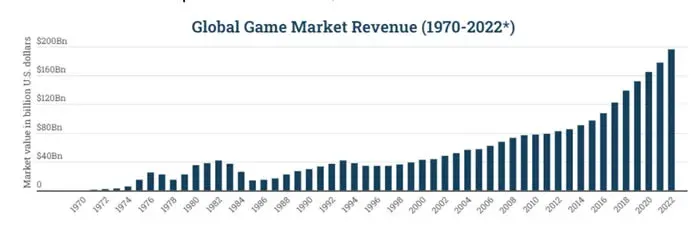
*Global gaming market revenue – Sources: Bloomberg, Pelham Smithers, GamingScan.com*
Experts forecast that by 2025 the number of online game streamers will climb to 1 billion.
In 2018, three of the four most‑watched U.S. sports events were not traditional sports at all—they were esports competitions. For instance, viewership of the *League of Legends* World Championship exceeded that of the AFC Asian Cup by 30 million and surpassed the NCAA Football Championship by 45 million.
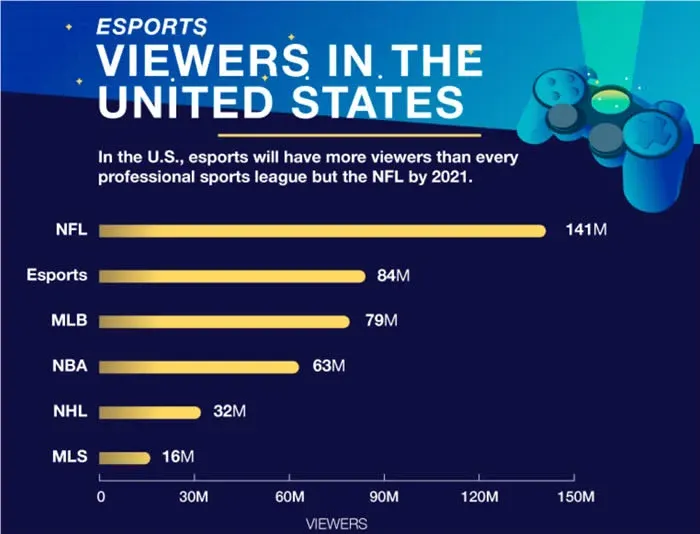
*U.S. esports audience – Source: MBA@Syracuse*
In April of last year, Travis Scott performed a live concert inside the popular platform Fortnite. According to TechCrunch and GamesIndustry.biz, the event garnered over 12.3 million views and generated more than USD 20 million in net revenue for Scott.
So, what is actually happening? Where is this growth coming from?
Much of it can be traced back to rapid technological advancement and exponential scaling. Technology continues to reshape how we communicate, gather, create, consume information, transfer value, and build online communities.
Former Starbucks CEO Howard Schultz popularized the concept of a “third place” with his coffee‑shop model, arguing that people need a third space beyond home and the office—Starbucks filled that need.
Today’s younger generations exhibit a similar craving, but the shared space has gone digital, known as the metaverse. In this realm, kids can socialize with friends, listen to music, and play games, tracing an evolution from AOL chat rooms → MySpace → Facebook → the metaverse.
We have already hosted concerts in the metaverse, such as a digital version of Burning Man, and this is just the beginning.
A Brief History of Gaming
The first video game appeared in the late 1950s, resembling a simple tennis‑style game like *Pong*. In 1977, Atari released a commercial home console. The 1980s saw Nintendo launch iconic titles such as *Mario Bros.*, *The Legend of Zelda*, and *Donkey Kong*.
It is worth noting that the business model has fundamentally shifted. In the past, players bought a physical copy of a game from GameStop for roughly USD 60 in a one‑time purchase, with about 90 % of revenue earned within the first two weeks after launch. Today, the free‑to‑play (F2P) model dominates: players can start for free and spend money on cosmetic skins, weapons, items, and other microtransactions.
*Roblox*, *Fortnite*, and similar titles epitomize this model. For developers, F2P is often more profitable because it boosts user retention, fuels social competition, and creates new social signals through virtual assets.
Why Games Are Moving to Blockchain
- Asset Ownership – In traditional games, items, characters, and other assets belong to the platform; players merely have usage rights. Axie Infinity broke that paradigm: the NFTs (non‑fungible tokens) players hold can be freely bought or sold on open markets, delivering true ownership.
- Incentive Mechanisms – Blockchain games reward players with native tokens (e.g., SLP, AXS). These tokens can be exchanged for other cryptocurrencies or fiat via SEPA/SWIFT transfers. During the pandemic, users in the Philippines earned several times the average monthly salary by playing such games.
- Decentralization – Public blockchains are permissionless and open to anyone. All that’s required is a smartphone and an internet connection, allowing participants worldwide—including those outside the United States—to earn without a centralized gatekeeper.
- Open Protocols – Public chains like Ethereum provide open standards that anyone can build upon. Development, operational, and capital costs are shared at the protocol layer, lowering entry barriers, spurring competition, and ultimately benefiting players.
- Cross‑Chain Compatibility & Portability – Future blockchain games may operate across multiple ecosystems such as Ethereum, Solana, and Cosmos. Players’ NFT assets (skins, avatars, weapons, etc.) could migrate, trade, or be repurposed across different games without being locked to a single platform.
The chart below shows Axie Infinity’s revenue trajectory since May 2023:
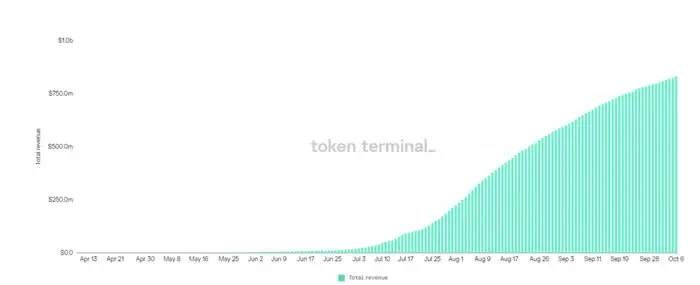
*Axie Infinity total revenue – Source: Token Terminal*
According to Token Terminal, this permissionless blockchain title generates roughly USD 2.7 billion in annualized revenue. Blockchain technology furnishes the technical foundation for users to truly own in‑game assets—something conventional architectures cannot achieve.
The openness of public chains combined with the global spread of internet connectivity enables an ever‑growing number of users in emerging markets to encounter cryptocurrencies and blockchain games. As 4G and 5G coverage expands and smartphone penetration rises, the user base for blockchain gaming is expected to scale rapidly.
Structured Breakdown: The Five Advantages of Blockchain Gaming
| Advantage | Explanation |
|---|---|
| **Asset Ownership** | NFTs held by players can be freely bought, sold, or transferred on‑chain, granting genuine value ownership. |
| **Incentive Mechanisms** | Token rewards enable “play‑to‑earn” models, increasing engagement and providing monetary upside. |
| **Decentralization** | No central platform approval is needed; players worldwide can join on equal footing. |
| **Open Protocols** | Anyone can develop on a public chain, reducing costs and fostering innovation. |
| **Cross‑Chain Compatibility** | Assets can move between games and across different blockchains, enhancing liquidity. |
Conclusion
The future of gaming economics lies on the blockchain. Blockchain delivers critical advantages—asset ownership, decentralization, open protocols, incentive mechanisms, and global accessibility—that push the industry toward a more open and equitable direction.
The information presented here reflects the personal views of the author and does not represent the stance of the Cointelegraph Chinese platform. It does not constitute financial or investment advice. Readers should maintain a sound monetary perspective, adopt prudent investment principles, and be aware that crypto‑related gains may be taxable under local jurisdictional rules.
This completes the detailed content of “In‑Depth Analysis: Five Reasons Why a Blockchain‑Based Gaming Economy Is the Future.” For more articles on blockchain gaming economics, follow Bitaigen (比特根) and explore additional resources!
Related Reading
- Blockchain Gaming Guilds: Play-to-Earn Services
- Blockchain Gaming: From Play‑to‑Earn to True Asset Ownership
- Blockchain Gaming Rise: Security, Assets & Ownership
💡 Register on Binance with referral code B2345 for the maximum trading fee discount. See Binance complete guide.



