
 Bitaigen Research
 Enso (ENSO) token is the native cryptocurrency of the Enso decentralized network, providing gas, governance, staking and other utilities. Its purpose is to simplify cross‑chain development complexity and to accelerate ecosystem growth.
In this article we conduct an in‑depth analysis of the core functions and ecosystem value of the Enso (ENSO) token, and we detail how to claim the Binance HODLer airdrop. The goal is to give readers enough information to quickly evaluate the potential opportunity presented by the project. From here, follow our perspective to learn about ENSO’s advantages in cross‑chain governance and staking, as well as the simple steps required to receive the airdrop rewards.
Introduction to the HODLer Airdrop
Binance HODLer airdrop is based on a historical snapshot of users’ BNB holdings and distributes token rewards to BNB holders. Anyone who uses BNB to subscribe to capital‑protected Earn products (fixed‑term and/or flexible) or on‑chain Earn products automatically qualifies for the airdrop, as well as for Launchpool and Megadrop rewards.
- Retroactive reward: Unlike Earn programs that require ongoing actions, the HODLer airdrop rewards users directly from the snapshot, making the process straightforward.
- Automatic eligibility: Simply holding BNB and participating in the aforementioned products triggers the token reward without any additional claim steps.
How to Benefit from the HODLer Airdrop
- If you do not yet have a Binance account, first register through the official sign‑up page (register here) and download the client (official download).
*For users located in the United States, the appropriate platform is Binance.US; the global Binance site is not available for US residents.*
- Navigate to the Finance (理财) section and search for BNB.
- Use your BNB balance to subscribe to a capital‑protected Earn product (either flexible or fixed‑term) or to an on‑chain Earn product.
- Binance takes multiple hourly snapshots of each user’s BNB balance together with the total pool balance, calculating an average holding for each hour.
- The airdrop reward will be deposited into your spot wallet within 24 hours after the official announcement.
Example: The HODLer airdrop announced on June 11 2025 might reference BNB balance snapshots taken between June 1 and June 7 2025.
Latest Enso (ENSO) Updates
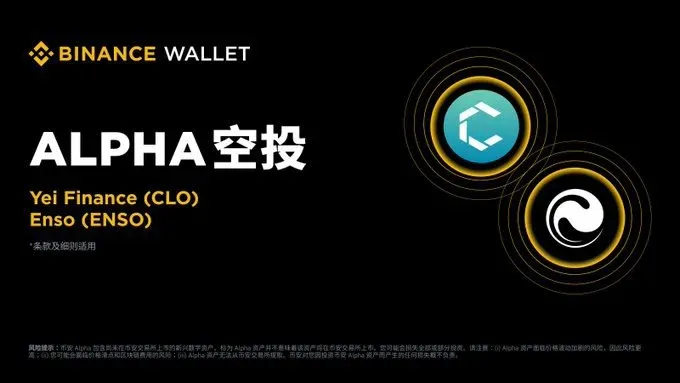
Binance Alpha will list Enso (ENSO) for the first time on October 14. Eligible users can use Binance Alpha points to claim a 10 ENSO airdrop within 24 hours after trading begins.
The airdrop is distributed in two phases:
| Phase | Time window | Required Alpha points |
|---|---|---|
| Phase 1 | First 18 hours | ≥ 245 points |
| Phase 2 | Remaining 6 hours | ≥ 225 points (first‑come, first‑served) |
- Each claim consumes 15 Alpha points and must be confirmed within the 24‑hour window; otherwise the claim is considered forfeited.
What Is Enso?
Enso aggregates all blockchains into a single, unified network that offers one access point. Developers need to integrate only once to read, write, and interact with smart contracts on any chain, enabling the creation of seamless consumer‑facing applications that can serve hundreds of thousands of users.
- Decentralised shared network: Generates executable bytecode across multiple blockchains, roll‑ups and app‑chains.
- Tendermint‑based Layer 1: Maps every smart‑contract interaction, allowing developers to compose and invoke any contract from a single source.
- Usability bottleneck solution: Developers declare the desired outcome; network participants collaborate to provide the solution, reducing friction and increasing composability.
More than 100 + enterprises are already using Enso, covering AI agents, asset management, cross‑chain infrastructure, decentralized exchanges, perpetual contracts, trading bots, money‑market services, staking platforms and more. Over US $15 billion of on‑chain settlement volume has been processed, making the platform suitable for everything from hobbyist developers to large‑scale corporations.
Problems Enso Is Addressing
By 2025, the real obstacle is no longer transaction‑per‑second (TPS), decentralisation, or storage capacity, but the complexity of building real‑world products on‑chain. If developers cannot ship reliable products quickly, underlying performance metrics become largely irrelevant.
- Traditional app stores host millions of applications (Google Play ≈ 2.7 million, Apple ≈ 1.95 million), whereas the crypto space hosts only about 4,800.
- More than 1,000 blockchain frameworks exist; Ethereum alone hosts 41 million deployed smart contracts.
- Integration costs are high: the average team spends US $500,000 and six months just to achieve cross‑chain integration, scattering innovation resources.
Enso’s unified entry point and collaborative network let developers concentrate on product development, community building and distribution rather than on low‑level integration work.
Key Highlights of Enso
- Blockchain shortcut: A single entry point delivers read and write capabilities across all chains, enabling rapid delivery of consumer‑oriented products.
- Production provability: Supports 100 + enterprise‑grade products, with on‑chain settlement exceeding US $15 billion; facilitated US $3.1 billion of transactions on Berachain; partnered with Uniswap, LayerZero, Stargate, Plume, zkSync, Sonic and others.
- Accelerating Web 3 adoption: While Web 2 boasts over 4.7 million apps, Web 3 still hovers around 4,700. Enso supplies the critical infrastructure that lowers the barrier for developers to join the Web 3 ecosystem.
- Community focus: The latest financing round offers more attractive valuation and token‑ownership terms for participants.
- Utility token: ENSO circulates fees among network participants, creating a positive economic flywheel.
- Top‑tier investors: Backed by renowned institutions such as Polychain, Multicoin, Naval Ravikant, Cyberfund, Dialectic, Spartan, IDEO, as well as 70 + angel investors from projects like LayerZero, Safe, 1inch, Yearn, Flashbots, Dune, Altlayer, Pendle and others.
Technical Overview of Enso
The Enso network spans the full stack of data retrieval and on‑chain execution. To meet the growing demand for smart‑contract calls, Enso has built a decentralized open network that lets developers and AI agents contribute the data and contract information required for execution.
- Contribution model: Similar to The Graph (GRT), but Enso additionally offers data acquisition + transaction execution services, expanding its market potential.
- Network participant roles
- Action providers: Supply modular contract abstractions.
- Graph designers: Develop composite algorithms that satisfy incoming requests.
- Validators: Verify the security and efficiency of proposed solutions.
What Is the ENSO Token?
ENSO is the native token of the Enso Tendermint‑based network. Classified as a digital asset, it is a core component of the ecosystem; without ENSO the network cannot function.
Key functionalities include:
- Gas – Pays for request fees and state‑changing operations on the network.
- Governance – Token holders can vote on protocol upgrades and parameter changes.
- Network participation – Validators, graph designers and action providers must stake ENSO to deter malicious behaviour.
- Delegation – Staking attracts additional participants, strengthening network security.
The total supply of ENSO is capped at 100 000 000 tokens.
ENSO Tokenomics
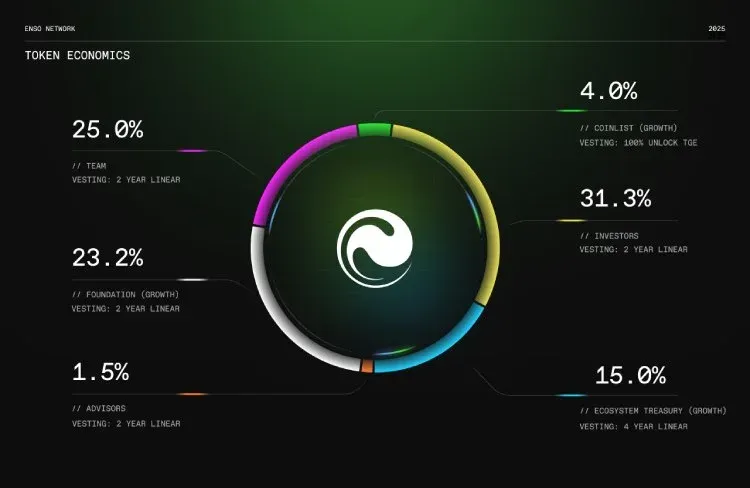
Token Allocation
| Category | Percentage |
|---|---|
| Team | 25 % |
| Foundation | 23.2 % |
| Advisors | 1.5 % |
| CoinList | 4 % |
| Investors | 31.3 % |
| Ecosystem fund | 15 % |
Token Utility
ENSO underpins a sustainable economic model for the Enso network:
- Query fees: Every request to the network incurs a fee; the fee embedded in the bytecode is auctioned in ENSO and distributed to network participants.
- Network governance: Holders can partake in decisions regarding upgrades, reward distribution and critical infrastructure, ensuring the network evolves in the right direction.
- Validation & staking: Token holders may delegate their stake to globally distributed node operators, boosting decentralisation resilience while earning staking rewards.
By providing public‑utility services across the entire network stack, ENSO creates a self‑reinforcing incentive loop that scales with network adoption.
Roadmap
The rollout of the Enso network is divided into several phases:
- Phase 1 – Initial network launch
- Independent validators simulate bytecode solutions; a centralized Enso service co‑exists with the nascent network.
- Action providers can feed the centralized service, ensuring smooth operation while the decentralized components are being built.
- Phase 2 – Fully permissionless contribution environment
- All types of graph designers become eligible to participate, achieving complete decentralisation and sustainability.
- Support expands from EVM to SVM (Solana Virtual Machine) and MVM (Mobile Virtual Machine), improving the cross‑chain developer experience.
This article has now provided a complete overview of what Enso (ENSO) token is, how it works, its tokenomics and future development plans. For additional Enso‑related material, please search the Bitaigen (比特根) archive or continue reading the recommended articles below. We hope you continue to support Bitaigen!
Note on taxation: Crypto‑related gains may be subject to tax in your local jurisdiction. Users should consult a qualified tax professional to understand their obligations, whether the gains arise from airdrops, staking rewards, or trading activities.
---
*All fiat references in this translation use United States Dollars (USD) or SEPA/SWIFT transfers where appropriate for a global audience.*
Related Reading
💡 Register on Binance with referral code B2345 for the maximum trading fee discount. See Binance complete guide.



