
 Bitaigen Research
From the perspective of the Bitaigen editorial team, we outline the brand‑new upgrade strategy that Ethereum is about to embark on. The article focuses on how AI becomes a development accelerator, explains the dual‑track path toward higher security and efficiency, and examines the community’s reflection on incrementalism. If you want to understand the key factors and practical details behind this transformation, keep reading.
AI‑Powered Acceleration: From the 2030 Roadmap Prototype to Faster Delivery
Recently, Vitalik Buterin repeatedly emphasized on X that artificial intelligence is becoming a catalyst for Ethereum development. He retweeted a “vibe‑coding” experiment that showed developers completing a prototype of the 2030 Ethereum roadmap within two weeks, remarking: “Six months ago this was unimaginable; today it’s becoming a trend.”
I have also tried it myself: running the gpt‑oss:20b model on a laptop produced backend code for a blog in just one hour; swapping in a more powerful model such as Kimi‑2.5 could probably “get it done in one go.” The efficiency gains delivered by AI are no longer linear—they are spreading exponentially.
To fully capture this dividend, Vitalik suggests allocating “half of the AI‑generated gains to speed, half to security.” Concrete actions include using AI to automatically generate massive test suites, applying formal verification to critical modules, and implementing multiple independent code versions for the same functionality to enable cross‑checking. He notes that a single prompt is still insufficient to directly produce high‑security code, but AI can boost the efficiency of verification and debugging by roughly five‑fold.
In the long run, he envisions Ethereum’s roadmap landing faster than external expectations, with security standards surpassing previous levels. What was once dismissed as an idealistic “bug‑free program” may soon become an achievable target.
Strawmap Sketch: Targeting 10,000 TPS by 2029
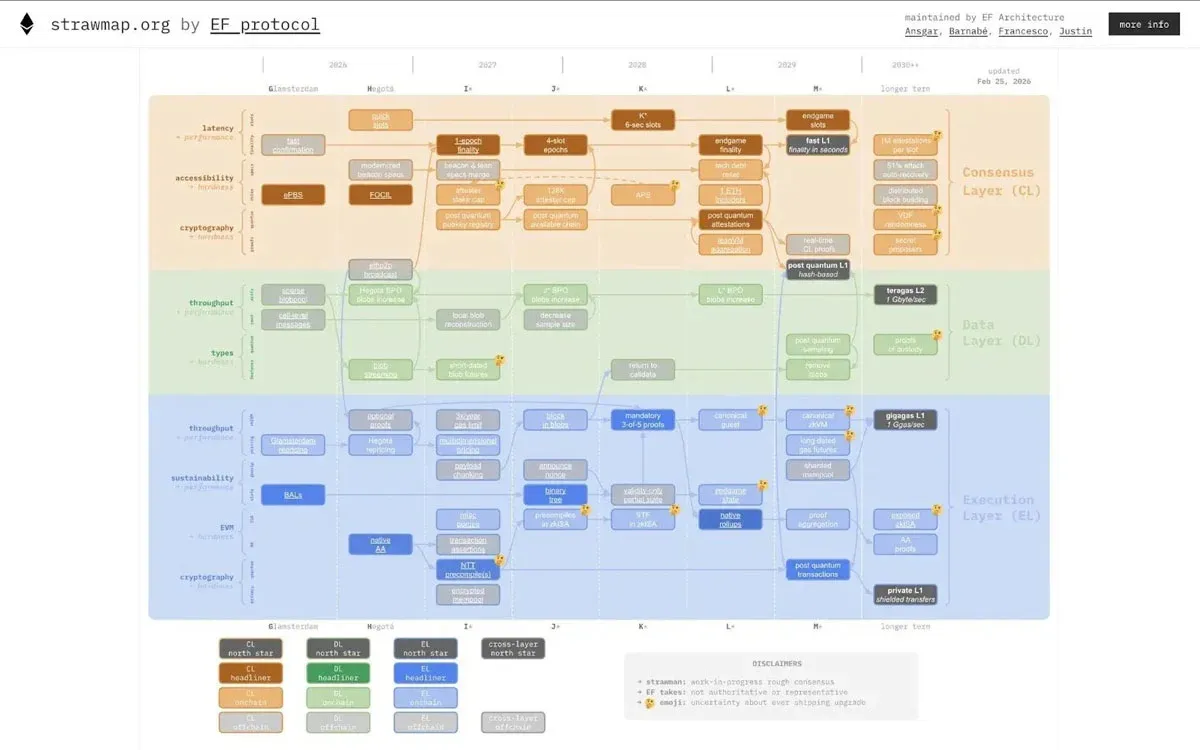
On February 25, Ethereum Foundation researcher Justin Drake publicly released a roadmap sketch named Strawmap, outlining the upgrade blueprint for Ethereum L1 over the next several years. The document lists five “North Star” objectives: ultimate L1 performance, L1 gigagas throughput, L2 teragas scaling, post‑quantum L1 security, and native L1 privacy transfers. The quantitative goals are explicit: L1 should process 10,000 transactions per second (TPS), while L2 should handle 10 million TPS.
The implementation path is expected to consist of seven hard forks, each roughly six months apart, covering systematic changes across the consensus, data, and execution layers. Vitalik Buterin expressed full support for this roadmap and, over the past two weeks, has dissected each key technology in a series of long‑form posts.
Strategic Focus: L1 Scaling and Execution‑Layer Revamp
1. Short‑Term Goal – Glamsterdam Upgrade
The upcoming Glamsterdam upgrade will introduce Block‑Level Access Lists (BALs), enabling parallel verification and breaking the bottleneck of strictly sequential processing. At the same time, the native Enshrined Proposer‑Builder Separation (ePBS) will be fully deployed, improving node utilisation of the 12‑second slot window.
2. Long‑Term Scaling Pillars – ZK‑EVM and Blob
- ZK‑EVM: The plan is to pilot ZK‑EVM clients with a small set of validators by the end of 2026, then gradually expand coverage and harden security starting in 2027. The ultimate aim is a “3‑of‑5 mandatory multi‑proof mechanism,” meaning each block must be validated by at least three out of five independent proof systems to become finalised.
- Blob: On the data‑layer side, PeerDAS (Data Availability Sampling) will continue to evolve, targeting an availability rate of roughly 8 MB/s. This technology allows nodes to download only a tiny fragment set while still being able to verify the whole block, boosting throughput and lowering hardware requirements. Simultaneously, the Ethereum mainnet will start writing block data directly into Blob space, replacing the costly, permanently stored calldata model and fundamentally re‑architecting the data‑carrying structure.
3. Execution‑Layer Overhaul – Binary State Tree Replaces Classic EVM
Vitalik points out that about 80 % of proof‑efficiency bottlenecks stem from the legacy architecture. According to EIP‑7864, migrating the current hexadecimal Keccak Merkle‑Patricia Trie (MPT) state tree to a binary state tree can shorten branch lengths by roughly a factor of four, delivering the following benefits:
- Bandwidth Cost: Reduced by about four‑fold, a qualitative leap for light clients such as Helios.
- Proof Speed: Leveraging BLAKE3 can accelerate verification by roughly three times; using a Poseidon variant could potentially yield improvements on the order of a hundred‑fold.
- Access Optimisation: Introducing “pages” of 64‑256 slots means that when a DApp reads or writes adjacent data, each transaction can save roughly 10,000 Gas.
A further ambition is VM migration: most ZK proof systems are currently written for RISC‑V. If the EVM runs directly on RISC‑V, the translation overhead between two virtual machines disappears, dramatically increasing overall provability. The migration path is divided into three steps:
- Let the new VM first host existing pre‑compiled contracts;
- Open the door for users to deploy new VM contracts themselves;
- Ultimately rewrite the EVM itself as a smart contract that runs on the new VM.
This approach maintains backward compatibility; the final conversion would only require a recalibration of Gas fees.
Post‑Quantum Threat Roadmap: Plugging Four Major Technical Weaknesses
In his extensive article, Vitalik identifies four quantum‑vulnerable points in Ethereum today and proposes corresponding remediation strategies:
- Consensus Layer – BLS Signatures
Proposes Lean consensus (精简共识…
*The article continues beyond this excerpt.*
---
Global‑Market Notes
- When dealing with fiat on‑ramps or off‑ramps, users in most jurisdictions can typically use USD transfers via SEPA (for Euro‑zone countries) or SWIFT.
- U.S. residents must use Binance.US or another U.S.-licensed exchange for regulatory compliance; the global Binance platform is not available to them.
- Crypto‑related gains may be taxable in your local jurisdiction. Please consult a qualified tax professional to understand your obligations.
💡 Register on Binance with referral code B2345 for the maximum trading fee discount. See Binance complete guide.
⚠️ Risk Disclaimer: Crypto prices are highly volatile. This is not investment advice.



