 Bitaigen Research
 We organize the core concepts of Ethereum in this article, covering everything from the principles of public‑ and private‑key wallets to hands‑on steps on major trading platforms, helping beginners get started smoothly. We also briefly explain the value of smart contracts and the upcoming ETH 2.0 upgrade, giving you a holistic view of the Ethereum ecosystem. If you want to dive deeper into purchase details and technical outlook, keep reading.
How to Purchase Ethereum (ETH)
Before you start using Ethereum, you first need a wallet capable of managing public and private keys.
- Public key: This works like an email address for crypto. Anyone can send ETH or Ethereum‑based tokens (such as USDC, Dai) to this address.
- Private key: Comparable to a login password—never share it. A private key is usually a long alphanumeric string and can also be presented as a mnemonic phrase. Losing it means permanently losing the assets stored on‑chain.
- Wallet: Beginners can open a custodial wallet directly in the Coinbase App (or at coinbase.com); the platform safeguards the private key on your behalf. As you become more comfortable, you may consider a non‑custodial solution better suited for DeFi, such as a hardware or software wallet that can interact with protocols like Compound or Uniswap.
Steps to Buy ETH on Binance
Note for U.S. residents: Use Binance.US instead of the global Binance platform.
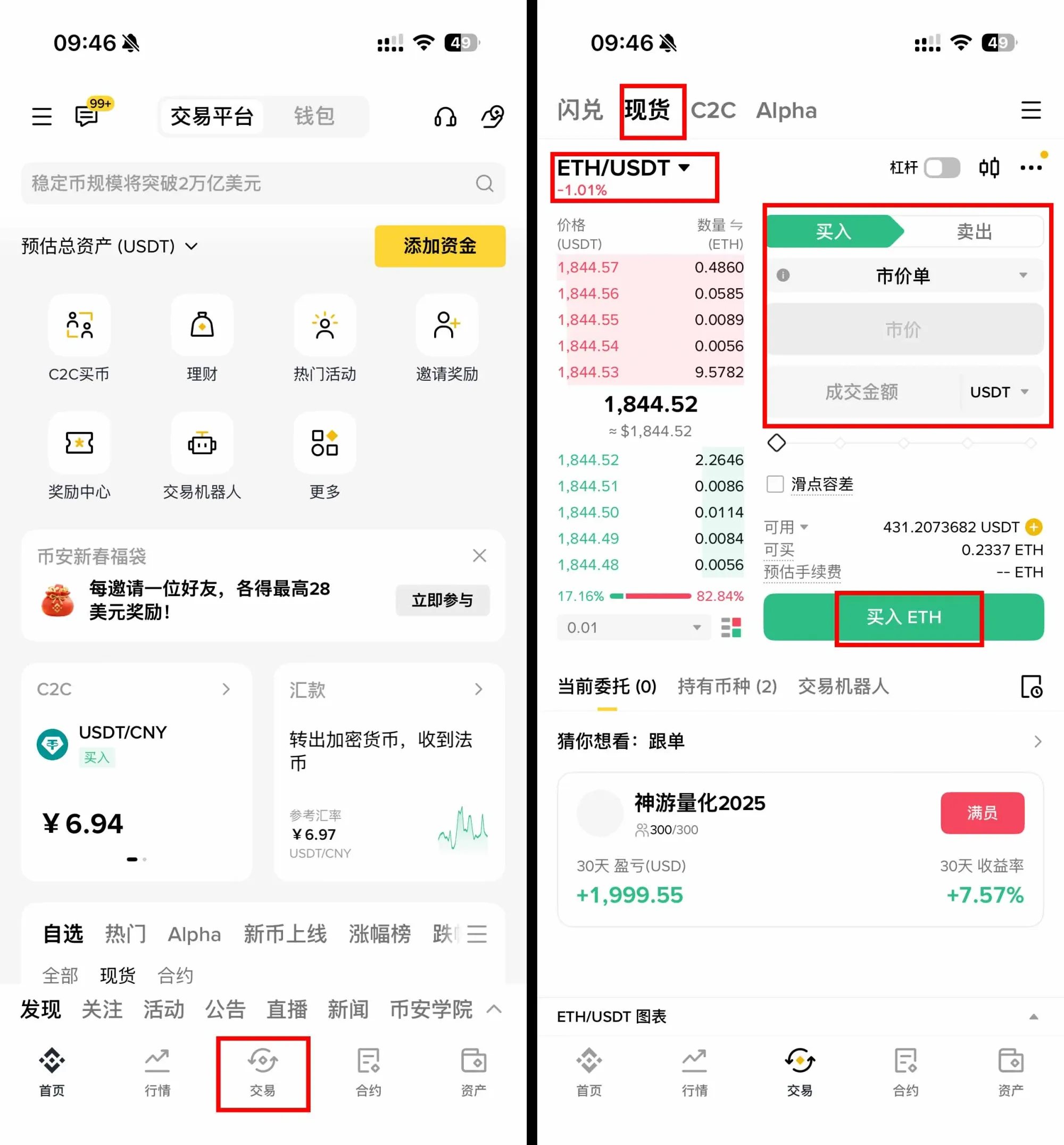
- Launch the Binance app and tap the Trade tab at the bottom.
- Switch to the Spot trading area at the top of the page.
- In the upper‑left search box, type the trading pair ETH/USDT and select it.
- In the Buy section below, choose either a Market Order (executed instantly) or a Limit Order (you set the price).
- Enter the amount of USDT or ETH you wish to purchase, confirm, and then tap Buy ETH to complete the transaction.
Fees and Caveats
- Spot trading fees: Market orders (Taker fees) are generally higher than limit orders (Maker fees), but they fill faster.
- Slippage risk: During periods of high volatility, the execution price of a market order may differ from the quoted price. For large purchases, consider splitting the order or using a limit order to control the price.
- Funding costs: Buying with a credit card incurs higher fees but offers instant settlement; bank transfers (SEPA, SWIFT, or local ACH) or fiat deposits followed by spot trading usually have lower fees.
- Withdrawal fees: Sending ETH to a personal wallet incurs an on‑chain gas cost, which can spike when the network is congested.
- Account security: Enable two‑factor authentication (2FA), avoid clicking unknown links, and never share verification codes with anyone.
---
What Is Ethereum?
Ethereum is the second‑largest cryptocurrency by market capitalization, trailing only Bitcoin, and it also serves as a decentralized global computing platform. Since its launch in 2015, its core purpose has never been limited to being a digital currency; instead, it provides an open blockchain environment where developers can deploy a wide variety of applications—from financial tools and games to complex database systems—with virtually no upper bound. The Ethereum Foundation has stated: “Ethereum can be used to code, decentralize, protect, and trade anything.”
- The network’s official name is Ethereum, and its native token is called Ether (ETH). In everyday conversation, people often refer simply to “ETH” or “Ethereum.”
- Besides acting as a medium of value transfer, ETH fuels the network: users must pay gas when executing smart contracts, giving ETH a unique utility role within the ecosystem.
If Bitcoin is often likened to “digital gold,” then Ethereum resembles “digital oil,” providing the energy that powers countless blockchain‑based services.
---
How Ethereum Operates
The Ethereum blockchain is more than a ledger; it functions like a massive distributed supercomputer composed of thousands of nodes worldwide. Each node runs the Ethereum Virtual Machine (EVM), which interprets and executes smart‑contract code. Network security and consensus rely on two intertwined layers:
- Transaction records – analogous to a bank’s ledger, recording every transfer and contract call.
- Computational layer – developers can deploy any program on‑chain, from decentralized finance (DeFi) protocols to supply‑chain management tools; all logic runs inside the EVM.
When users interact with the chain, they must pay gas in ETH. Network congestion directly influences gas prices, which can fluctuate rapidly.
---
Overview of Smart Contracts
The concept of a smart contract was first introduced in the 1990s by computer scientist and lawyer Nick Szabo. Szabo illustrated the idea with a vending machine: after you insert a coin, the machine automatically delivers the product according to preset rules, or returns the coin if the item is out of stock. Blockchain smart contracts work the same way—code automatically executes once predefined conditions are met, without a third‑party intermediary.
On Ethereum, every decentralized application (dApp) is built on top of smart contracts. Their security depends on the quality of the code written by developers; although the source is public, vulnerabilities can still lead to asset loss. Therefore, before using any dApp, you should verify that it has undergone thorough audits and conduct your own risk assessment.
---
Ethereum’s Security
Today’s Ethereum network secures itself through a Proof‑of‑Stake (PoS) consensus mechanism, which we will detail in the next section.
The decentralized nature of blockchain means the system does not rely on a single authority; the core software is open‑source, allowing cryptographers worldwide to audit the code at any time. This openness provides a strong foundation for overall security. By contrast, the safety of an individual dApp hinges on its development team’s expertise, so users should always review audit reports and community feedback before interacting.
---
Ethereum 2.0 (ETH2) and Proof‑of‑Stake
Why Upgrade?
Ethereum 1.0 originally used Proof‑of‑Work (PoW)—the same consensus as Bitcoin—where miners expend large amounts of computational power to solve mathematical puzzles and create blocks. While PoW secures the network, it brings several drawbacks:
- Transaction bottlenecks – fees surge when the network is congested.
- Energy consumption – massive global hash power translates into high electricity usage.
- Throughput limits – a new block is generated roughly every 30 seconds; although faster than Bitcoin’s 10‑minute block time, it still struggles under heavy load.
To overcome these constraints, in September 2022 Ethereum completed the transition to Ethereum 2.0, replacing PoW with PoS and merging the original chain with the new beacon chain.
How Does Proof‑of‑Stake Work?
In a PoS system, validators are chosen not by computational race but by the amount and duration of ETH they lock up in a staking pool. The process unfolds as follows:
- Staking – Users deposit ETH into a designated staking contract, becoming collateral for a validator.
- Selection – The protocol randomly selects validators to propose and attest to new blocks, weighted by the size and age of each validator’s stake.
- Validation – Chosen validators sign the new block and broadcast it; other validators then confirm its validity.
- Reward distribution – All participating validators share newly minted ETH rewards proportionally to their stake.
This model delivers higher efficiency, dramatically lower energy usage, and theoretically stronger security.
---
The Value Proposition of Ethereum
From a macro perspective, ETH’s price, like any other asset, is determined by global supply and demand dynamics and reacts continuously to buying and selling pressure from investors worldwide. Compared with fiat currencies or mature equities, ETH exhibits greater volatility because it remains in the early stages of technological innovation.
More importantly, ETH serves as the foundational layer for stablecoins, DeFi platforms, and countless dApps. As the user base of these applications expands, network utilization rises, leading to higher total gas consumption. This increasing demand for block space is a key driver behind ETH’s market‑cap growth.
Tax reminder: Crypto gains may be taxable in your jurisdiction. Consult a local tax professional to understand your obligations.
---
Closing Thoughts
This article has walked through Ethereum’s basic concepts, purchase procedures, technical underpinnings, the latest ETH 2.0 upgrade, and the Proof‑of‑Stake mechanism, providing a systematic overview of the world’s second‑largest crypto asset. To explore further, you can search for historical pieces from Bitaigen or follow the related links below. We look forward to exploring more possibilities together as the blockchain landscape evolves.
💡 Register on Binance with referral code B2345 for the maximum trading fee discount. See Binance complete guide.



