
 Bitaigen Research
 The Bitaigen editorial team notes that with U.S. regulators approving an Ethereum spot ETF, investors will gain a brand‑new avenue for trading. This article examines the ETF’s listing date, the mainstream brokerage channels, as well as the funds’ operational mechanics and risk safeguards, helping readers quickly identify the appropriate investment path. For detailed order‑placement steps and key risk considerations, keep reading.
When Will Ethereum Spot ETF Appear on Exchanges?
U.S. regulators have approved the listing of nine Ethereum spot ETFs. The Chicago Board Options Exchange (CBOE) confirmed that on July 23 the first five funds will go live on its platform, namely 21 Shares Core Ethereum ETF, Fidelity Ethereum Fund, Invesco Galaxy Ethereum ETF, VanEck Ethereum ETF, and Franklin Ethereum ETF. The remaining four are slated for debut on Nasdaq or the New York Stock Exchange (NYSE) Arca; although official announcements are still pending, market consensus expects them to commence trading concurrently on July 23.
Through Which Channels Can These ETFs Be Purchased?
Virtually all major brokerage firms will provide access to this batch of products. After the listings go live, investors do not need to place orders directly on the exchange; instead, they can buy and sell through familiar brokerage platforms such as **Fidelity, E*TRADE, Robinhood, Charles Schwab, TD Ameritrade**, and others. As long as the platform is connected to Nasdaq, NYSE Arca, or Cboe BZX, the corresponding Ethereum‑ETF ticker will appear in its trading interface.
Core Structure of Spot ETFs and Their Risk Protections
The nine funds share essentially the same underlying architecture: each is launched by a reputable fund manager, the assets are held by a qualified custodian in the form of physical ETH, and professional market makers handle the creation and redemption of shares. To shield retail investors, every product incorporates insurance mechanisms that address brokerage insolvency and cyber‑security incidents.
Fee Comparison: A Key Factor When Choosing
In terms of expense ratios, eight of the ETFs charge 0.15 % – 0.25 % annually, with a single outlier—Grayscale Ethereum Trust (ETHE)—which, due to its distinct fund structure dating back to 2017, carries a 2.5 % management fee.
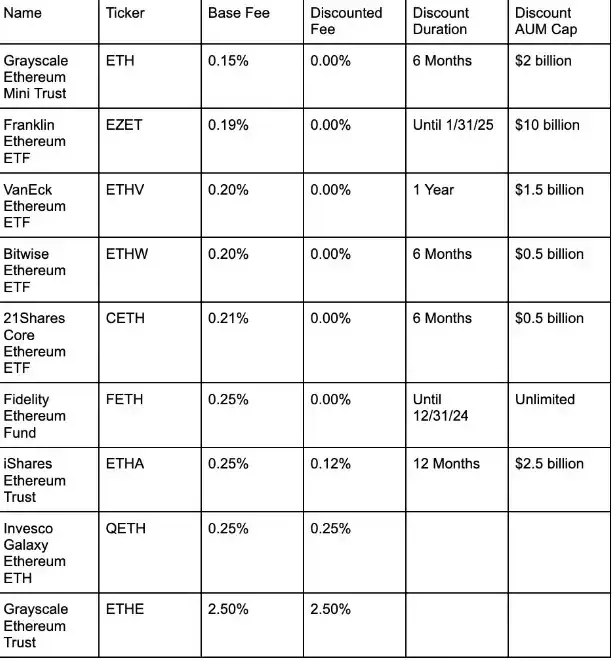
Specific Fee Incentives
- Grayscale Ethereum Trust and Invesco Galaxy Ethereum ETF (QETH) offered fee waivers or reductions during their launch periods to attract early investors.
- Grayscale Ethereum Mini Trust (ETH), a newly created ETF‑style vehicle, charges only 0.15 % management fee and waives the fee entirely for the first six months after listing or until assets under management (AUM) reach $2 billion.
- Franklin Ethereum ETF (EZET) carries a 0.19 % expense ratio, the second‑lowest among its peers, and will also forgo fees until January 2025 or until AUM reaches $10 billion, whichever comes first.
Will Staking Be Integrated Into Spot ETFs?
The short answer is no, although the industry continues to explore possible pathways. Staking involves depositing ETH into validator nodes on the Ethereum Beacon Chain to earn network fees and block rewards. While staking can generate roughly 3.7 % annualized yield (according to StakingRewards.com data as of July 19), it also carries the “slashing” risk that arises from validator misbehavior.
Earlier this year, issuers such as Fidelity, BlackRock, and Franklin Templeton submitted applications to regulators seeking permission to embed staking within their spot ETFs, but the SEC rejected all proposals. Industry insiders point to liquidity as the primary hurdle: ETH that is staked on the Beacon Chain typically requires several days to be withdrawn, which would impede an ETF’s ability to meet redemption requests promptly.
There are reports that issuers are attempting to mitigate the issue by maintaining a “liquidity buffer” of unstaked ETH, but such solutions are expected to take several more months before they can be implemented. Consequently, in the near term Ethereum spot ETFs will not offer direct staking capabilities.
Closing Remarks
The foregoing constitutes the Bitaigen editorial team’s concise guide to purchasing Ethereum spot ETFs. We hope it proves useful for investors planning to enter the market on July 23. Wishing you a smooth investing experience!

Related Reading
- Ethereum ETF Guide: Spot & Futures Funds After SEC Approval
- Bitcoin Pseudo‑Staking: 5 Ways to Earn Passive Income
- BTC & Crypto Investment: Short, Medium & Long-Term
💡 Register on Binance with referral code B2345 for the maximum trading fee discount. See Binance complete guide.
⚠️ Risk Disclaimer: Crypto prices are highly volatile. This is not investment advice.



