
 Bitaigen Research
SB 314 expands Florida’s money‑services business regulations to explicitly include payment‑type stablecoins. Issuers must comply with existing financial regulatory requirements, and it is prohibited to conduct stablecoin activities without a proper license.
At the same time, lawmakers have finalized a regulatory framework for payment stablecoins operating within the state and have submitted the draft to Governor Ron DeSantis. The bill will become effective once the governor signs it.
Samuel Arms, founder of the Florida Blockchain Business Association, disclosed on X that Senate Bill 314 received unanimous approval in the Senate. The bill will become state law after DeSantis’ signature, and Arms expects the governor to complete the signing process within the next month.
“The bill has cleared both the Senate and the House; DeSantis will sign within 30 days!” he wrote on X.
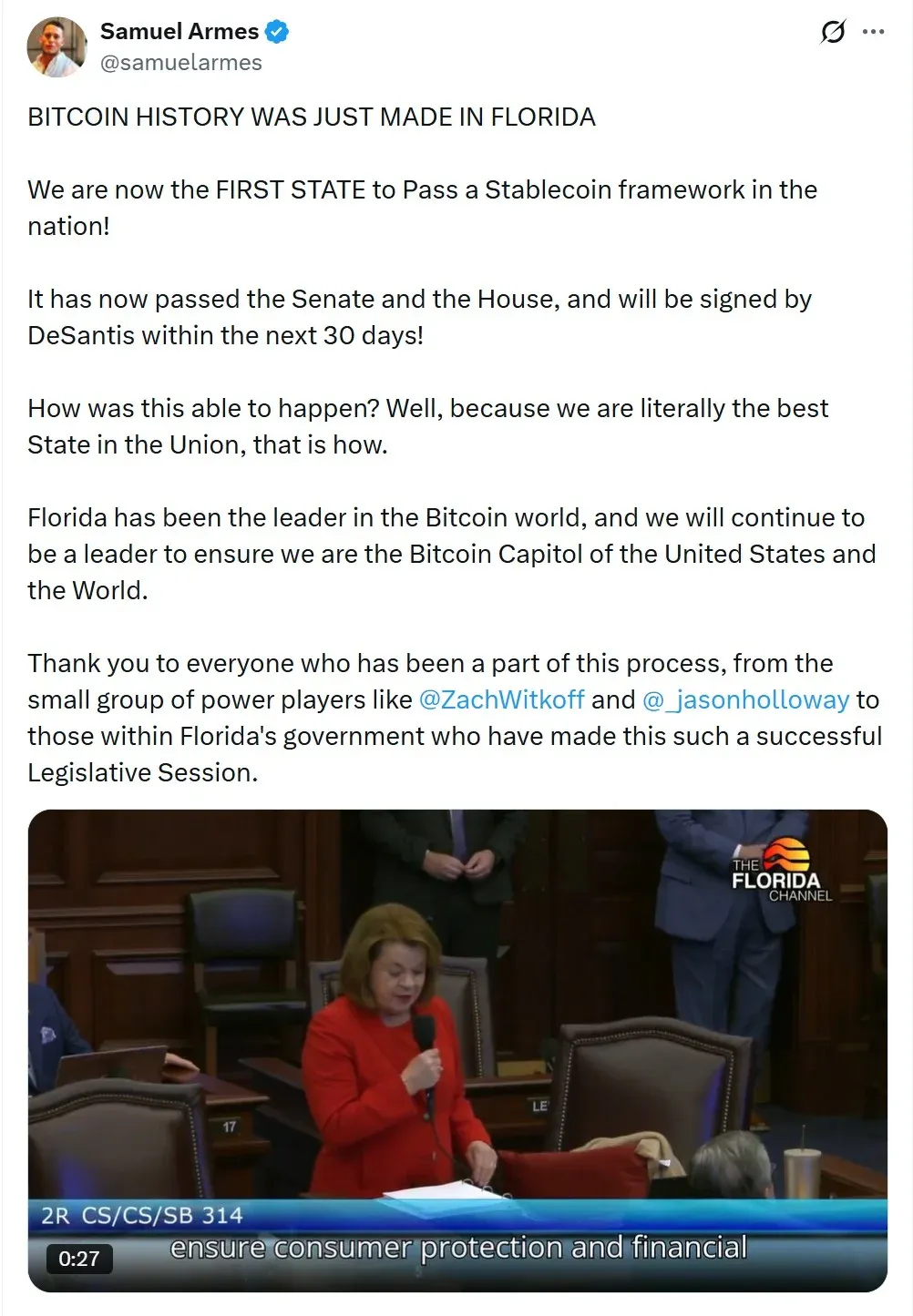
The Florida Senate has officially approved this stablecoin legislation. Source: Samuel Arms
The ordinance provides concrete regulatory guidance for issuers of payment stablecoins operating in Florida. It aligns with the House‑passed HB 175, adding consumer‑protection and financial‑oversight standards that are consistent with the federal Innovation Act that took effect in July of this year.
In this article we outline the latest stablecoin legislative framework passed by the Florida Senate, break down the key requirements for issuing and regulating payment‑type stablecoins, and discuss the potential impact on the state’s blockchain ecosystem. The full text will give you a comprehensive view of policy direction and help you gauge subsequent market developments. Please continue reading.
Florida Bill Revises Anti‑Money‑Laundering Law to Include Stablecoins
Under SB 314, Florida’s Money Services Business AML Act will be amended to expressly list stablecoins as a regulated asset class. The revised statute requires issuers to fulfill the same financial‑compliance obligations that already apply to traditional money‑services businesses, and it strictly forbids any unlicensed issuance of stablecoins within the state. The bill also clarifies that certain payment‑type stablecoins should not be treated as securities.
For issuers headquartered outside of Florida, a formal filing with the Florida Office of Financial Regulation (OFR) is required before commencing any business activities in the state. Supervision will be tailored to the issuer’s organizational structure: some issuers will fall entirely under OFR oversight, while others will be jointly supervised with the state’s Office of the Comptroller.
The law also touches on the potential risks associated with incentive mechanisms tied to stablecoins. If federal regulations prohibit the distribution of such incentives to token holders, qualifying issuers will likewise be barred from offering the related payments.
Florida Re‑examines State Crypto‑Investment Legislation
In October of last year, state legislators revived the agenda of allowing public investment in crypto assets. HB 183, introduced by Republican Representative Webster Barnaby, would permit the state government and certain public institutions to allocate up to 10 % of their portfolios to digital assets. The revised proposal expands the scope beyond plain‑vanilla Bitcoin to include exchange‑traded crypto products, crypto securities, non‑fungible tokens (NFTs), and other blockchain‑derived derivatives.
HB 183 is essentially an updated version of the earlier HB 487, which was withdrawn in June after failing to advance out of the House Operations Subcommittee.
---
The above summarizes the main components of the state‑level stablecoin legislation passed by the Florida Senate. It still awaits formal signing by Governor Ron DeSantis. For ongoing updates on Florida’s stablecoin regulatory developments, stay tuned to Bitaigen’s (BitGen) coverage.
*Note: U.S. residents who wish to trade cryptocurrencies should use Binance.US rather than the global Binance platform.*
*All fiat references are understood to be in United States Dollars (USD); cross‑border transfers may use SEPA or SWIFT networks where applicable.*
💡 Register on Binance with referral code B2345 for the maximum trading fee discount. See Binance complete guide.
⚠️ Risk Disclaimer: Crypto prices are highly volatile. This is not investment advice.



