
 Bitaigen Research
 We start from a panoramic view of the industry, dissecting Gate’s inaugural rollout of TradFi trading functionality, its architectural implementation, and the potential impact on the convergence of traditional finance and crypto assets. We also evaluate the user experience of handling precious metals, foreign exchange, stocks and other instruments on a single platform. This article helps readers grasp the logic and risk considerations behind this pivotal shift and is worth a read.
Industry Trends: From Independence to a Integrated Financial Landscape
Traditional financial institutions’ growing focus on crypto assets is driven by clear economic incentives. In recent years, digital currencies have built a self‑contained liquidity network, derivatives market, and settlement system, forming an ecosystem that runs parallel to conventional finance.
For legacy exchanges, continuing to treat this domain as a peripheral spectator means forfeiting substantial trading volume and fee revenue, and relinquishing the proactive role in providing investors with a full suite of financial tools.
---
Asset Classes Supported by Gate TradFi
To meet increasingly diverse demand, Gate’s TradFi module integrates a wide range of globally mainstream assets in one go, allowing users to execute contract‑for‑difference (CFD) trades on the following underlyings through a single app:
- Precious Metals: e.g., XAU/USDT (gold)
- Foreign Exchange: major currency pairs such as EUR/USD, USD/JPY
- Stock CFDs: FAANG stocks and other selected technology‑sector equities
- Global Indices: S&P 500, NASDAQ 100, FTSE 100, etc.
- Commodities: crude oil, copper, platinum and more
---
Technical Implementation and Core Mechanics
Gate TradFi’s underlying architecture is built on the mature MetaTrader 5 (MT5) platform, with user account information and trade records synchronized in real time between the Gate app and the MT5 client.
All contracts use USDx as the margin and accounting unit. USDx is neither a fiat currency nor a cryptocurrency; it is an internal ledger token designed exclusively for TradFi assets and is pegged 1:1 to USDT.
Regarding trading rules, TradFi products follow the conventional market sessions and holiday schedules, with leverage offered in fixed tiers that users cannot adjust themselves. Platform fees start at $0.018, while foreign‑exchange and index products can be traded with up to 500× leverage, and stock CFDs up to 5×.
---
Step‑by‑Step Guide: How to Trade TradFi on Gate
- Register and Log In
- Create an account via the official registration link below or by downloading the app.
- Follow the video tutorial to complete identity verification and fund your account.
- Enter the TradFi Section
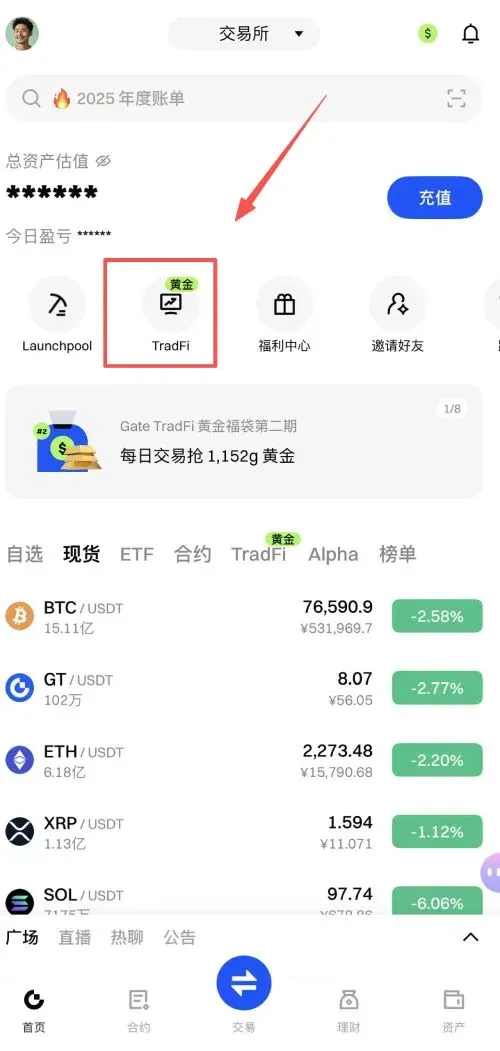
- Tap “TradFi” in the navigation bar of the Gate app; a service agreement will pop up for you to read and acknowledge.
- Activate a TradFi Account
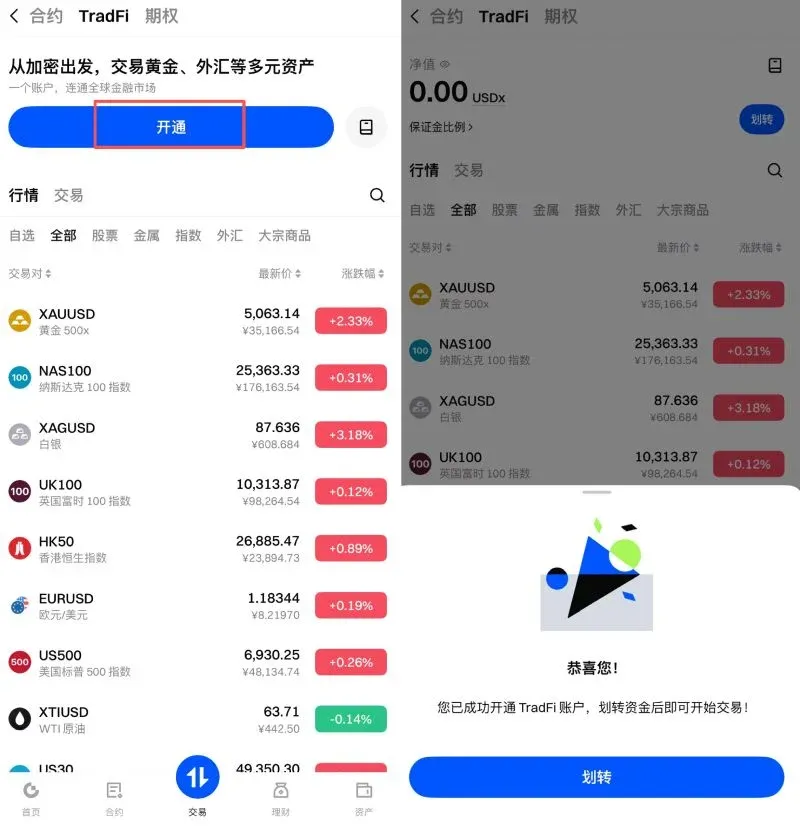
- Follow the on‑screen prompts to activate the relevant account.
- Transfer Funds
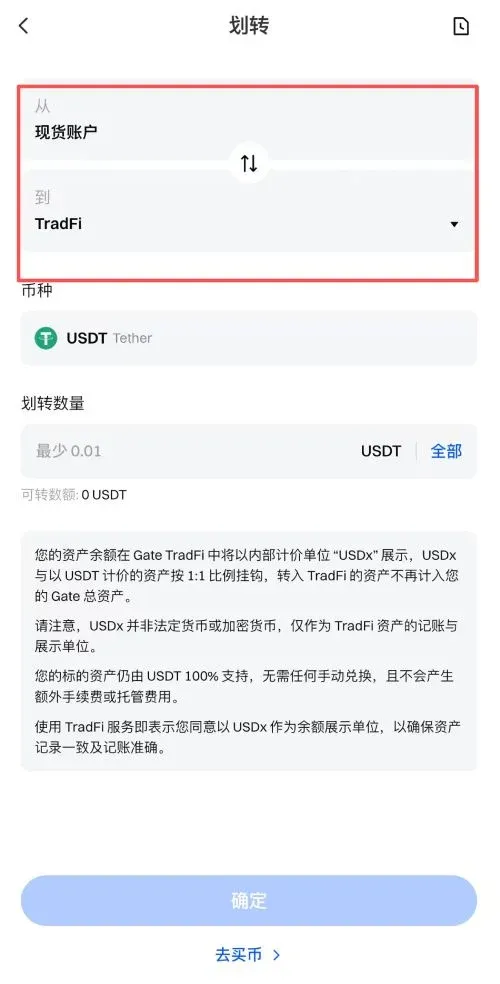
- Move existing USDT (or other spot‑account assets) into the TradFi account; the system will automatically display the balance in USDx.
- Place an Order
- Select the desired underlying, then on the order page you will see contract specifications, current leverage, required margin and the estimated liquidation price.
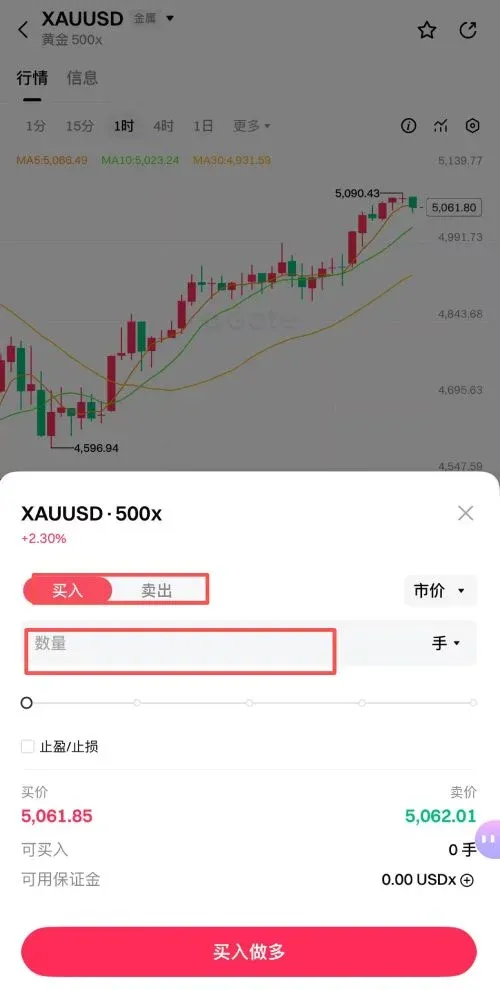
- Manage Positions
- Gate uses MT5 as its matching engine; you can view account overviews and trade history in real time via the app or the MT5 client. To close a position, simply execute an opposite‑direction order.
---
Strategic Significance for the Gate Ecosystem
Since its founding in 2013, Gate has served 48 million users, listed over 4,300 cryptocurrency pairs, and holds roughly $9.478 billion in excess reserves.
The addition of TradFi assets expands the product matrix across chains and asset classes, enabling users to manage both crypto and traditional‑finance positions from a single interface, dramatically simplifying asset allocation and risk‑control workflows.
From acquisition and retention perspectives, this feature is expected to attract professional traders, institutional clients, and retail investors who are active in both digital and conventional markets and who seek diversified portfolios.
---
Far‑Reaching Implications for the Crypto Industry
Gate’s TradFi launch could become a watershed moment, signalling that crypto platforms are beginning to adopt mature financial‑market rules for product design and risk management.
As more exchanges introduce traditional assets, liquidity bridges between the two markets will become smoother and price‑discovery mechanisms more efficient.
Regulatory-wise, the move aligns with global supervisors’ expectations for deeper integration of crypto and traditional finance; shifting part of the business to a model resembling conventional exchanges facilitates the application of existing regulatory tools.
In terms of market structure, the line between single‑asset crypto exchanges and emerging multi‑asset platforms will gradually blur, reshaping competitive dynamics across the sector.
---
Practical Tips and Opportunities for Traders
- Margin and Liquidation: Gate employs a margin‑ratio‑based liquidation system; when the account’s margin ratio falls below 50 %, an automatic forced liquidation is triggered.
- Fee Structure: TradFi contracts incur funding rates and overnight financing fees, which differ from the fee model of perpetual contracts; traders should keep these costs in mind.
- Referral Rewards: New users who complete registration can receive up to 110 USDT in trial credit, and meeting trading thresholds may unlock staged incentives totalling 3,000 USDT.
---
Ideal User Profiles
- High‑Frequency / Arbitrage Traders: With 500× leverage and millisecond‑level execution, users can rapidly capture arbitrage opportunities between crypto volatility and macro events (e.g., non‑farm payrolls, interest‑rate decisions), achieving 24/7 strategy coverage.
- Asset Allocators: During crypto market pullbacks or periods of high volatility, traders can swiftly shift to gold, FX or other traditional safe‑haven assets to dynamically rebalance portfolios.
- Crypto‑First Investors Wanting to Skip Traditional Brokerage Onboarding: Holding USDT or BTC alone enables direct participation in global financial markets without additional fiat‑conversion steps, SEPA/SWIFT transfers, or cumbersome broker account opening procedures. (U.S. residents should use Binance.US for fiat on‑ramps.)
---
Risks and Precautions
- High‑Leverage Risk: Some TradFi contracts allow up to 500× leverage; even minimal price movements are magnified hundreds of times. Continuous monitoring of margin levels is essential to avoid liquidation due to insufficient equity.
- Trading‑Hour Discrepancies: Traditional markets are influenced by central‑bank rates, non‑farm payroll data, geopolitical events, and observe weekend and holiday closures, which can cause opening gaps. This demands higher financial literacy from crypto traders accustomed to 24‑hour markets.
- Extreme Liquidity Scenarios: In black‑swans or other stress events, liquidity may evaporate, leading to widened spreads, slippage, or even negative balances. Selecting a compliant platform with robust risk‑control mechanisms is a prerequisite for safeguarding assets.
---
Challenges and Opportunities on the Integration Path
As the boundary between crypto and traditional finance continues to fade, platforms face several key challenges:
- Technical Integration: Delivering a seamless trading experience across disparate asset classes, unified account management, and consistent risk controls requires a powerful backend infrastructure.
- Compliance Complexity: Expanding into more conventional financial domains obliges the platform to satisfy regulatory requirements across multiple jurisdictions, demanding ongoing monitoring of legal developments and timely adjustments.
- Innovation vs. Risk Balance: While catering to diverse user demands, product design must avoid introducing excessive risk, preserving a stable operational model.
Conversely, these challenges open avenues for platforms to broaden revenue streams, increase user stickiness, and carve out differentiated competitive advantages in a crowded market.
---
Outlook
The official launch of Gate TradFi marks a significant milestone for the veteran exchange with 12 years of history. Users can now fluidly switch between 4,300+ crypto tokens and major traditional‑finance instruments, achieving a truly multi‑asset trading experience.
When the account dashboard simultaneously displays Bitcoin price movements and a gold CFD position, the barrier between traditional finance and crypto assets has essentially vanished.
This article concludes here. For more tutorials on Gate TradFi’s features, search the Bitaigen (比特根) archive or follow the related links below. Thank you for following and supporting Bitaigen (比特根)!
*Note: Depending on your jurisdiction, gains from cryptocurrency trading may be subject to tax. Please consult local tax regulations or a professional advisor.*
Related Reading
- How to Configure Binance C2C Payment Methods in 2026
- OKX China 2026: Register, Download App, Buy USDT, Trade
- How to Sell Ethereum on Binance Spot Market: Order Types Explained
💡 Register on Binance with referral code B2345 for the maximum trading fee discount. See Binance complete guide.
⚠️ Risk Disclaimer: Crypto prices are highly volatile. This is not investment advice.



