
 Bitaigen Research
From an industry‑wide perspective, we break down the core functions and entry requirements of HashKey Launchpool, and assess the yield characteristics of its staking‑mining model. The article also examines the platform’s security‑compliance mechanisms and flexible asset‑management options, helping newcomers get started quickly while keeping risk under control. If you want to know whether it’s worth a try, keep reading.
Why Choose HashKey Launchpool?
For users who are just stepping into the crypto space, HashKey Launchpool offers several attractive features:
- Low entry barrier – No need for large capital outlays or specialized mining hardware; a few simple staking steps are enough to join.
- Relatively stable returns – Reward rates set by different projects can deliver appreciable yields to participants.
- Operational flexibility – Staked assets can be withdrawn at any time, allowing investment strategies to be adjusted on the fly.
- Asset safety – HashKey Global operates under global regulatory licences and adheres to strict compliance standards, helping users protect their holdings.
When staking stablecoins such as USDT, the activity is generally viewed as a relatively low‑risk way to earn yield.
It is worth noting that the regulatory frameworks governing most crypto exchanges are still evolving. Investors should assume their own risk and are encouraged to verify an exchange’s reserve status through data providers such as CoinMarketCap.
What Is HashKey Launchpool?
HashKey Launchpool is built by HashKey Global as a staking‑mining service platform that assists newly launched crypto projects in quickly gathering capital and users. Participants simply lock up existing crypto assets (e.g., USDT, ETH, etc.) and receive the corresponding project tokens as rewards before the official token issuance. This model lets investors gain early‑stage exposure and extra earnings without having to purchase the new tokens outright.
Yield Rates on HashKey Launchpool
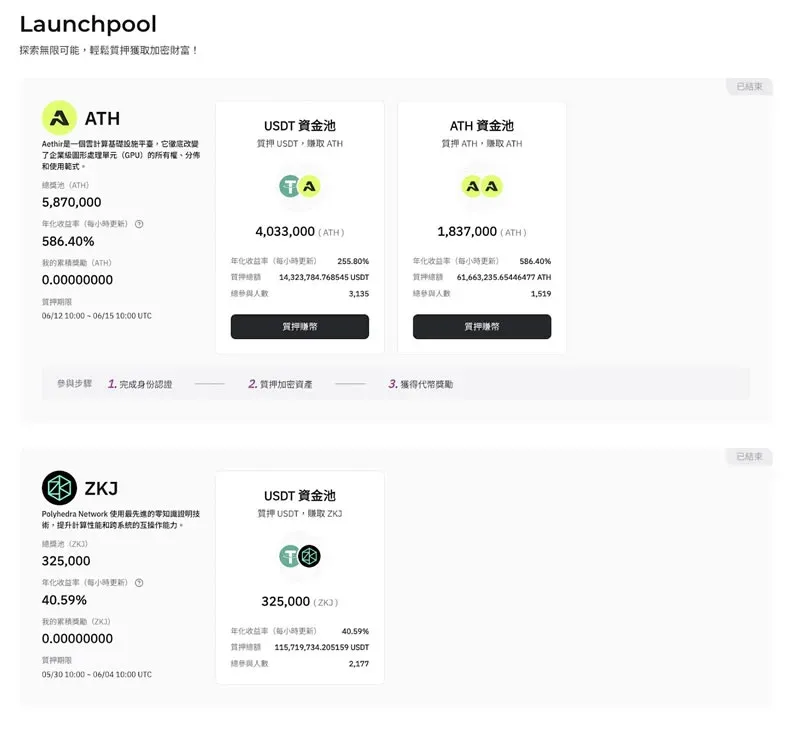
Since its launch, the platform has attracted a relatively modest number of participants, which makes the annualized returns of some projects appear especially high. Below are the overall yield figures from two separate Launchpool campaigns:
- Polyhedra Network (ZKJ)
- Campaign period: May 30 – June 4 2024
- Reward pool: 325,000 ZKJ ≈ $500,000 USD
- Annualized return: 40.59 %
- Aethi (ATH)
- Campaign period: June 12 – June 15 2024
- Reward pool: 5,864,000 ATH
- USDT‑denominated pool annualized return: 255.80 %
- ATH‑denominated pool annualized return: 586.40 %
How to Use HashKey Launchpool
The participation workflow is straightforward and consists of the following steps:
1. Open an account and complete KYC
Register on the HashKey Global website and follow the prompts to finish identity verification (including address verification). This is a prerequisite for any subsequent staking activity.
2. Prepare eligible tokens
Hold the required amount of the specified token for the project you wish to join (e.g., USDT, ETH, etc.). These assets will be used for staking.
3. Initiate staking
Log in to the Launchpool main page, select a project of interest, and click “Stake to Earn”. After confirming, the system automatically begins accruing interest.
4. Yield calculation
The platform takes a snapshot of every user’s stake every hour and calculates that hour’s reward based on each user’s share of the total pool. Accumulated earnings are settled once every 24 hours and transferred directly to the user’s account.
5. Redeem at any time
There is no lock‑up period for staked assets. Users may click “Redeem” at any moment, and the assets will be returned instantly to their personal wallet.
Users who have already completed verification on the Hong Kong version can log in to the international version directly, but they will still need to undergo a secondary identity check.
Frequently Asked Questions
1. Who can participate?
Anyone who has completed HashKey’s KYC process can access all Launchpool projects on the platform.
2. How are rewards calculated?
Rewards are proportional to the amount you have staked relative to the total pool. Snapshots are taken hourly, and after a 24‑hour period the rewards are settled in a single payout.
3. Is automatic compounding supported?
The platform does not currently offer an auto‑reinvest feature. To compound, you must manually withdraw your earnings and restake them.
4. When can I withdraw my staked assets?
Staked assets are withdrawable at any time. Once you confirm the redemption, the assets are returned to your account instantly.
5. Are there referral rewards?
During an active project, you can generate a personal invitation link. If a referred friend successfully stakes, the inviter receives an additional reward.
Summary
HashKey Launchpool gives investors a low‑threshold pathway to participate in new crypto projects while earning relatively stable returns through staking. The process only requires account verification, holding the appropriate tokens, and clicking a “Stake” button; assets remain liquid and can be withdrawn at any time, making it suitable for newcomers who want to dip their toes into the broader crypto market.
Further Reading
- Binance Launchpool mining guide: new‑token yields, risks, and operational instructions (U.S. users should use Binance.US instead of the global Binance platform)
- OKX Jumpstart overview: yield details and participation steps
- Bybit Launchpool tutorial: opportunities for free‑staking mining
For more practical tips on HashKey staking‑mining, follow the upcoming专题 articles from Bitaigen (比特根).
*Please note that cryptocurrency gains may be subject to tax in your local jurisdiction; consult a tax professional for advice.*
Related Reading
- Boost Binance Launchpool Rewards by Raising Your Lock‑Up
- FRAG Token Launch on Bitget: New‑Coin Mining & Candy Bomb Events
- Bitcoin Hyper (HYPER) Review: Layer‑2 Smart Contracts, Staking & Near‑Instant Lo
💡 Register on Binance with referral code B2345 for the maximum trading fee discount. See Binance complete guide.
⚠️ Risk Disclaimer: Crypto prices are highly volatile. This is not investment advice.



