
 Bitaigen Research
 We provide newcomers with a clear overview of the core concepts behind Ethereum and a step‑by‑step guide to purchasing ETH on Binance. By reading the following sections, you will understand the essential actions from account creation to order placement, enabling a secure entry into Ether investment.
How to Purchase ETH on Binance?
When selecting a trading platform, opting for a well‑known and large‑scale exchange helps reduce counter‑party risk. Below we use the world’s biggest exchange Binance as an example to illustrate the complete workflow—from opening an account to successfully buying ETH.
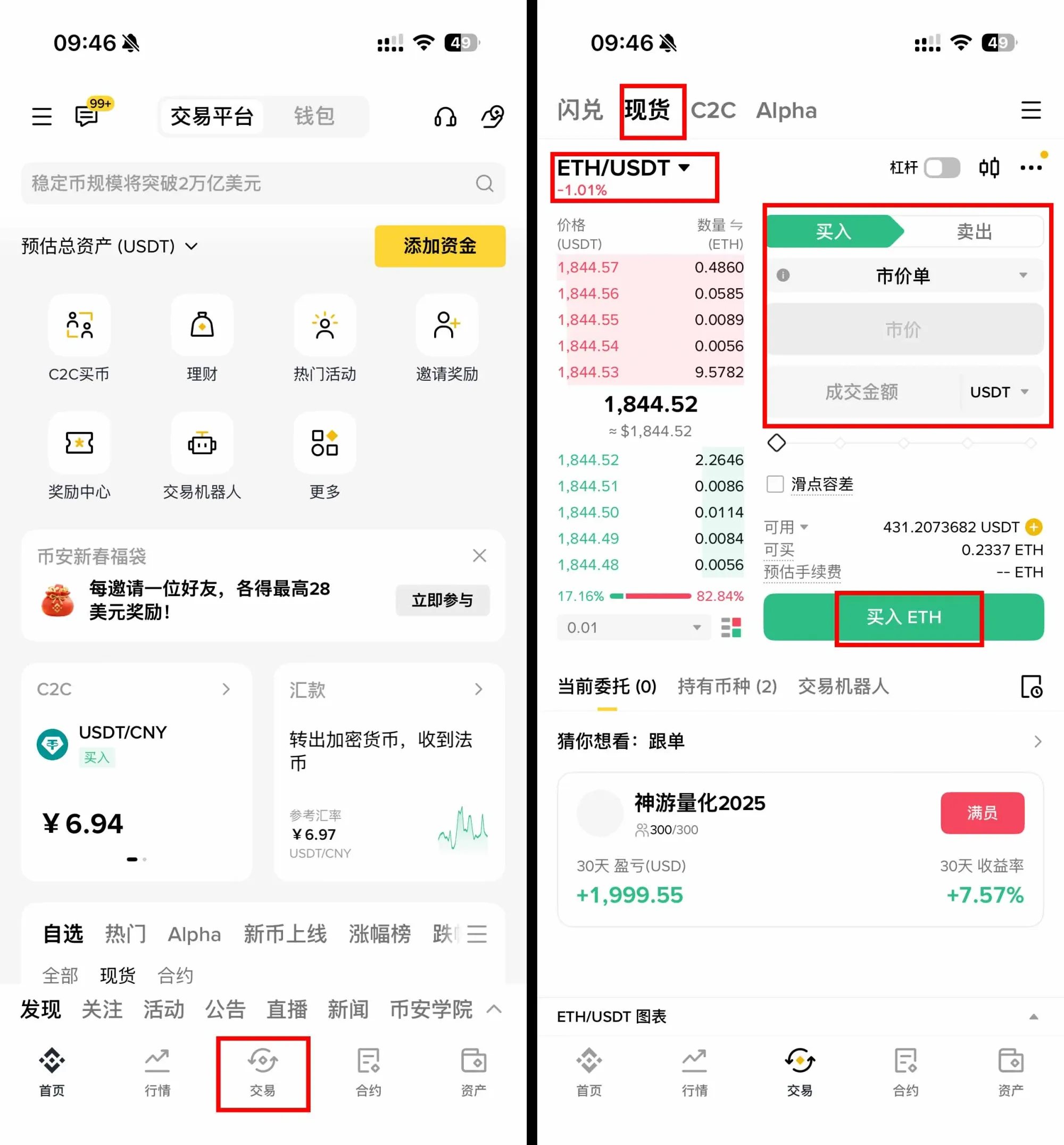
- Open the Binance mobile app and tap the Trade tab at the bottom of the screen.
- Once the page loads, switch to the Spot trading section.
- In the trading‑pair search box at the top‑left, type ETH/USDT and select the pair from the dropdown.
- Scroll down to the Buy area. You can choose a Market Order (executed instantly at the current market price) or a Limit Order (you set a price, and the order fills only when the market reaches that level).
- Enter the amount of USDT you wish to spend or the amount of ETH you want to receive. After confirming that all details are correct, tap Buy ETH to complete the transaction.
Fees and Important Considerations
- Trading fees: Market orders (Taker) and limit orders (Maker) carry different fee rates. Market orders are executed faster but usually cost a bit more.
- Slippage risk: During periods of high volatility, the execution price of a market order may deviate from the quoted price. For large purchases, consider splitting the order or using a limit order to control the price.
- Deposit costs: Credit‑card top‑ups are convenient but come with higher fees. Bank transfers (via SEPA, SWIFT, or local ACH) or fiat‑on‑ramp deposits generally have lower costs before you trade on the spot market.
- Withdrawal fees: If you need to move ETH to a personal wallet, you must pay the on‑chain gas fee, which fluctuates with network congestion.
- Account security: Enable two‑factor authentication (2FA), avoid clicking unknown links, and never share your verification codes or seed phrase with anyone.
- Tax note: In many jurisdictions, gains from the sale or exchange of cryptocurrency are taxable. Consult a local tax professional to understand your reporting obligations.
Important for U.S. residents: Use Binance.US rather than the global Binance platform, as the former complies with U.S. regulatory requirements.
ETH and Ethereum: Conceptual Breakdown
Ethereum is a decentralized blockchain platform launched in 2015 by Vitalik Buterin. It offers a programmable settlement layer that allows assets and financial logic to run directly on‑chain. The native token of the platform is ETH (Ether), which serves both as a medium of exchange and as the “fuel” that powers the network.
An analogy can be drawn to the steam engine and coal during the Industrial Revolution: the steam engine (Ethereum) is the power system itself, while coal (ETH) is the essential energy source. Without ETH, transactions, contract deployments, and all DeFi or NFT activities on the chain would be impossible.
Overview of How Ethereum Works
Once you grasp the high‑level idea of Ethereum, three core components help you understand its internal mechanics: the consensus mechanism, ETH issuance and distribution, and the role of gas fees.
Evolution of the Consensus Mechanism
- Proof‑of‑Work (PoW): In its early years, Ethereum relied on PoW, where miners competed with computational power to package blocks and earned ETH as block rewards. This approach is highly secure but consumes a lot of electricity and tends to centralize around large mining pools.
- Proof‑of‑Stake (PoS): After the 2022 “Merge” upgrade, Ethereum transitioned to PoS. Network participants are now called Validators; they must lock up a certain amount of ETH as collateral to take part in block validation. Successful validation yields staking rewards and a share of transaction fees, while malicious behavior can lead to a partial or total loss of the staked ETH. PoS dramatically reduces energy consumption and aligns network security with the economic interests of token holders.
Beyond validators, the ecosystem includes two additional pivotal roles:
- Developers: They write smart contracts and launch on‑chain applications, earning revenue through protocol fees or native tokenomics.
- Users: They perform transfers, interact with DeFi protocols, buy NFTs, etc., and must pay gas fees for each action.
These three groups form a closed loop: Users pay ETH → Validators receive rewards → Developers create products that attract users → More activity generates additional gas fees.
The Role of Gas Fees
Every on‑chain operation consumes computational resources. Gas is the unit that measures these resources, and the Gas Fee is the amount of ETH a user pays for the consumed gas. The fee consists of two parts:
- Base Fee: An algorithmically determined amount that reflects current network congestion.
- Priority Fee (tip): An optional extra that users can add to incentivize validators to prioritize their transaction. Higher tips usually result in faster inclusion in a block.
This design prevents spam, while the price signal helps order transactions efficiently, keeping the open network functional even under heavy load.
Smart Contracts and DApps
- Smart contracts: Self‑executing code deployed on the blockchain. Their rules are transparent and immutable. For example, in a lending scenario, a contract automatically disburses a loan once sufficient collateral is posted, and it liquidates the position if the collateral value falls below a predefined threshold.
- Decentralized applications (DApps): Front‑ends that look like ordinary apps, but whose back‑end logic resides entirely in smart contracts. Common DApp categories include DeFi, NFTs, GameFi, and DAOs, all benefiting from blockchain’s transparency, immutability, and automatic execution.
Ether vs. Bitcoin: Key Differences
| Comparison Item | Ether (ETH) | Bitcoin (BTC) |
|---|---|---|
| Launch Year | 2015 | 2009 |
| Founder(s) | Vitalik Buterin | Satoshi Nakamoto |
| Supply Model | No fixed cap; issuance is protocol‑controlled and a portion is burned via fees | 21 million cap; block reward halves roughly every four years |
| Consensus Mechanism | PoS (Proof‑of‑Stake) | PoW (Proof‑of‑Work) |
| Primary Positioning | Provides the base layer for decentralized applications; value derives from **utility** | First decentralized cryptocurrency; value derives from **store‑of‑value** and “digital gold” perception |
Investment Value and Potential Risks of Ether
Although ETH’s price swings are often less extreme than Bitcoin’s, many investors still allocate capital when the price appears relatively low, hoping that ecosystem growth will lift its value. Below is a concise analysis of both upside drivers and risk factors.
Value Drivers
- Ecosystem Scale and Network Effects
Ethereum hosts the largest developer community, the most mature DApp ecosystem, and deep liquidity pools. The majority of mainstream DeFi protocols, stablecoins, and NFT marketplaces choose Ethereum or its Layer‑2 solutions as their primary deployment environment. Continuous activity in these applications sustains demand for ETH.
- Diverse Use Cases
- Spot Holding: Long‑term investors who believe in the platform’s future can allocate ETH as a store of value.
- Derivative Trading: Leveraged products allow traders to amplify price movements (note the higher risk).
- Staking: Participants lock ETH to support network security and earn staking rewards.
- DeFi Participation: Supplying liquidity, borrowing, or engaging in yield‑optimizing strategies on platforms such as Uniswap, Aave, or Lido.
Risk Factors
- Ecosystem Migration Risk
Competition among blockchains is intense. Alternative Layer‑1s constantly innovate on transaction speed, fee structure, and developer incentives. If a sizable portion of projects, capital, or developers migrate to rival chains, Ethereum’s usage could decline, potentially weakening ETH’s long‑term value proposition.
- Market Volatility Risk
Cryptocurrencies are inherently volatile. Macro‑economic variables (e.g., changes in U.S. interest‑rate policy, inflows/outflows from crypto‑focused ETFs) and fluctuations in on‑chain activity can cause ETH to swing 20 %–30 % or more within a short period. Leveraged positions can amplify these moves and trigger cascading liquidations.
- Regulatory Uncertainty
Jurisdictions differ in how they regulate exchanges, staking services, and DeFi protocols. Future restrictions targeting ETH trading or related financial products could affect liquidity and price stability.
Is Ether a Scam?
Ether itself is not a scam. Ethereum is an open‑source, publicly audited blockchain that has been operating for years with a large, active community. ETH is listed on virtually every major exchange and is underpinned by a clear technical and economic model.
Nevertheless, various fraudulent schemes exploit the popularity of ETH. Investors should stay vigilant against the following common scams:
- Investment scams: Fraudsters create “insider” or “high‑yield” groups on platforms such as LINE, Telegram, or Discord, offering small initial returns to build trust before demanding large, unrecoverable deposits.
- Phishing sites and fake platforms: Imitations of exchanges or airdrop pages that ask users to enter seed phrases or private keys. Once the information is submitted, the attacker can transfer the assets away.
- Project scams: Fake projects claim partnerships with Ethereum or promise imminent major upgrades, but they lack any code, roadmap, or development team, existing solely to collect funds.
Prevention Tips
- Treat any claim of “guaranteed returns” or “risk‑free profit” with extreme skepticism.
- Do not trust individuals solely because they present themselves as “teachers,” “engineers,” or “industry insiders.”
- Avoid clicking unknown links and never input your seed phrase or private key on non‑official websites.
- Before investing in a new project, independently verify the team’s credentials, check community discussions, and look for data on reputable platforms.
Ether Q&A
1. Is Ethereum a cryptocurrency?
No. Ethereum is a blockchain platform for deploying smart contracts and DApps. ETH is the cryptocurrency that circulates on that network.
2. What are the main uses of ETH?
- Paying Gas Fees for on‑chain transactions and contract interactions.
- Trading as a digital asset on exchanges.
- Staking (participating in network security and earning rewards).
- Deploying capital in DeFi activities such as lending, providing liquidity, or executing yield strategies.
3. How can I acquire ETH?
The simplest method for beginners is to buy it on a regulated exchange (e.g., Binance or Binance.US). You can fund the account via credit card or bank transfer (SEPA/SWIFT) and then place a spot‑market order. Other ways include earning staking rewards, participating in DeFi protocols, or receiving payments, but purchasing through an exchange remains the most straightforward for newcomers.
4. Can ETH be converted to cash?
Yes. Sell ETH on an exchange for fiat currency (USD, EUR, etc.) and withdraw the proceeds to your bank account via the exchange’s supported withdrawal methods (e.g., SEPA, SWIFT, ACH). Fees and processing times vary by platform, so consult the specific exchange’s documentation before initiating a withdrawal.
5. Is there a risk of losing my ETH?
The blockchain itself does not arbitrarily destroy assets, but loss can occur under certain circumstances:
- Your exchange account is compromised.
- You lose or expose your seed phrase/private key.
- You send ETH to an incorrect address.
Keeping your address accurate, storing your seed phrase securely, and enabling 2FA significantly reduce the likelihood of loss.
Closing Thoughts
In summary, ETH’s value stems from its utility within the Ethereum ecosystem—more applications, more users, and more on‑chain activity translate into higher demand for the token. At the same time, competing blockchains that offer lower fees, faster finality, or different incentive structures exert pressure on Ethereum’s long‑term value.
Thus, ETH functions both as a foundational asset that powers a vast decentralized infrastructure and as a volatile digital currency. Some participants treat it as a long‑term infrastructure investment, while others view it as a trading instrument. Regardless of your perspective, it is essential to understand the technology, assess your personal risk tolerance, and determine an allocation that aligns with your financial goals.
When you know exactly what you are buying—not just the price movement—you are practicing truly rational investing.
---
The above text is a comprehensive rewrite of “What Is Ether (ETH)? How to Buy on Binance? Understand Ethereum’s Mechanics in Three Minutes.” For further details on Ether, you can search for past articles by Bitaigen or explore the recommended reading list below. Stay rational and resilient as you navigate the crypto space!
Related Reading
- Top 10 ETH Rich List 2026: Who Holds the Most Ethereum?
- Ethereum Panic Over Chinese New Year: Causes & Market Shift
- Ethereum Investment: Is It Safe, Profitable & Future Outlook
💡 Register on Binance with referral code B2345 for the maximum trading fee discount. See Binance complete guide.



