
 Bitaigen Research
Why OpenPaw has suddenly attracted attention
In the past few weeks, OpenPaw’s presence on cryptocurrency forums, the X platform and even Google search results has risen noticeably. The project sits at the intersection of two hot trends: AI agents and Web3 automation.
The factors driving this surge include:
- AI‑agent narrative – an increasing number of projects are trying to connect autonomous software agents with blockchain infrastructure.
- Solana ecosystem – a wave of experiments that interact with on‑chain automation is emerging within Solana.
- Community chatter – developers and traders frequently discuss OpenPaw as a potential infrastructure layer for AI agents.
- Early‑stage token – the PAW token is still in its infancy, which naturally draws the interest of on‑chain traders.
This article outlines OpenPaw’s core concepts and technical implementation, analyses its innovative value at the crossroads of AI agents and Web3 automation, and, together with the current ecosystem status, explores the potential outlook for the PAW token. By dissecting the project’s architecture, community dynamics and development roadmap, readers can build a systematic understanding; the following sections dive deeper into the details and are worth a careful read.
What is OpenPaw?
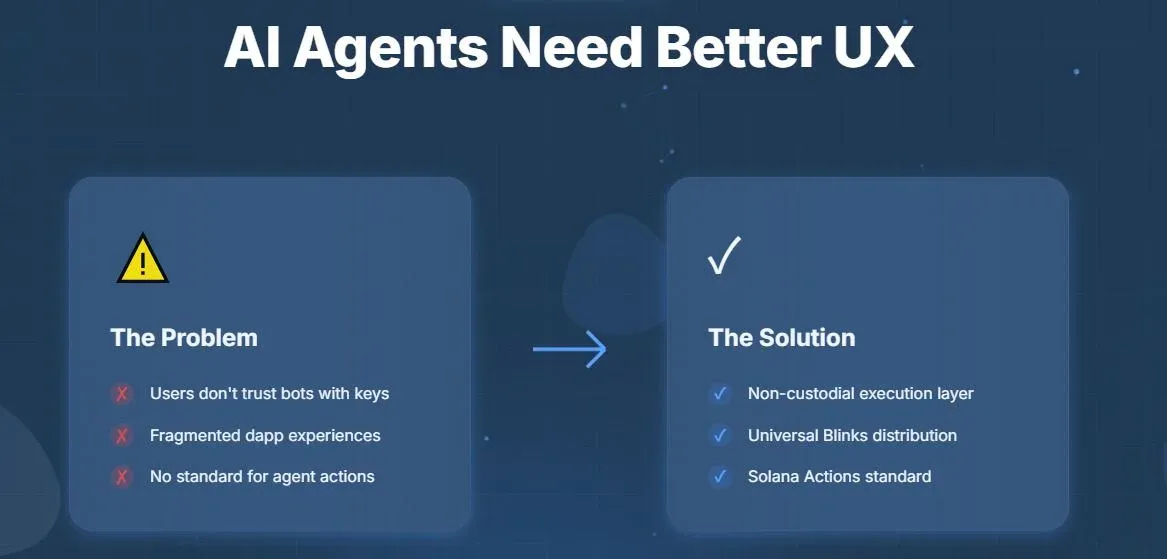
OpenPaw is an experimental Web3 project that aims to provide an execution layer for AI agents operating on a blockchain. Unlike conventional solutions, OpenPaw relies on a non‑custodial infrastructure, meaning that every transaction ultimately requires the user’s own signature.
Key components of the project
| Element | Description |
|---------|-------------|
| AI‑agent layer | The infrastructure that connects AI agents with blockchain actions |
| Non‑custodial execution | Private keys are always held by the user |
| Solana actions | Standardised on‑chain operations implemented within the Solana ecosystem |
| Wallet signature | A transaction is only executed after it is signed in the user’s wallet |
Example
A user gives an instruction to an AI agent:
“Swap 0.5 SOL for USDC.”
The agent prepares the corresponding transaction, but it will only be executed after the user signs it with their wallet. This design distinguishes OpenPaw from robot systems that need direct access to private keys.
The associated OpenPaw token (PAW Coin) functions as a utility and infrastructure token inside the ecosystem, for example to pay for services, skills or platform features.
OpenPaw vs. OpenClaw
Developers point out that OpenPaw was born out of security criticisms of the OpenClaw package – the latter was released without sufficient security testing.
| Project | Focus |
|---------|-------|
| OpenClaw | Original AI‑agent framework, open skill uploads |
| OpenPaw | Strengthened security, emphasising on‑chain execution |
OpenPaw’s security measures include:
- Explicit definition of skill permissions.
- Pre‑release package inspection.
- Reduction of malicious‑code risk.
Consequently, OpenPaw is more oriented toward providing a secure on‑chain execution environment for AI agents, whereas OpenClaw resembles a generic autonomous‑agent framework.
The philosophy behind OpenPaw: AI agents in Web3
OpenPaw sits within a broader movement toward autonomous software agents. An AI agent is essentially a process capable of performing tasks independently; such agents already have many use‑cases on the traditional Internet, like virtual assistants or intelligent bots.
Typical examples include:
- ChatGPT‑powered automation agents
- Trading bots
- Self‑directed analytics tools
In the Web3 space, a new idea has emerged: AI agents should be able to interact directly with blockchain protocols. Conventional chatbots or virtual assistants can only respond to requests and struggle to perform autonomous on‑chain actions. In a Web3 environment, an AI agent could proactively carry out tasks such as:
- Automatic portfolio rebalancing
- DeFi liquidity management
- Blockchain monitoring
- Automated trading strategies
These systems would interact with the blockchain directly, which is precisely the niche OpenPaw aims to fill. The project seeks to build a bridge between AI agents and blockchain, turning an agent’s decisions into real on‑chain transactions.
Unlike traditional automation tools, when using OpenPaw the user remains the ultimate control point, because every transaction must be confirmed through a wallet signature.
Technical fundamentals of OpenPaw
From a technical standpoint, OpenPaw’s workflow can be broken down into four distinct steps.
Simplified flow
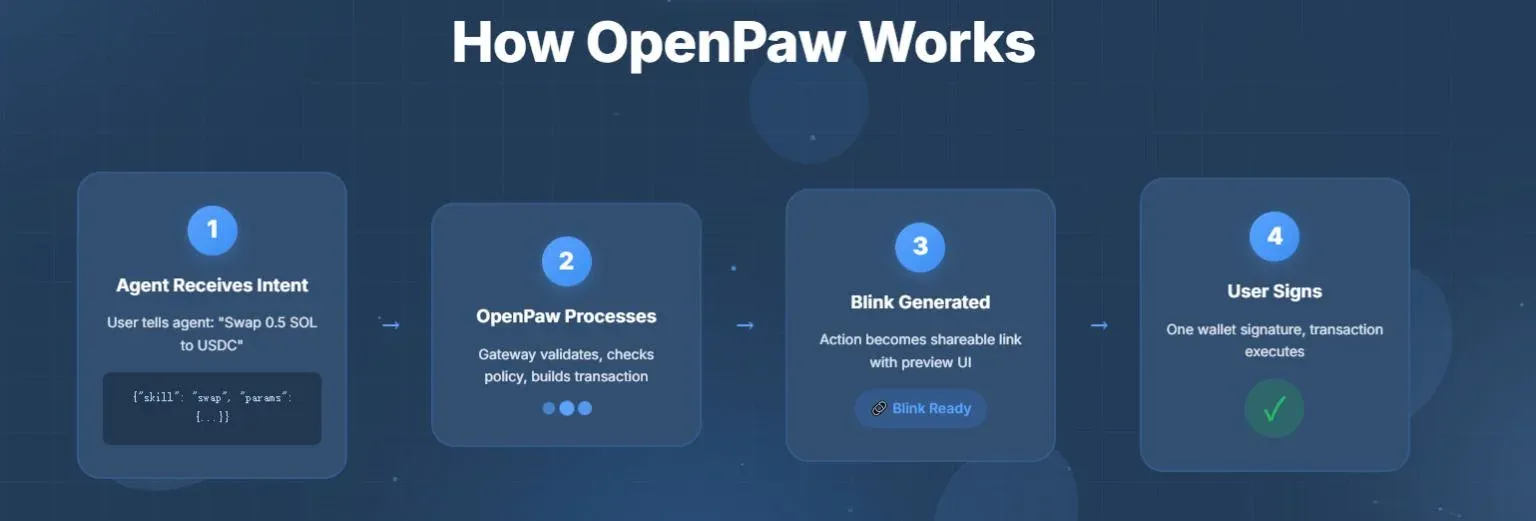
The model achieves AI‑driven automation without relinquishing private‑key control.
1. Agent intent
The user tells the agent what to do, for example:
“Swap 0.5 SOL for USDC”
The agent translates this natural‑language command into a structured request.
2. OpenPaw gateway
The gateway receives the structured request and creates a transaction that can be executed on the blockchain. This stage includes:
- Allow‑list enforcement
- Consumption‑limit configuration
- Protocol validation
3. Blink generation
The resulting transaction is presented as a “blink” – a partially completed blockchain transaction that includes a preview and a signature option. Blinks can be shared instantly via messaging apps or UI components.
4. Wallet signature
Only after the user signs the blink does Solana actually execute the on‑chain transaction.
What is the OpenPaw Token (PAW)?
PAW is the native utility token of the OpenPaw ecosystem. While the project’s core mission is to provide infrastructure for AI agents on a blockchain, PAW also underpins a variety of platform functions.
The primary purpose of the PAW Coin is to enable users to access services, skills and infrastructure associated with autonomous agents.

Use cases for PAW
In the current design, the OpenPaw token serves several functions:
- Acquiring agent skills – developers can publish “skills” that provide automation, monitoring or DeFi interaction capabilities; users pay PAW to unlock access.
- Platform fees – certain infrastructure services (e.g., API calls or premium agent features) may require PAW as payment.
- Ecosystem incentives – skill providers could earn PAW revenue shares in the future.
- PawHub marketplace – the planned skill marketplace will become the ecosystem’s core; developers can list modules and earn proceeds.
Token attributes
| Category | Details |
|----------|---------|
| Token name | PAW |
| Project | OpenPaw |
| Function | Utility token supporting AI‑agent infrastructure |
| Ecosystem | Solana blockchain |
Thus, PAW is more akin to an access key for autonomous‑software‑agent infrastructure rather than a generic payment currency. Coupled with the upcoming PawHub skill marketplace, PAW could play a central role in the ecosystem—provided the developer community continues to grow.
OpenPaw price: current market data
On‑chain data shows that OpenPaw’s price is still at an early‑stage level. According to Dexscreener, PAW primarily trades in Solana‑based liquidity pools.
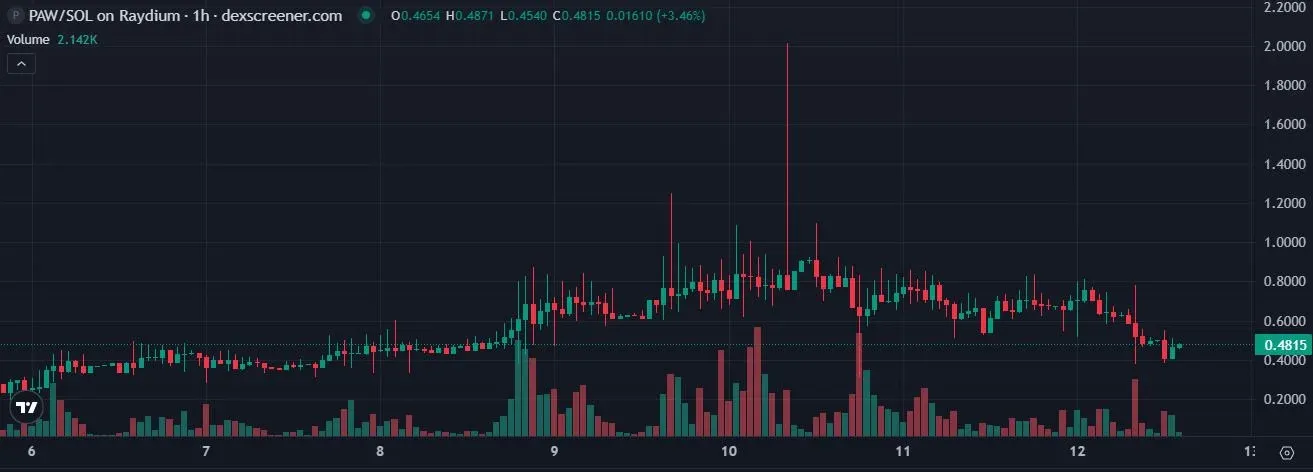
Source: Dexscreener
Market snapshot (as of 12 March 2026)
- Price ≈ $0.49 USD
- Market cap ≈ $1.7 million USD
- Liquidity ≈ $33,000 USD
- 24‑hour trading volume ≈ $224,000 USD
These figures illustrate two typical traits of emerging crypto projects:
- Relatively low liquidity – a $33 k pool means that large orders can cause noticeable price movement, i.e., high slippage.
- High short‑term volatility – the token has exhibited roughly a 30 % price decline over the past 24 hours, a pattern not uncommon for nascent tokens.
- On‑chain activity – thousands of transactions in a short window suggest that most holders are DEX traders and early‑stage speculators.
Overall, OpenPaw’s price is driven more by public perception, community hype and liquidity inflows than by traditional fundamental metrics.
Tax note: Crypto gains may be taxable in your jurisdiction. Please consult a local tax professional to understand reporting obligations for any PAW transactions.
How to acquire PAW tokens?
PAW is currently traded mainly on Solana‑based decentralized exchanges (DEXes) and has not yet been listed on major centralized exchanges.
1. Buying via a Solana DEX
Step‑by‑step overview
- Create a wallet – Choose a Solana‑compatible wallet such as Phantom or Solflare to hold tokens and interact with DEXes.
- Obtain SOL – SOL is the native asset required for most swaps; most Solana pools use SOL as a base pair.
- Connect to a DEX – Link your wallet to popular DEX platforms like Raydium or the Jupiter Aggregator.
- Execute the swap – Select the SOL → PAW pair, confirm the transaction, and the trade will be settled on‑chain and appear in your wallet.
2. Indirect route through a centralized exchange
Although PAW is not directly listed on large CEXs, investors can still acquire it indirectly:
- Deposit fiat (USD via SEPA/SWIFT, or other local currencies) into a regulated exchange.
- Purchase a liquid crypto such as USDT or SOL.
- Transfer the purchased asset to your personal Solana wallet.
- Use the wallet‑connected DEX to swap for PAW.
Important considerations before buying
- Liquidity is limited; large orders may cause significant price impact.
- Always verify the contract address to avoid counterfeit tokens.
- DEX platforms do not provide custodial protection; you bear full responsibility for the security of your assets.
For a brand‑new token like PAW, it is prudent to allocate only funds you can afford to lose.
Comparison of AI‑agent tokens
The AI‑driven crypto‑agent market is expanding rapidly, with several projects attempting to blend autonomous software with blockchain trading. The table below gives a quick snapshot of where OpenPaw sits within this landscape.
| Project | Emphasis | Blockchain |
|---------|----------|------------|
| OpenPaw | Execution layer for AI agents | Solana |
| Fetch.ai | Autonomous multi‑agent system | Multi‑chain |
| Bittensor (TAO) | Decentralised AI infrastructure | Multi‑chain |
OpenPaw positions itself as the execution layer, offering the plumbing that lets agents act on‑chain. Fetch.ai focuses more on a network of interacting agents and machine‑learning capabilities, while Bittensor aims to create a marketplace for decentralized AI models.
Opportunities and risks for OpenPaw
| Opportunities | Risks |
|---------------|-------|
| Rapid growth of AI agents in the crypto space | Early‑stage project with limited transparency |
| Integration with the Solana developer ecosystem | Low liquidity leading to high slippage |
| Potential demand for standardised agent execution | Price may be subject to speculative spikes |
| First‑mover advantage for early adopters | Real‑world adoption of AI‑agent trading still unproven |
Future outlook for OpenPaw
OpenPaw’s long‑term success hinges on the overall evolution of AI agents within Web3. Current trends include:
- Increasing autonomy of AI agents.
- Blockchains providing verifiable execution trails.
- Developers seeking a unified layer for agent operations.
If these trends materialise, OpenPaw could play a role similar to that of a smart‑contract platform during DeFi’s early days. Its deep integration with Solana Actions and wallet signatures may make it a foundational building block for AI‑agent‑driven trading.
Frequently asked questions (FAQ)
What is OpenPaw?
OpenPaw is a Web3 project that offers an execution infrastructure for AI agents on a blockchain. By leveraging wallet signatures and Solana Actions, autonomous software agents can perform on‑chain transactions without a centralized custodian.
What is the PAW token?
PAW is the native token of the OpenPaw ecosystem. It is used for interacting with agents, purchasing skills, paying for platform services and may later support governance functions.
Where can I buy OpenPaw?
PAW currently trades mainly on Solana‑based DEXes such as Raydium and Jupiter. Large centralized exchanges typically list more established AI tokens first; new projects like OpenPaw generally appear on DEXs before any CEX listing.
How trustworthy is OpenPaw?
As an emerging Web3 AI project, OpenPaw is still in early development. Its concept is technically innovative, but investors should monitor factors such as team transparency, liquidity depth and overall market sentiment.
Does OpenPaw have a future?
OpenPaw’s prospects are tightly linked to the growth of AI agents in the blockchain arena. If autonomous agents become more integral to on‑chain trading and services, OpenPaw could become a critical infrastructure layer. At present it remains experimental, and continued observation of ecosystem developments is advised.
💡 Register on Binance with referral code B2345 for the maximum trading fee discount. See Binance complete guide.



