
 Bitaigen Research
Introduction
Whether you are a seasoned trader with years of experience or a newcomer just stepping into the world of digital assets, Order Book Depth (Depth of Market, or DOM) is an analytical tool that cannot be ignored. This article will explore the concept of DOM, its constituent elements, and its practical value, helping readers systematically understand how this metric functions across different trading strategies.
In digital‑asset trading, order‑book depth is a key window for insight into supply‑demand dynamics and liquidity assessment. We will break down the concept, examine core components, and present practical techniques, outlining both the strengths and limitations of DOM. This will enable readers to accurately interpret market signals under various strategies. To learn how to leverage depth information to improve trading decisions, keep reading.
Why Should You Pay Attention to Order Book Depth?
The order book provides an instant snapshot of market supply and demand, allowing traders to capture potential price trends. For example, when buy‑order volume significantly exceeds sell‑order volume, upward pressure is often implied; the opposite may signal a downtrend. Using the order book, investors can also act as market makers, benefiting from relatively lower fees offered by exchanges.
More importantly, order‑book depth directly reflects the level of liquidity. A well‑liquified market can absorb large buy or sell orders without causing dramatic price swings, whereas in a thin‑liquidity environment even modest orders can generate sizable slippage. When liquidity is lacking, large players—often called “whales”—can place massive buy or sell orders on the book to create a false impression, coaxing retail participants to follow, then sell at the inflated price for profit, which subsequently triggers a rapid price drop.
What Is an Order Book?
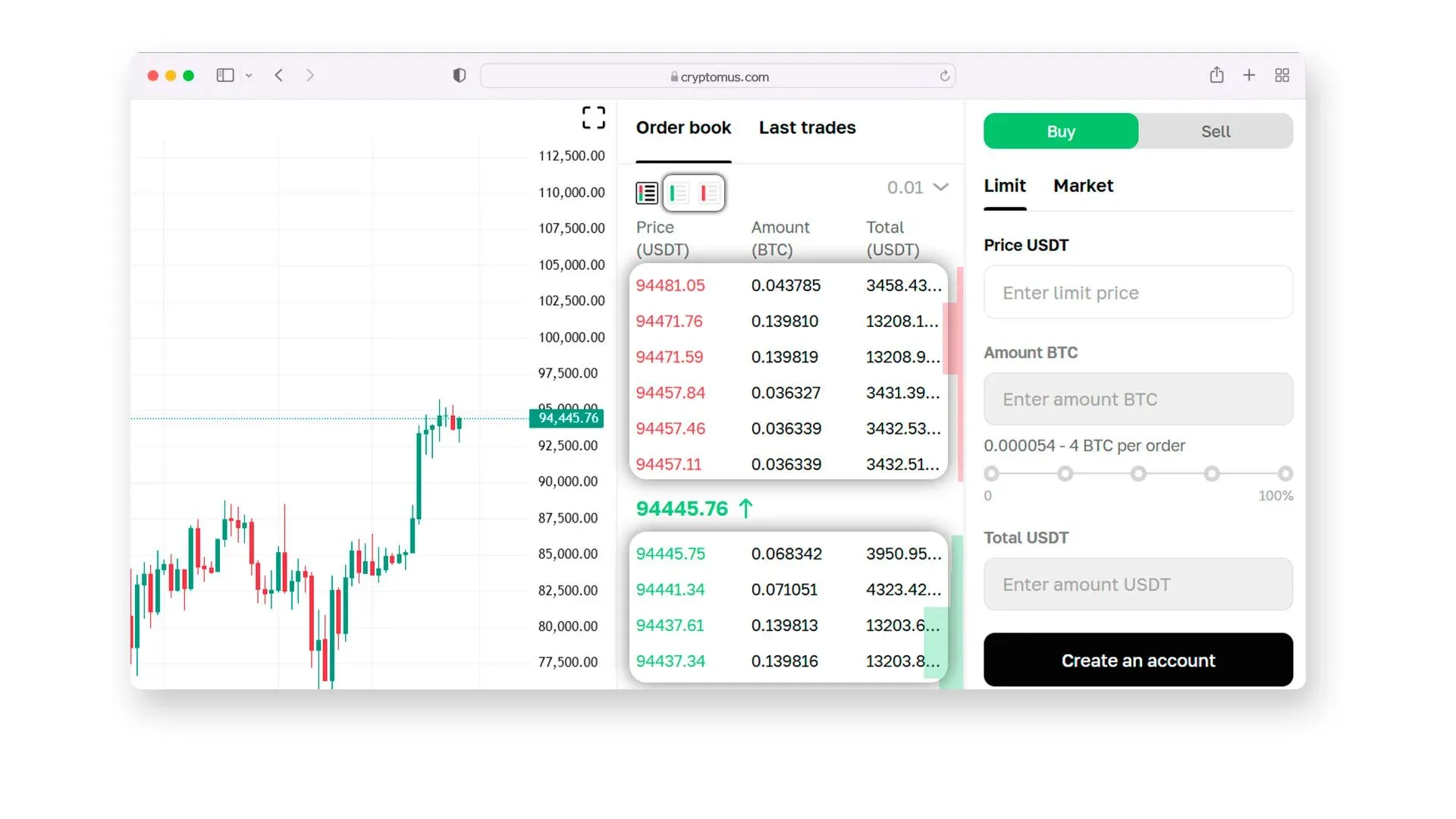
An order book is an electronic ledger that records all outstanding orders for a particular asset, sorted by price from high to low for sell orders (asks) or low to high for buy orders (bids). Each price level displays the corresponding quantity available to buy or sell, allowing participants to quickly gauge how many tokens are waiting to be traded at a given price.
Almost every major cryptocurrency exchange offers this feature. In Cryptomus’s spot‑trading view, for instance, ask orders appear in red at the top of the screen, while bid orders are shown in green below; users can also toggle to view only bids or only asks.
What Is DOM (Depth of Market)?
Order‑book depth, known as Depth of Market (DOM), refers to the cumulative quantity of orders posted at a specific price level. If there are large numbers of limit orders on both the buy and sell side across multiple price levels, the market is considered “deep.” Greater depth indicates better liquidity for that exchange or asset, meaning sizable trades can be executed without substantially moving the price up or down.
Core Elements of DOM
In trading software, DOM is usually displayed graphically, allowing users to instantly capture market dynamics. Its main components include:
- Buy and Sell Orders: Green bars represent buy orders (demand), red bars represent sell orders (supply), and a horizontal line in the middle marks the current transaction price.
- Spread: The difference between the highest bid and the lowest ask, reflecting the immediate cost of buying versus selling.
- Quantity: The total amount participants are willing to trade at a particular price level. For example, if ten traders each want to buy 2 BTC at the same price, the cumulative quantity shown at that level would be 20 BTC.
Traders skilled at reading this information can identify common order‑book patterns and infer short‑term price direction.
How Does DOM Aid Trading Decisions?
Understanding DOM lets you more precisely gauge current market sentiment:
- Trend Signals: During an uptrend, if buy‑side depth expands noticeably, it suggests strong bullish confidence; during a downtrend, expanding sell‑side depth may indicate growing bearish pressure.
- Liquidity Assessment: In a market with ample depth, large orders have limited price impact, making it suitable for strategies that require rapid entry and exit while minimizing slippage. Conversely, in shallow markets even small orders can trigger volatile moves, demanding greater caution.
- Detecting Manipulation: Fake large orders (sometimes called “spoofing”) tend to be effective in low‑liquidity environments; recognizing such patterns can help you avoid being misled.
How to Use DOM in Practice?
Below is a typical workflow built around DOM, designed to help you execute efficiently on a trading platform:
- Verify Platform Support for Order Books: Not every exchange offers a full view of bid and ask stacks; choose a platform that does.
- Open and Configure the DOM Window: Adjust the displayed price range and depth levels to match your personal strategy.
- Lock In Key Price Levels: Look for zones where orders cluster heavily and volume is high; these often act as support or resistance.
- Monitor Order Flow in Real Time: Watch the addition, removal, or lingering of large orders to capture shifts in buying or selling intent.
- Enter Positions Within Well‑Liquidity Zones: After confirming that the buy‑ and sell‑side depth at your target price can sustain your intended position size, place your order.
- Dynamically Manage Your Position: While holding, continue observing DOM; if demand keeps rising and price follows, you may consider scaling in or locking in profit.
- Exit Strategy: In a liquid market, a market order can close the position quickly. In a thin market, it is advisable to place a limit order near the nearest dense order cluster to reduce slippage risk.
By following these steps, you maintain awareness of overall market liquidity while mitigating the potential loss that can arise from abrupt price swings.
Conclusion
Order‑book depth (DOM) is a critical metric for measuring the liquidity and price stability of crypto assets. Markets with rich depth provide a more favorable execution environment for large trades and add an extra dimension to technical analysis. Whether your trading style leans toward short‑term scalping or medium‑to‑long‑term holding, mastering DOM interpretation helps you better understand the underlying supply‑demand balance, boosting confidence and success rates in decision‑making.
This article ends here. For deeper dives into DOM, you can search for past Bitaigen (比特根) articles or continue browsing the recommended posts below. Thank you for supporting and following Bitaigen (比特根)!
💡 Register on Binance with referral code B2345 for the maximum trading fee discount. See Binance complete guide.



