
 Bitaigen Research
In this article we summarize the latest security report from PeckShield, focusing on the overall trends of crypto‑asset theft and scams in February and the shifting drivers behind them. By comparing the volatility of the preceding months, we help readers capture the dynamics of industry risk and understand why losses saw a marked decline this month. For insights on the link between incidents and market sentiment, keep reading.
February crypto‑asset losses hit a new low
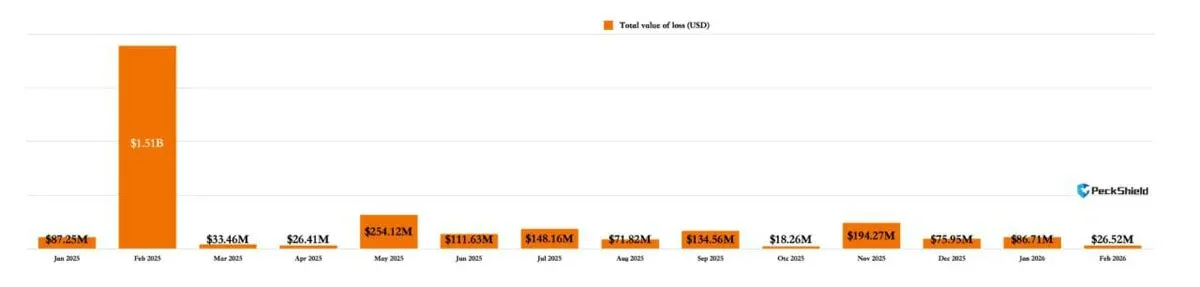
PeckShield’s data indicates that the total loss caused by hacking and fraud in February 2026 was only US $26.5 million, the lowest monthly figure recorded since March 2025. The month logged 15 security incidents, with two of them accounting for the overwhelming majority of the loss. The largest incident occurred on February 21, when a hacker manipulated the price of the lending pool managed by the YieldBlox DAO, siphoning roughly US $10 million; on the same day, the decentralized identity protocol IoTeX suffered a private‑key breach that resulted in a loss of about US $8.9 million. Compared with the ≈US $86 million lost in January, February’s loss dropped 69.2 % month‑over‑month.
PeckShield’s spokesperson told Cointelegraph: “The US $1.5 billion Bybit incident from February 2025 did not inflate this month’s statistics; on the contrary, market volatility cooled exploit activity significantly.” He added that Bitcoin fell below US $70,000 at the start of February, shifting industry focus from protocol vulnerabilities to institutional deleveraging and model‑driven sell‑offs, which heightened attention to liquidity risk during periods of high volatility.
Potential impact of risk control and security upgrades
Dominic John, an analyst at Kronos Research, believes the recent decline may also reflect strengthened risk‑control measures, counter‑party onboarding standards, and real‑time monitoring on major exchanges. “Capital is becoming more selective, preferring projects that have mature security frameworks,” John said. “As long as security standards evolve in step with innovation, continuous downside pressure can be mitigated.”
John further noted that as audit practices, monitoring tools, and institutional risk‑management frameworks mature, overall losses in 2023 are expected to keep falling. He added: “Artificial intelligence is poised to accelerate this shift, using automated code review, anomaly detection, and pre‑deployment attack simulations to spot and fix vulnerabilities earlier in the software lifecycle.”
“AI‑driven checks and automated vulnerability scans can catch issues sooner, but the rapidly evolving ecosystem still makes this a challenging cat‑and‑mouse game.”
Phishing remains a stubborn threat
Even though total losses have decreased, the risk from phishing has not been eliminated. PeckShield reports that phishing‑related losses in 2025 dropped sharply from US $494 million to US $83.85 million, yet attack techniques continue to evolve, with perpetrators increasingly impersonating trusted institutions or individuals to steal sensitive information.
“Phishing is the most persistent security threat,” the company’s spokesperson emphasized. “Unlike direct contract breaches, attackers now focus more on human error.”
“For institutions and large holders, employing multi‑signature cold storage and rigorously safeguarding private keys are key defenses against this type of risk.”
Conclusion
In summary, crypto‑currency losses in February 2026 have fallen to the lowest level since March 2025, driven by a reduction in hacking incidents, heightened market volatility, and upgraded risk‑management practices. Looking ahead, continued improvements in audit technology, AI‑based detection, and institutional security standards are expected to deliver more robust safety progress for the industry. To stay updated on the detailed breakdown of February’s record‑low losses, follow the ongoing coverage from Bitaigen.
*Note for U.S. readers: when converting fiat to crypto on exchanges, use Binance.US or other U.S.-compliant platforms rather than the global Binance service. For cross‑border fiat transfers, SEPA (for euros) and SWIFT (for other currencies) remain the standard channels. Crypto gains may be taxable in your jurisdiction; consult a local tax professional for guidance.*
💡 Register on Binance with referral code B2345 for the maximum trading fee discount. See Binance complete guide.
⚠️ Risk Disclaimer: Crypto prices are highly volatile. This is not investment advice.



