
 Bitaigen Research
 In less than three years, perpetual contract decentralized exchanges (Perp DEX) have leapt from the fringe of DeFi to the core of the derivatives market. In‑chain perpetual contract trading volume surpassed $1.5 trillion in 2024, and daily volume approached $100 billion in 2025, indicating a fundamental shift in leverage, control, and risk‑management approaches.
A Perp DEX (perpetual decentralized exchange) is a decentralized platform that trades perpetual contracts directly on a blockchain. Users retain custody of their assets, no KYC is required, and they can go long or short using funding rates and leverage.
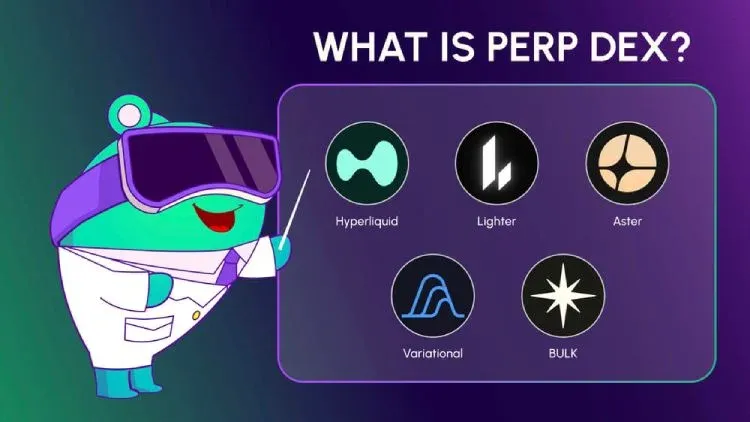
In this article we outline the core concepts, operating mechanisms, and ecosystem layout of Perp DEX, and we highlight the perpetual decentralized trading platforms that performed strongly in 2026, helping readers quickly grasp the technical innovations and risk points in this field. Subsequent sections will provide in‑depth analysis of each topic.
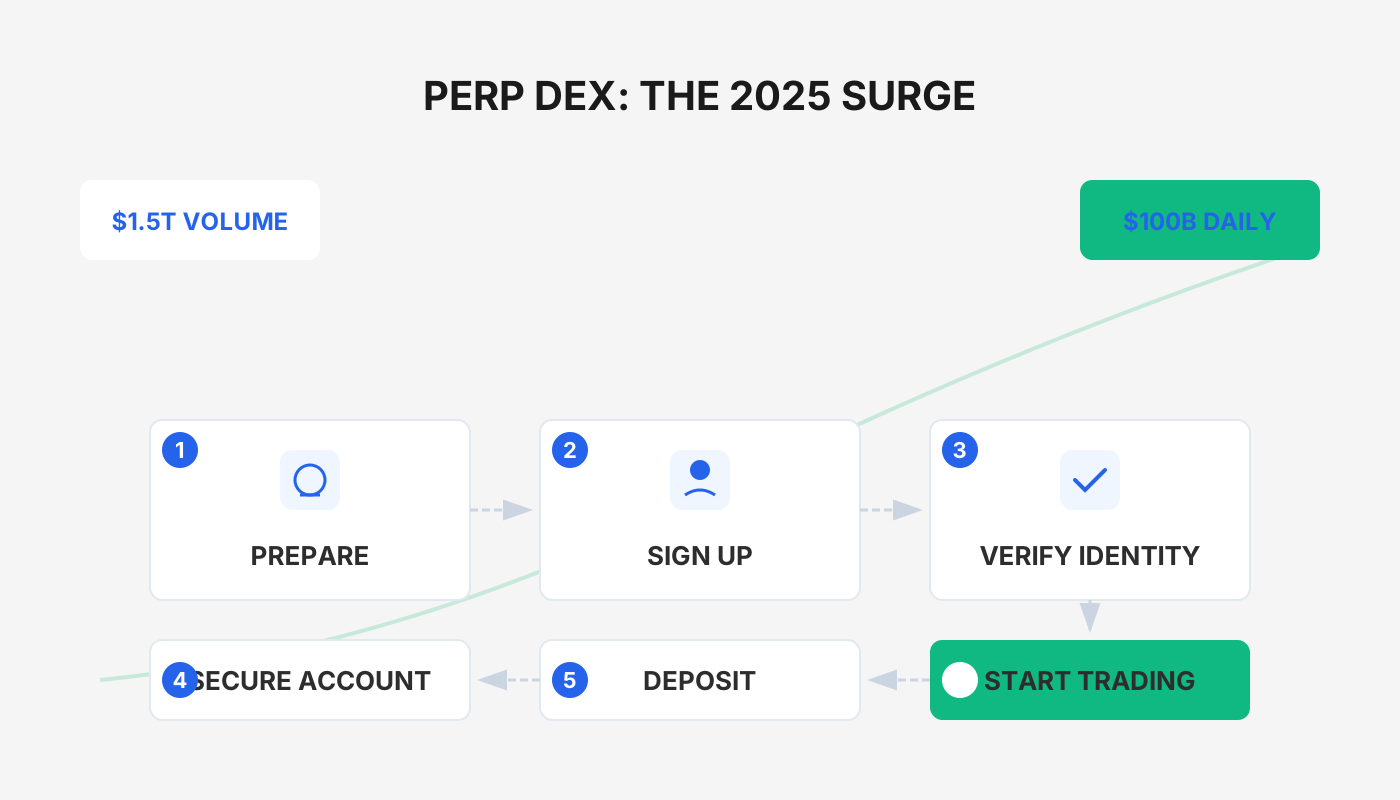
What Is a Perpetual DEX
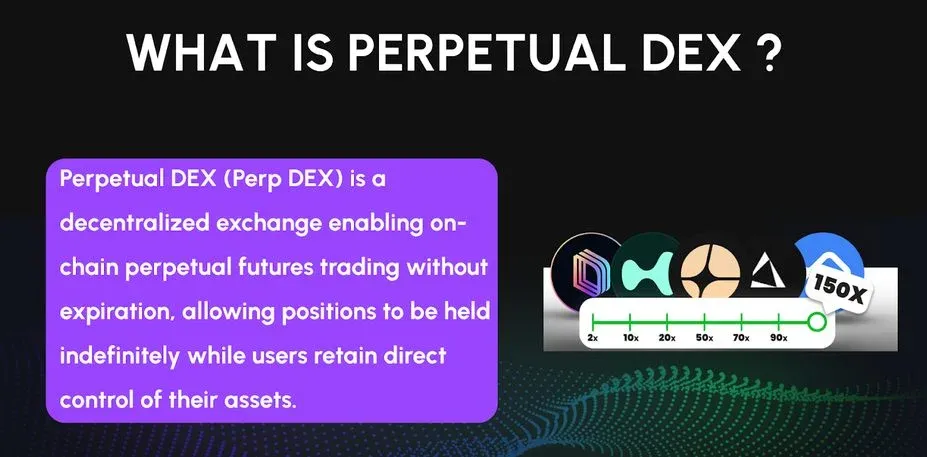
Perpetual DEX (Perp DEX) allows users to trade futures with no expiry date on‑chain. Unlike traditional futures, perpetual contracts can be held indefinitely, letting users go long or short based on price expectations. They combine DeFi‑level asset control with the professional experience of centralized exchanges.
Eight Key Features of Perpetual Decentralized Exchanges
- Self‑custody: Assets always remain in the user’s wallet, eliminating third‑party custody and reducing the risk of exchange insolvency, hacks, or asset freezes.
- No KYC: Most Perp DEXs require only a wallet connection to trade, satisfying privacy needs and enabling global access.
- Full transparency: All trades, funding rates, and liquidations are recorded on‑chain and can be publicly verified, eliminating black‑box operations.
- CEX‑level performance: For example, Hyperliquid can process 200,000 orders per second with latency under 1 second, and the BTC/ETH spread is about 0.1‑0.2 basis points.
- Competitive fees: Hyperliquid charges a maker fee of 0.01 % and a taker fee of 0.035 %; Lighter even offers zero fees, both below the average CEX fee of 0.04 %.
- DeFi composability: Perpetual trading can be stacked with yield farming, lending, and other DeFi strategies, creating workflows that centralized platforms cannot provide.
- Expanded product range: Some Perp DEXs have launched perpetual contracts for stocks, forex, and commodities, enabling 24/7 trading.
- Airdrop incentives: Platforms such as Variational, EdgeX, and Paradex award points for trading; accumulated points are distributed as token airdrops at the token generation event (TGE), driving user growth.
The Rise of Perp DEX
The top ten perpetual DEXs generated a cumulative $1.5 trillion in trading volume in 2024, a 138 % year‑over‑year increase from the $647.6 billion recorded in 2023. According to CoinGecko, December 2024 alone saw $344.75 billion in volume.
As of September 2025, Perp DEXs recorded an average daily volume of $96.97 billion and a monthly volume approaching $1.064 trillion, representing roughly 26 % of the crypto derivatives market—a leap from less than 10 % the previous year.
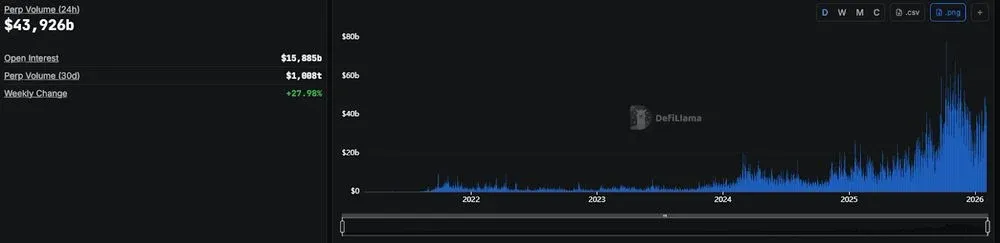
DefiLlama’s end‑2025 statistics are as follows:
- Daily volume ≈ $44 billion
- 30‑day rolling volume > $1 trillion
- Open interest ≈ $16 billion
These figures demonstrate that capital continues to flow into perpetual protocols.
How Perpetual Decentralized Exchanges Operate
The Nature of Perpetual Futures
Perpetual futures (or perpetual contracts) are derivatives that require no ownership of the underlying asset and have no expiration date. Traders can speculate on future prices by going long or short. The concept was first proposed by Nobel laureate Robert Shiller in 1991; after BitMEX introduced it to crypto in 2016, it quickly became mainstream. Digital Chamber data shows daily volumes now exceed $100 billion.
Funding Rate Mechanism
Because perpetual contracts never expire, a funding rate is used to keep the contract price aligned with the spot price. The calculation rules are summarized as follows:
- Periodic settlement: Every 8 hours, funding fees are settled between longs and shorts.
- Positive funding rate: When the contract price trades above spot (a futures premium), longs pay shorts.
- Negative funding rate: When the contract price trades below spot (a spot premium), shorts pay longs.
This mechanism incentivizes traders on opposite sides to bring the contract price back toward the spot market.
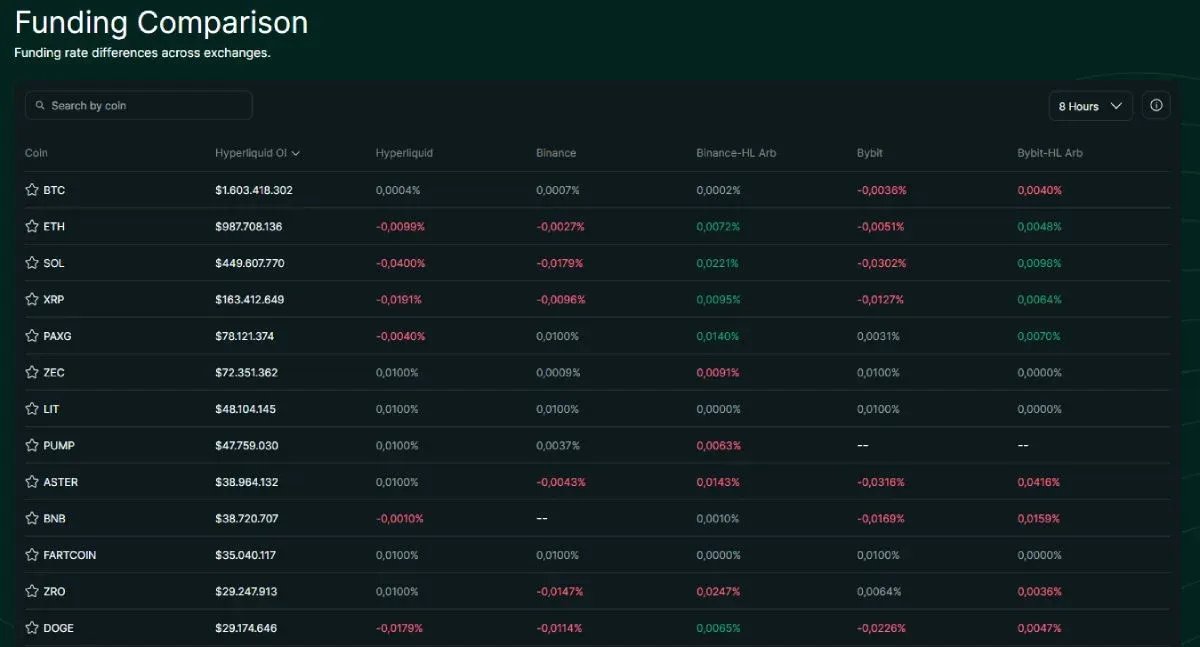
Example: If Bitcoin’s spot price is $30,000 but the perpetual contract trades at $31,000 due to strong long demand, the funding rate becomes positive. Longs must pay shorts, encouraging shorts to open positions or longs to close, pulling the price back toward spot. If the 8‑hour positive rate is +0.01 %, a $50,000 position incurs roughly $15 of daily cost, equivalent to an annualized rate of about 11 %.
Leverage Mechanism
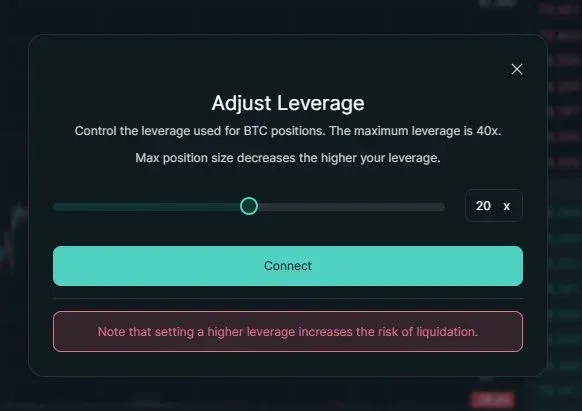
Leverage is the primary attraction of perpetual contracts; platforms typically offer 5‑100× leverage, with some—such as Aster—reaching 1,001×. A simple illustration:
- Deposit $1,000 as margin, select 10× leverage → control a $10,000 position.
- If the price rises 10 %, profit is 100 % ($1,000).
- If the price falls 10 %, the margin is wiped out and the position is liquidated.
Perpetual contracts link spot price movements through funding rates while providing high liquidity and flexibility. However, they also introduce holding costs and liquidation risk, especially at high leverage.
Top Perpetual Decentralized Exchanges (Perp DEX)
The following list is based on DefiLlama’s cumulative trading‑volume data up to February 2026, highlighting four platforms that performed exceptionally.
Hyperliquid
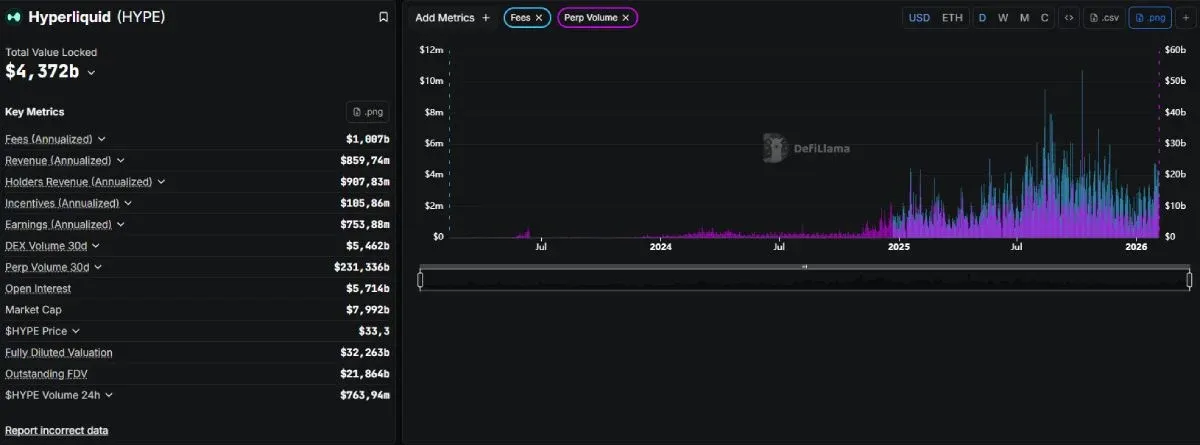
Hyperliquid is a Layer‑1 blockchain dedicated to derivatives, employing a proprietary HyperBFT consensus and operating independently of Ethereum/Arbitrum, optimized for trading performance.
| Metric | Value |
|---|---|
| Cumulative volume | > **$3.7 trillion** |
| Open interest | ≈ **$5 billion** (≈ 54 % of the Perp DEX market) |
| TVL | ≈ **$4.5 billion** |
| Order throughput | **200,000 orders / second** |
| Latency | **0.2 seconds** |
| Fees | Maker **0.01 %** / Taker **0.035 %** |
Key points: The project is fully self‑funded with no token‑unlock pressure; a HYPE token airdrop at the end of 2024 sparked market buzz; BTC/ETH spreads sit at 0.1‑0.2 bp, comparable to top CEXs; on‑chain order books provide transparent trading; the upcoming HIP‑3 aims to launch perpetual contracts backed by real‑world assets and U.S. Treasury bonds.
Aster
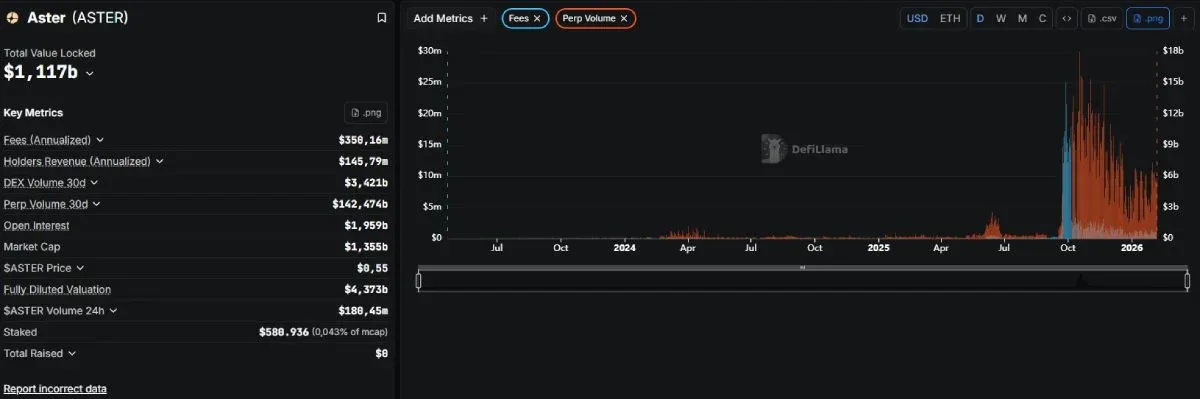
Aster resulted from the late‑2024 merger of Asterus and APX Finance, offering cross‑chain perpetual trading without the need for asset bridges.
| Metric | Value |
|---|---|
| Cumulative volume | > **$1 trillion** |
| Open interest | ≈ **$2 billion** |
| TVL | ≈ **$1.5 billion** |
| Maximum leverage | **1,001×** |
| Feature | 24/7 stock perpetuals (e.g., Apple, Tesla) |
| Backing entity | **YZi Labs (CZ)** |
Key points: Multi‑chain accessibility reduces friction; ultra‑high leverage caters to aggressive strategies; the platform is the first to provide around‑the‑clock stock perpetuals, opening a bridge for traditional‑finance users.
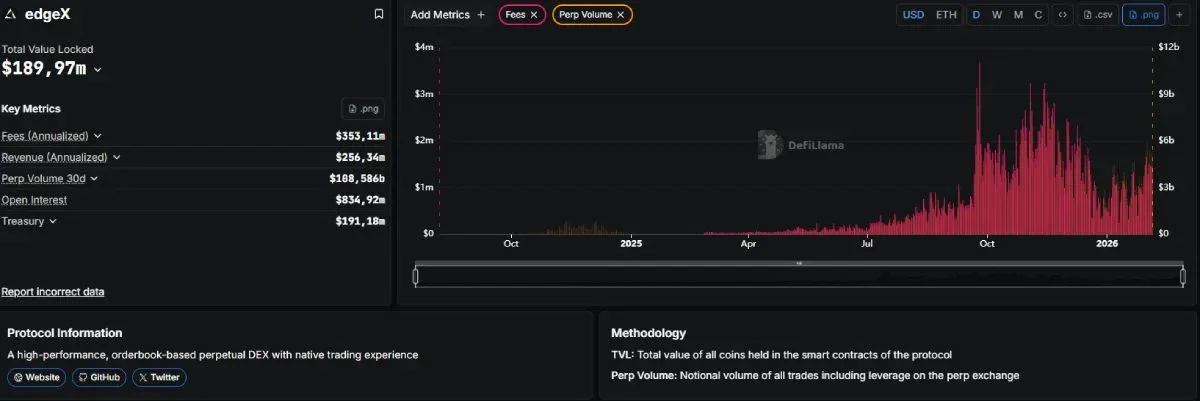
EdgeX
EdgeX is built on an Ethereum Layer‑2 solution, using an order‑book architecture that separates custody, execution, and liquidity aggregation to boost high‑frequency trading performance.
| Metric | Value |
|---|---|
| Cumulative volume | > **$700 billion** |
| Open interest | > **$800 million** |
| TVL | ≈ **$200 million** |
| LP annual yield | Up to **57 % APY** |
| Supported chains | Over **70** |
| Maximum leverage | **BTC 100×** |
| Security audits | Amber Group, PeckShield, SlowMist |
Key points: Broadest multi‑chain coverage; rigorous security audits; maintained profitability even under stress‑test conditions, demonstrating financial resilience.
Lighter
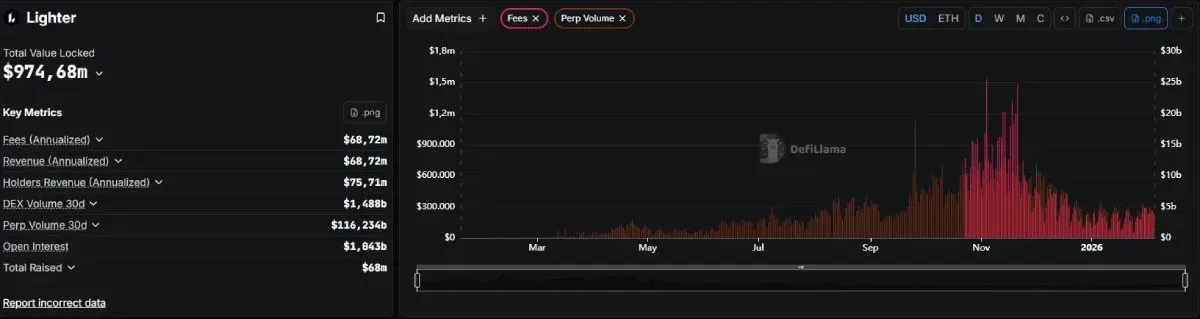
Lighter employs zk‑rollup zero‑knowledge proof technology to deliver zero‑fee trading while preserving high throughput and privacy.
| Metric | Value |
|---|---|
| Cumulative volume | > **$1.4 trillion** |
| Open interest | > **$1 billion** |
| TVL | ≈ **$1 billion** |
| Funding round | **$68 million** (led by a16z and others) |
| Fee model | No direct trading fees; profit generated from spread capture |
| Tech stack | zk‑rollups |
Key points: The zero‑fee model attracts massive trading volume; zk‑rollups provide an efficient, privacy‑friendly on‑chain experience.
Perp DEX vs. Perp CEX: Which Is Better
Market‑share evolution
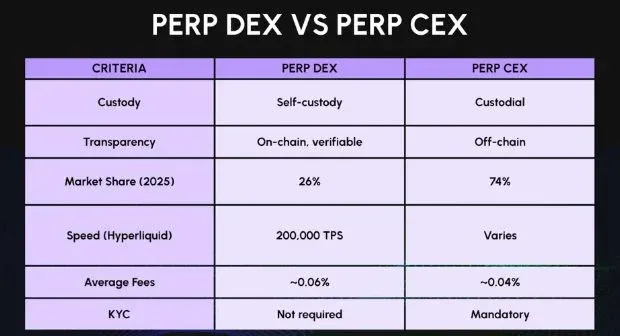
In 2022, Perp DEXs accounted for only 1 % of the crypto derivatives market. By mid‑2025 that share had risen to 26 %, meaning one out of every four perpetual contracts now runs on decentralized infrastructure.
Custody comparison
- CEX: Users deposit assets into the platform; they actually hold the platform’s liability tokens, exposing them to exchange insolvency, hacks, or account freezes.
- Perp DEX: Assets remain in the user’s wallet; smart contracts interact only when necessary, giving users full control while requiring them to manage contract‑related risks themselves.
The fallout from the FTX collapse accelerated regulatory and security concerns, prompting a sizable migration of capital toward Perp DEXs.
Transparency differences
- CEX: Order books may contain dark pools, front‑running, or other opaque practices that are difficult to verify.
- Perp DEX: All trades are on‑chain and can be audited in real time; for instance, Hyperliquid’s “whale leaderboard” makes large‑holder activity visible to the entire network.
Performance and liquidity
CEXs still dominate absolute liquidity (Binance’s monthly volume in May 2025 was about $1.7 trillion), but the performance gap is shrinking rapidly. Hyperliquid processes 200,000 orders per second, with latency around 0.2 seconds, and maintains spreads of 0.1‑0.2 bp, comparable to top centralized venues.
Fee comparison
- Average CEX fee: Approximately 0.04 % (some large traders enjoy 0.02 %).
- Average DEX fee: Roughly 0.06 %.
- Hyperliquid: Maker 0.01 %, taker 0.035 %, significantly lower than most centralized platforms.
KYC and Accessibility
Perp CEXs require full KYC, limiting anonymity and cross‑border convenience. Perp DEXs only need a wallet connection, lowering entry barriers, protecting privacy, and allowing global participants to engage in derivatives markets without relying on traditional financial infrastructure.
Main Risks of Trading on Perpetual DEXs
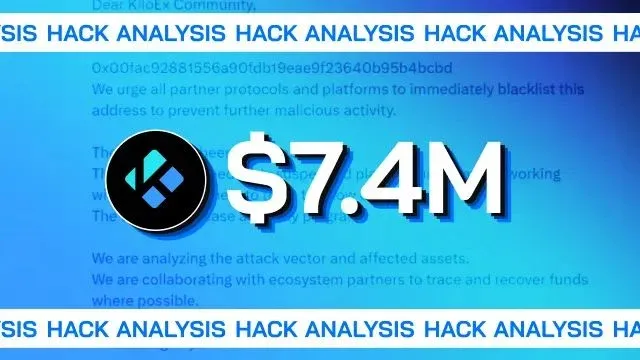
- Smart‑contract risk: Code vulnerabilities can lead to asset loss, as seen in April 2025 when KiloEx lost $7.4 million due to an oracle access‑control flaw.
- Oracle manipulation: Weak or AMM‑based oracles can be attacked with flash loans, causing price distortion and unfair liquidations.
- Liquidation cascades & ADL: Extreme volatility can trigger mass liquidations; if insurance funds are insufficient, the system may enforce forced liquidation.
- Funding‑rate risk: Persistent positive funding rates accumulate holding costs, eroding profits over time.
- Liquidity gaps: Low‑liquidity DEXs can suffer significant slippage on large orders, preventing execution at expected prices.
- Regulatory uncertainty: Jurisdictions differ widely; sudden policy changes may restrict access or trading activity.
- Leverage misuse: High leverage magnifies both gains and losses; during sharp moves it can quickly lead to forced liquidation.
Frequently Asked Questions
Which type of trader is Perp DEX best suited for?
It suits traders who are comfortable managing wallets, understand funding rates and leverage, and value self‑custody and on‑chain transparency.
Can beginners start right away?
Yes,
Related Reading
- Top 5 Undervalued Perp DEX Dark Horses to Watch in 2025
- Perp DEX Guide: Decentralized Perpetual Contracts Explained
- Perp DEX: Decentralized Perpetual Contract Exchange
💡 Register on Binance with referral code B2345 for the maximum trading fee discount. See Binance complete guide.



