
 Bitaigen Research
 Tether, the issuer of USDT, is experiencing a second consecutive month of market‑cap contraction. The 0.8 % decline in February follows a 1 % drop in January, pulling the total USDT market cap down from a peak of roughly $186.84 billion to about $183.61 billion.
Although the percentage drop appears modest, the underlying implications are more significant. A contraction in stable‑coin supply often signals capital outflows and a reduction in liquidity across the digital‑asset ecosystem, raising questions about the sustainability of the recent cryptocurrency rebound.
In this article we dissect the factors behind USDT’s back‑to‑back market‑cap shrinkage, assess its potential impact on overall liquidity and future price dynamics, and combine ETF flow data with the US dollar’s trajectory to give readers a panoramic view that helps capture the subtle shifts in the crypto ecosystem. Please continue reading for the full analysis.
Key Takeaways
- USDT has posted market‑cap declines for two months in a row, possibly reflecting liquidity pressure in the crypto market.
- Contractions in stable‑coin supply have historically preceded slow‑downs in Bitcoin and other altcoin price momentum.
- Weak ETF inflows and a robust US dollar rally amplify concerns about reduced capital entering the crypto ecosystem.
Why Tether’s Market‑Cap Is Shrinking
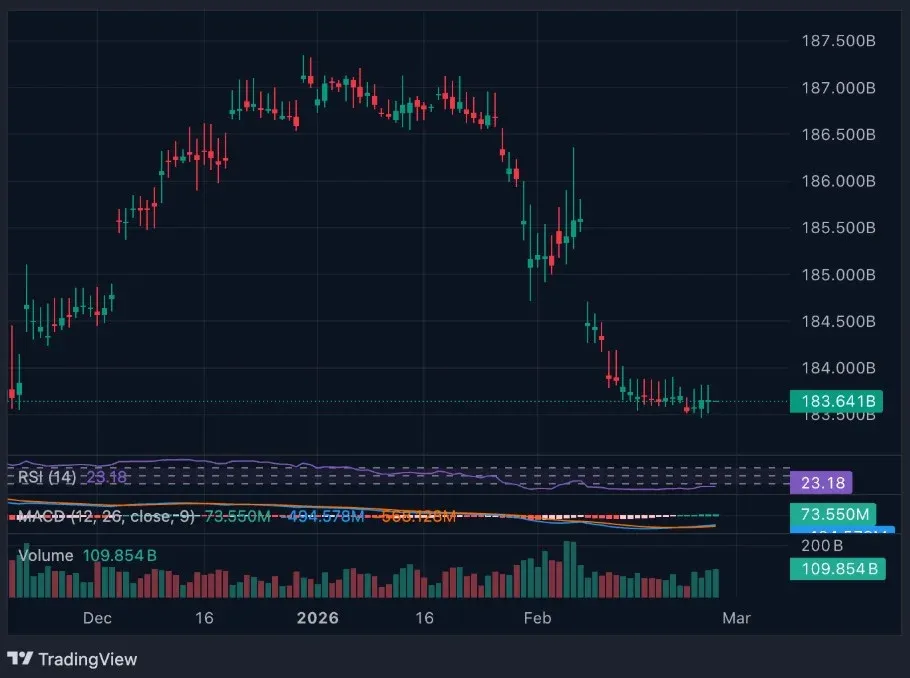
USDT remains the world’s largest stablecoin and the primary settlement asset for crypto trading. A shrinkage in its supply generally means redemptions are outpacing new issuances.
In February, Tether’s market cap fell by 0.8 %, extending the 1 % drop recorded in January. This marks the first time since the 2022 Terra collapse that USDT has contracted for two consecutive months.
The decline is not yet a severe crisis, but the psychological signal warrants attention. Stablecoins act as the liquidity conduit for the crypto market; a supply reduction often indicates waning trading demand or capital exiting the ecosystem.
Why Stable‑Coin Supply Matters
Stablecoins form the foundational liquidity layer in digital‑asset markets. Traders park funds in USDT to hedge volatility while still being able to operate on exchanges.
When stable‑coin supply expands, it is usually accompanied by increased purchasing power; a contraction, however, hints at:
- Reduced speculative activity
- Profit‑taking or capital withdrawal
- Lower demand for leveraged trading
Because USDT is widely used in perpetual futures markets and spot trading pairs, a drop in its supply can have a cascading effect on derivatives liquidity and altcoin trading depth.
Is This a Signal of Crypto‑Liquidity Stress?
Liquidity stress in the cryptocurrency space often manifests subtly. Early warnings are not dramatic price crashes but rather declining stable‑coin issuance and weaker ETF inflows.
Recent data show that U.S.-listed spot Bitcoin ETFs have not attracted significant new capital. Bitcoin’s upward momentum above $70,000 has stalled, retreating to a range around $60,000.
The contraction in USDT supply, combined with soft ETF demand and a slowdown in capital rotation, points to a deceleration rather than an acceleration of inflows.
Liquidity tightening does not automatically trigger a market decline, but it does sap the fuel that sustains a prolonged rally.
Comparing to the 2022 Terra Collapse
The last time Tether posted consecutive monthly declines was during the 2022 Terra ecosystem collapse. At that time, massive stable‑coin redemptions sparked extreme market turbulence.
The current situation differs structurally; there is no systemic crisis and USDT remains firmly pegged.
Nevertheless, both episodes share a sentiment factor: outflows of stablecoins typically reflect traders’ defensive positioning amid rising volatility or macro‑economic uncertainty.
USDC Growth Has Also Stalled
While USDT is contracting, USDC has not shown notable expansion either. Its market cap rose from roughly $70 billion in January to just under $75 billion, essentially flat year‑to‑date. This suggests that overall demand for stablecoins among major issuers is plateauing, rather than a shift of capital between platforms.
When the two dominant stablecoins are both constrained, it indicates a net supply contraction rather than a weakness specific to a single issuer.
Tether Liquidity’s Impact on Bitcoin
Bitcoin price swings are closely linked to stable‑coin liquidity cycles. Historically, strong Bitcoin rallies have coincided with sizable increases in stable‑coin market caps. Recent Bitcoin action has been tentative: after a bounce from around $60,000 in early February that briefly touched $70,000, it slipped back to roughly $65,000.
Absent fresh stable‑coin inflows, the momentum needed to break higher may be insufficient. Stablecoins serve as the gateway for new capital into exchanges; a reduction in that flow makes aggressive upward moves harder to sustain.
Macro and Regulatory Considerations
Global macro uncertainty and regulatory developments also shape stable‑coin dynamics.
Higher interest rates encourage capital allocation to traditional yield‑bearing instruments, while regulatory scrutiny of stable‑coin compliance frameworks can affect issuance practices.
If institutional participants lower risk exposure or slow capital deployment, the expansion of stable‑coin supply naturally decelerates.
Current data do not signal panic; rather, they reflect cautious positioning and a dip in speculative demand.
Temporary Pause or Structural Shift?
The crucial question is whether Tether’s second‑month decline is a short‑term blip or a deeper liquidity contraction.
Possible scenarios include:
- Optimistic view: If macro conditions stay stable and ETF inflows rebound, stable‑coin issuance could accelerate again, reversing February’s shrinkage.
- Pessimistic view: If risk appetite remains low, USDT’s market cap may continue to erode gradually, heralding a longer consolidation phase for crypto assets.
Investors should monitor monthly stable‑coin supply trends, exchange inflows, and ETF flow data to gauge the direction of capital movement.
The Next Metric to Watch
Traders may focus on three key indicators:
- Combined market‑cap change of USDT and USDC – the total stable‑coin pool.
- Net inflow trend of Bitcoin ETFs – a proxy for fresh institutional capital.
- Ratio of open‑interest in derivatives to stable‑coin liquidity – gauges leverage pressure.
If these metrics rise in tandem, confidence in a broader crypto‑market recovery strengthens; if they remain weak, any rebound could face sizable pull‑back risks.
Conclusion
USDT’s market cap fell 0.8 % in February, marking a second consecutive month of contraction—a rarity since the turbulence of 2022.
While not an immediate crisis, history shows that stable‑coin supply shrinkage often coincides with weakened liquidity conditions and slower market momentum.
The current USDT contraction appears more like a prudent response than a crisis. Whether it evolves into a deeper liquidity strain for the crypto sector will depend on upcoming capital inflows, ETF demand, and macro‑risk sentiment over the next few months.
Frequently Asked Questions
Why did USDT decrease in February?
The decline reflects redemptions outpacing new issuances, indicating reduced internal liquidity demand within the crypto market.
Does a stable‑coin supply contraction mean Bitcoin will fall?
Not necessarily, but a shrinking supply usually weakens purchasing power and can limit the momentum behind a sustained Bitcoin rally.
Is this similar to the 2022 Terra collapse?
Although both feature consecutive monthly declines, the present scenario lacks a systemic crisis and mainly signals a slowdown in liquidity.
What role does USDT play in crypto trading liquidity?
USDT is the largest stablecoin and serves as the primary settlement asset across spot pairs and perpetual futures markets.
How do Bitcoin ETF inflows relate to the current USDT market‑cap drop?
Weak ETF inflows suggest a slower pace of new capital entering the crypto ecosystem; combined with USDT’s supply contraction and stagnant USDC growth, overall liquidity pressure increases.
That concludes the analysis of why USDT contracted by 0.8 % in February 2026. For more USDT‑related content, search for previous Bitaigen (比特根) articles or continue browsing the related pieces below. We appreciate your continued support of Bitaigen (比特根)!
💡 Register on Binance with referral code B2345 for the maximum trading fee discount. See Binance complete guide.



