
 Bitaigen Research
In this article we outline the recent changes in market capitalization and trading activity of tokenized gold, dissect the market‑making and institutional arbitrage logic behind it, and discuss its emerging role in asset allocation and risk hedging. If you want to understand why this digital‑gold wave can keep pushing forward over the weekend, it’s worth a read.
Tokenized Gold’s Market Capitalization Jumps to $4.4 Billion
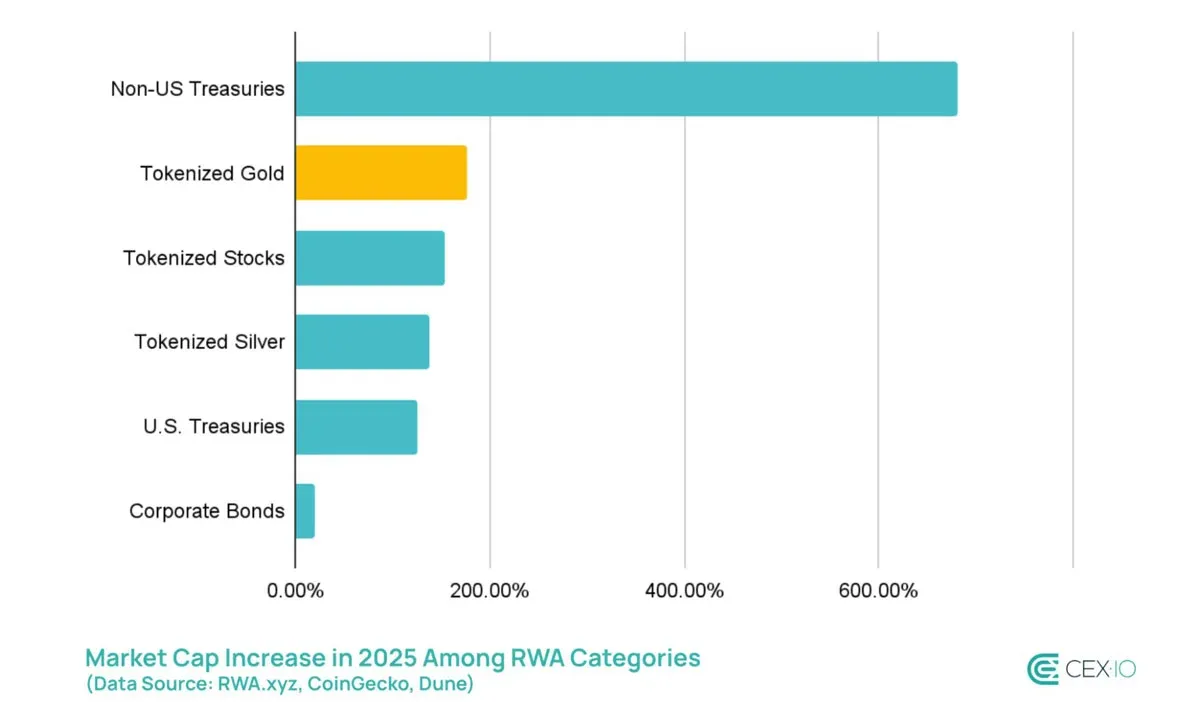
Over the past year, the total market cap of tokenized gold expanded rapidly, adding roughly $2.8 billion in new value and lifting the figure from about $1.6 billion to $4.4 billion—a rise of 177%. This growth rate clearly outpaces the traditional gold market and most spot‑gold ETFs. The number of holders also nearly doubled, with more than 115,000 new wallets, accounting for about one‑quarter of all net inflows. Compared with other real‑world assets (RWAs), tokenized gold’s expansion has already surpassed tokenized equities, corporate bonds, and non‑U.S. sovereign debt in cumulative scale.
Trading activity for tokenized gold has also risen markedly. In 2025 the cumulative trading volume for tokenized gold reached approximately $1.78 trillion, with the fourth quarter alone peaking above $1.26 trillion, making it the second‑largest gold‑investment instrument worldwide after the SPDR Gold Shares ETF.
Ioape points out that the market is primarily driven by market makers and cross‑platform liquidity providers, who exploit price differentials between digital and traditional markets for arbitrage. At the same time, macro‑traders native to the crypto space are actively participating; they use tokenized gold not only as an exposure tool to spot gold prices but also as collateral, a hedge, and a vehicle for yield strategies during periods of geopolitical or macro‑economic uncertainty.
“Some institutions are monitoring the on‑chain gold market over the weekend, especially those in macro and cross‑asset desks, and they keep a close eye on the gap risk before the CME reopens,” Ioape explains. Most institutions treat this information as a reference point rather than a direct trigger for opening positions.
Tokenized Gold Performs Price Discovery Over the Weekend
When the U.S. futures market closes for the weekend, gold’s pricing focus shifts to blockchain networks. Former Credit Suisse chief investment officer and current CIO of liquidity‑infrastructure firm Theo, Iggy Ioape, disclosed that CME gold futures stop trading at 5 p.m. Eastern Time on Friday and resume at 6 p.m. on Sunday. During the closure, regulated futures markets no longer emit price signals, and the remaining trades occur mainly in private Asian over‑the‑counter venues that lack public disclosure.
At that moment, tokenized gold assets such as PAX Gold (PAXG) and Tether Gold (XAUt) become the only channels that can trade continuously. Ioape told *Cointelegraph*: “For publicly visible price formation, the on‑chain market essentially carries 100 % of the weekend price discovery.” He added that once futures reopen, the trend already formed on‑chain is usually reflected on the CME, “We observe that when the CME reopens, the weekend’s price movement is fully echoed.”
24/7 Tokenized Gold Trading Helps Investors Manage Risk
The 24‑hour trading characteristic of tokenized gold offers investors a practical risk‑management tool. If a geopolitical flashpoint occurs while futures markets are closed, traditional investors may struggle to adjust positions in time, whereas the on‑chain market can rebalance instantly.
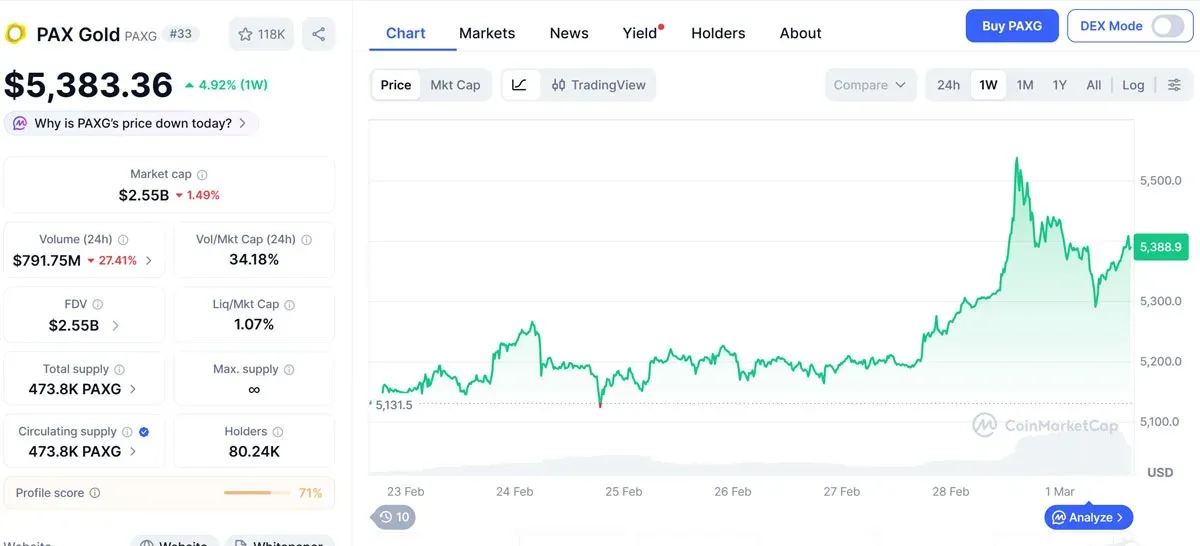
For example, on a Saturday when U.S. and Israeli military actions against Iran heightened regional tension, tokenized gold showed a clear rally. Investors moved into XAUT and PAXG, causing Bitcoin and Ether to underperform relative to gold. Data from CoinMarketCap showed XAUT briefly breaching the $5,450 mark, while PAXG approached $5,536, before both assets pulled back later in the day.
Although the advantages of on‑chain gold are becoming more evident, Ioape cautions that current liquidity remains lower than that of futures or ETFs, making large‑size trades difficult to execute without moving the price. The regulatory environment is gradually clarifying, yet fragmentation across jurisdictions still limits the speed at which institutions can deploy capital. Differences in custody, accounting, and capital‑requirement rules also act as obstacles.
He forecasts that tokenized gold will coexist with traditional products for the foreseeable future rather than replace them entirely. “The most likely near‑term trend is that tokenized markets and traditional markets will operate side by side, each serving distinct functions,” Ioape concludes.
Note for U.S. readers: When accessing cryptocurrency services, U.S. users should use Binance.US rather than the global Binance platform. Transactions involving fiat may be processed via SEPA or SWIFT, and all figures in this article are quoted in U.S. dollars (USD).
This concludes the full analysis of how tokenized gold has taken up the price‑discovery mantle over weekends. For more details on weekend pricing dynamics, stay tuned to Bitaigen’s upcoming reports.
💡 Register on Binance with referral code B2345 for the maximum trading fee discount. See Binance complete guide.
⚠️ Risk Disclaimer: Crypto prices are highly volatile. This is not investment advice.



