
 Bitaigen Research
 In this article we outline the key points of the first U.S. spot Dogecoin ETF, explain its operating model, issuance background, and how beginners can safely enter. With clear steps and risk warnings, we help investors get started quickly and make rational decisions; the following sections will provide detailed explanations.
Dogecoin ETF Overview
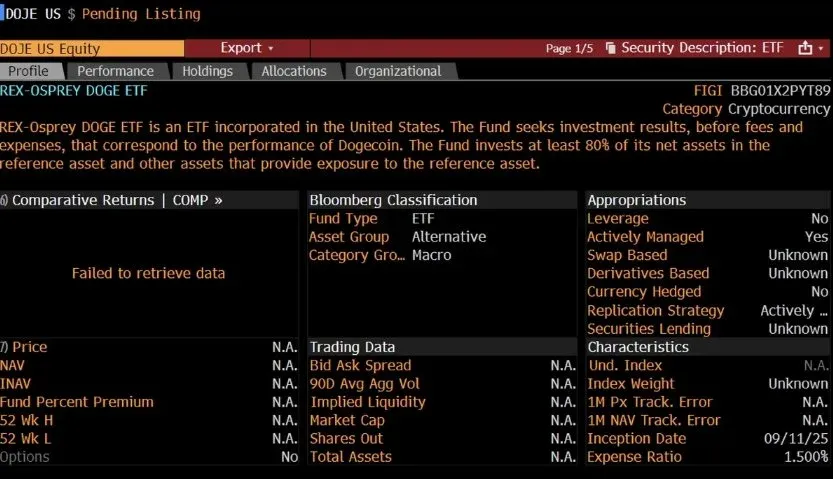
Starting on September 11 2025 (U.S. Eastern Time 9:30 – 16:00), the first U.S. spot Dogecoin exchange‑traded fund (ticker DOJE) will open for trading on an exchange. The fund is launched through a partnership between REX Shares and Osprey Funds, and is established under the Investment Company Act of 1940. It is expected to be officially listed and begin trading on the same day. In the week preceding the announcement, DOGE’s price rose roughly 13%‑17%, hovering around $0.24 per token, with a total market capitalization of about $3.8 billion.
At the same time, the SEC is reviewing multiple cryptocurrency ETF applications, including those for Bitcoin and Ethereum. By the end of August, 92 proposals had been submitted, and Bitwise’s Dogecoin ETF proposal has been postponed until November 12 2025 for approval. These fluctuations in the approval timeline provide context for how DOJE may complete its issuance through different legal pathways.
This article will systematically explain the concept of a Dogecoin ETF, the operating mechanism of REX‑Osprey’s DOJE, key issuance points, potential risks, and a complete step‑by‑step guide for novice investors to purchase the fund through a broker.
---
What Is a Dogecoin ETF
A Dogecoin ETF (Exchange‑Traded Fund) is a regulated financial product that lets investors gain exposure to DOGE price movements without directly holding or managing the underlying cryptocurrency. Investors simply buy shares of the fund through a regular securities account, following a process similar to purchasing a stock or an S&P 500 index fund, and they do not need to manage wallets or private keys.
ETFs have been proven to be a critical bridge that brings digital assets into the mainstream investor’s view. Data from *The Block* shows that the United States’ first spot Bitcoin ETF attracted over $107 billion in assets in its first year, making it one of the fastest‑growing funds in history. Analysts expect a Dogecoin ETF to replicate this growth pattern within the meme‑coin segment.
The fund pools investors’ capital and allocates assets that can mirror DOGE’s price performance, offering both retail and institutional investors a regulated and familiar entry point. For example:
- Trading convenience: During U.S. market hours (ET 9:30 – 16:00) investors can buy or sell DOJE on platforms such as Fidelity, Robinhood, and other broker‑dealers.
- No‑wallet requirement: The fund handles custody and compliance, so investors do not have to worry about losing private keys.
- Tax‑advantaged accounts: Unlike holding DOGE directly, ETF shares can be placed inside an IRA, 401(k), or other tax‑advantaged accounts.
- Usage limitation: ETF shares provide only price exposure; they cannot be used for on‑chain payments or tipping.
---
Core Features of the REX‑Osprey Dogecoin ETF (DOJE)
DOJE, as the first U.S. Dogecoin ETF, has several distinctive structural elements:
- Investment Company Act of 1940 framework
Unlike most spot Bitcoin and Ethereum ETFs that were approved under the Securities Act of 1933, DOJE follows a regulatory path that resembles a mutual fund, allowing it to bypass certain SEC approval steps.
- Cayman subsidiary holdings
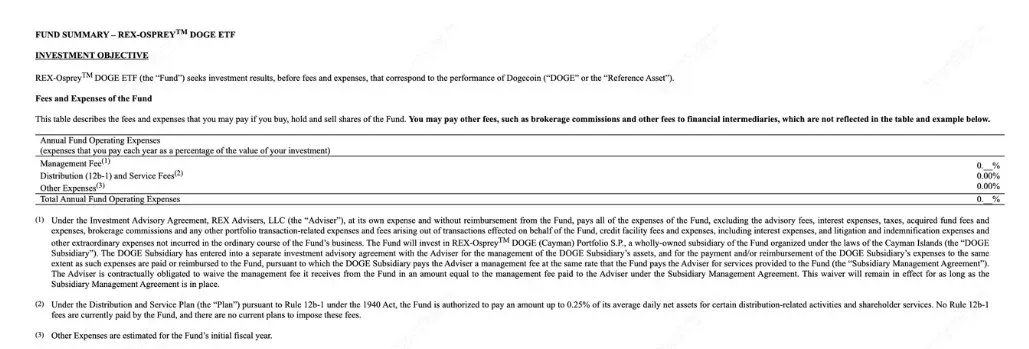
Up to 25 % of the fund’s assets may be invested in a wholly‑owned Cayman Islands subsidiary, which directly holds DOGE or derivative contracts linked to DOGE (e.g., futures, swaps). This structure helps the fund retain its U.S. tax‑efficiency status as a Regulated Investment Company (RIC).
- Diversification requirement
To satisfy the diversification rules of the 1940 Act, DOJE must also hold U.S. Treasury securities or other regulated crypto‑related ETPs. Consequently, during periods of extreme volatility the fund may show a slight deviation from the spot DOGE price.
- Fee structure
While the exact expense ratio will be disclosed after issuance, prior meme‑coin ETFs have carried management fees as high as 1.5 %, compared with an average of 0.25 %‑0.50 % for Bitcoin ETFs.
Differences From Traditional BTC/ETH ETFs
Most spot Bitcoin and Ethereum ETFs obtained explicit SEC approval under the 1933 Act, whereas DOJE follows the 1940 Act route, similar to REX‑Osprey’s earlier Solana Staking ETF (ticker SSK) that launched in July 2025. Funds using this model typically limit subsidiary assets to about 25 % of total assets to preserve their RIC tax status in the United States.
---
How a Dogecoin ETF Operates (Using DOJE as an Example)
- Fund creation
DOJE is set up under the 1940 Act. Its core assets are held by the Cayman subsidiary, which may own DOGE and related derivatives, while the main fund may also allocate cash, U.S. Treasury bonds, or other crypto‑related ETPs to balance overall exposure.
- Share creation and redemption
Authorized participants—usually large market‑making firms—create or redeem ETF shares based on the fund’s net asset value (NAV), keeping the secondary‑market price tightly aligned with NAV. In the early trading days, spreads can be wider, so investors should consider using limit orders.
- Secondary‑market trading
Investors buy and sell DOJE on U.S. exchanges. The fund’s return fluctuates with DOGE’s price, after deducting management fees and any applicable tax or structural costs, which are reflected in the investor’s account balance.
---
Practical Guide to Buying DOJE
For U.S.‑Based Investors
- Open a brokerage account
Choose a broker that supports U.S. equity trading, such as Fidelity, Charles Schwab, **E*TRADE, Robinhood**, etc., and complete the KYC verification.
- Search for ticker DOJE
On the launch day—or any subsequent trading day—enter “DOJE” in the platform’s search bar to view the fund’s quote.
- Place an order
Because the new fund may have limited liquidity, it is advisable to use a limit order to control the execution price and avoid excessive slippage from wide bid‑ask spreads.
- Select account type
Decide whether to hold the shares in a taxable brokerage account or in a tax‑advantaged vehicle such as an IRA or 401(k) for potential tax optimization.
Note for U.S. investors: If you prefer to trade on a cryptocurrency‑focused exchange, you must use Binance.US (the U.S.‑registered entity) rather than the global Binance platform, in order to remain compliant with U.S. regulations.
For International Investors
- Tradeability
DOJE is listed only on U.S. exchanges. Whether you can purchase it depends on whether your local broker provides access to U.S. equities. Global platforms such as Interactive Brokers, eToro, and TradeStation Global often allow cross‑border trading.
- Regulatory constraints
Retail investors in the EU, UK, and other jurisdictions are subject to PRIIPs regulations. If a fund does not provide a Key Information Document (KID), those investors may be prohibited from buying the U.S. ETF. Verify that your broker has satisfied the necessary compliance requirements.
- Currency conversion
DOJE is priced in U.S. dollars. When you place an order, the broker will automatically convert your local currency (e.g., EUR via SEPA, GBP via SWIFT) into USD. Be aware of foreign‑exchange fees, as they can erode overall returns.
Comparison With Direct DOGE Holding
Buying DOGE directly enables on‑chain payments, staking, or participation in DeFi protocols, and trading is 24 hours a day, unrestricted by stock‑market hours. Direct ownership incurs no ETF management fee, but you must manage a wallet, safeguard private keys, and you cannot place the asset inside traditional tax‑advantaged accounts.
---
Risks and Considerations When Investing in a Dogecoin ETF
- Price volatility
As a classic meme coin, DOGE experiences sharp price swings. In early September 2025, DOGE moved from roughly $0.216 to $0.249 within a few days—a gain of about 15 %. DOJE will mirror such volatility, meaning investors may see rapid profit or loss fluctuations.
- Tracking error
Because the fund uses a Cayman subsidiary structure under the “40 Act” model, its NAV may deviate slightly from the spot DOGE price. Additionally, the C‑corp layer could generate corporate‑level taxes before distributions are made to shareholders.
- Liquidity and spread risk
Newly listed ETFs often have modest trading volume, leading to wider bid‑ask spreads or premiums/discounts relative to NAV. Beginners are encouraged to use limit orders rather than market orders to mitigate execution risk.
- Tax implications
Like other U.S. ETFs, DOJE’s distributions (including capital gains) are taxable in the United States. If held in a taxable brokerage account, gains are taxed as ordinary income or capital gains according to the investor’s tax bracket. Placing the ETF in an IRA, 401(k), or similar retirement vehicle may defer or exempt tax, subject to the specific account rules. Investors in other jurisdictions should consult local tax regulations, as crypto‑related gains may be taxable.
- Regulatory uncertainty
The SEC continues to review additional DOGE ETF proposals; Bitwise’s filing has been delayed until November 12 2025. This cautious stance suggests that future policy shifts or further approval delays could affect DOJE’s operations, liquidity, or even its continued existence.
Tip: Before committing capital, thoroughly assess the risks above and read the fund’s prospectus, fee schedule, and any supplemental disclosures.
---
Frequently Asked Questions (FAQ)
1. When will DOJE officially start trading?
It is scheduled to debut on September 11 2025 on major U.S. exchanges, during regular market hours (ET 9:30 – 16:00).
2. Who are the sponsors of the fund?
DOJE is jointly managed by REX Shares and Osprey Funds, with issuance services provided by Foreside Fund Services.
3. Is DOJE a “spot” ETF?
It is not a traditional spot ETF. The fund uses a 1940 Act structure and obtains DOGE exposure through a Cayman subsidiary that holds the cryptocurrency and/or related derivatives.
4. Can I hold DOJE inside an IRA or 401(k)?
Yes. Most ETFs are eligible for inclusion in tax‑advantaged retirement accounts, but you should confirm eligibility with your broker or plan administrator.
5. Should I choose DOJE over buying DOGE directly?
If you prefer a regulated trading platform, traditional account structures, and the possibility of tax‑advantaged treatment, DOJE may be appealing. If you value 24/7 on‑chain functionality, zero management fees, and direct control of the asset, buying DOGE on a crypto exchange (e.g., BingX) might better suit your needs.
---
Conclusion
The launch of DOJE gives investors a way to obtain Dogecoin exposure the same way they trade ordinary stocks, providing a new pathway for those who wish to enter the crypto space via regulated broker‑dealers rather than crypto‑centric exchanges. If you value trading convenience, unified account management, and potential tax benefits, an ETF‑style exposure can be attractive; however, if you prioritize 24‑hour trading, on‑chain use cases, and avoidance of management fees, holding DOGE directly on platforms such as BingX remains a straightforward alternative.
Regardless of the route you select, allocate capital in line with your risk tolerance, keep an eye on the latest SEC regulatory developments, and review the fund’s official documentation and fee schedule before investing.
---
This article ends here. For more information on Dogecoin ETFs, you can search the archives of Bitaigen (比特根) or follow the related links below. Thank you for reading!
Related Reading
- Bitcoin Spot ETF Net Outflows Hit $2.9B, BTC Falls Below $73K – 2026 Low
- Bitcoin Spot ETF Surge: $462M Inflow & BTC Breaks $73K
- Bitcoin Rebounds on Spot‑ETF Inflows: Short‑Term Impact
💡 Register on Binance with referral code B2345 for the maximum trading fee discount. See Binance complete guide.
⚠️ Risk Disclaimer: Crypto prices are highly volatile. This is not investment advice.



