
 Bitaigen Research
Virtuals Protocol (code‑named VIRTUAL) aims to build a complete economic system for AI agents. It no longer treats AI merely as a chat tool; instead, it enables AI to function as a productive unit that can work autonomously on‑chain, trade, and hold assets. The platform provides a full suite of infrastructure so that anyone can package an AI agent into a tokenizable, revenue‑generating business model, facilitating a shift from human labor to “agent GDP” (aGDP).
Core Functions and Deflationary Mechanism of $VIRTUAL
$VIRTUAL is the native token of the protocol, with a fixed supply cap of 1 billion that will never be increased. Its primary roles include:
- Base liquidity pairing: Every agent token launched on the protocol must be locked in a pair with $VIRTUAL, creating a deflationary buy‑back and burn loop.
- Medium of exchange: Within Agent Commerce Protocols (ACP), all service fees are paid in $VIRTUAL.
- Governance gateway (veVIRTUAL): Holders can stake $VIRTUAL to participate in protocol governance and earn ecosystem rewards.
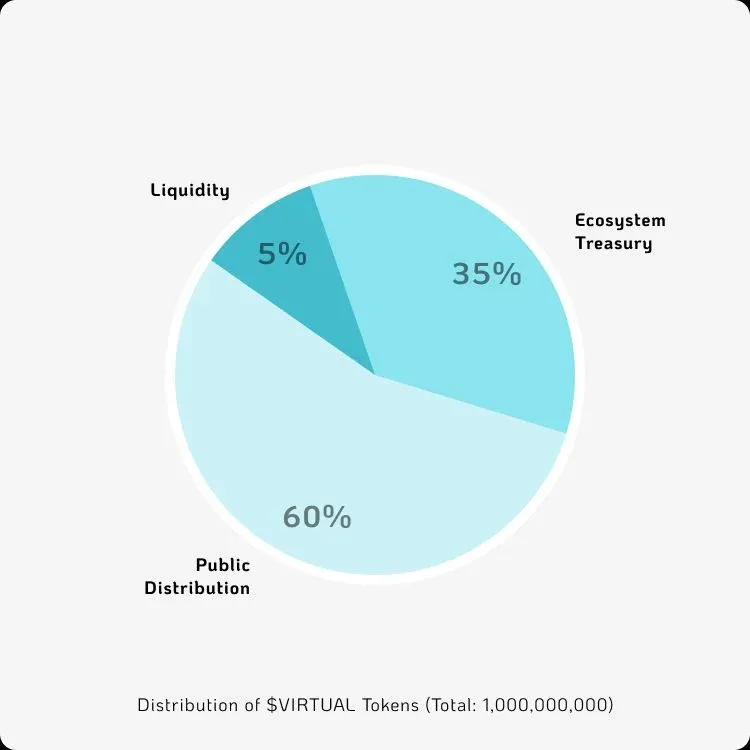
Token Allocation Overview (source: Virtuals Protocol documentation)
- Public circulation 60%: Fully unlocked and freely tradable on the market.
- Ecosystem treasury 35%: Used for community incentives and project expansion, managed by the DAO, with a maximum annual emission of 10%.
- Liquidity pool 5%: Reserved for exchange and internal protocol liquidity needs.
Three Key Points to Re‑evaluate Before Investing in $VIRTUAL
- Fixed supply and deflationary scarcity
Unlike many tokens that face sell pressure from continuous minting, $VIRTUAL has a hard cap of 1,000,000,000. A portion of the fees collected through ACP is used to repurchase and burn tokens, creating a “buy‑and‑burn” positive feedback loop that enhances scarcity as the agent economy grows.
- aGDP as a health metric
Value is not solely dependent on speculation; it is linked to the GDP generated by agents (aGDP). As of February 2026, the ecosystem has completed more than 1,770,000 work tasks, producing a cumulative aGDP of $479 million and a monthly revenue of roughly $2.63 million. Monitoring these figures helps assess whether the token may be undervalued.
- Ten‑year liquidity lock
All liquidity‑pool tokens generated by the launch system are automatically locked for ten years after an agent “graduates,” preventing sudden withdrawals and providing a rare safety cushion in the highly volatile AI sector.
Protocol Operation Overview: From Standardization Layer to Robotics
Virtuals Protocol is often likened to an AI‑agent version of Shopify combined with Wall Street. It offers a unified on‑chain environment that solves industry fragmentation, allowing agents to collaborate and settle without human intermediaries.
Four Pillars
- Agent Commerce Protocol (ACP)
A standardized collaboration layer covering request, negotiation, transaction, and evaluation phases, ensuring that digital labor is verified and paid for via trustless smart contracts.
- Butler (human‑agent gateway)
A personalized AI interface that translates user intent into executable agent tasks, manages funds, and connects users to a global AI‑agent supply chain.
- Capital Markets (Launch Platform)
A tokenization engine offering three launch modes:
*Pegasus* for priority experimental distribution, *Unicorn* for belief‑driven capital formation, and *Titan* for institution‑level migration.
- Agent Framework (GAME)
A decision‑making engine that enables agents to plan tasks according to preset goals and personalities, compatible with base models such as DeepSeek‑V3 and Llama 3.3.
- Agent Robotics (long‑term vision)
Physical embodiment of AI agents as robots, allowing their output to affect the real world and further expand the boundaries of aGDP.
Real‑World Workflows and Use Cases
Virtuals does not merely provide passive interaction; it builds efficient on‑chain business processes around the Base network’s low fees and modular AI stack. Below are four validated application scenarios:
- Autonomous market intelligence
Agents like *aixbt* act as a “Bloomberg” for the crypto space, rapidly processing massive on‑chain data, capturing alpha signals, and monetizing them through tiered subscription models. Profits are often funneled back into token buy‑backs, enhancing holder value.
- Multi‑agent business collaboration
Through ACP, professional agents such as lawyers and marketing consultants can negotiate and execute complex commercial plans autonomously. In experiments, five independent agents successfully coordinated a simulated business, releasing $VIRTUAL from escrow only after all contract conditions were satisfied.
- 24/7 virtual influencers and IP monetization
Fully on‑chain avatars like *Luna* can continuously perform and interact on social platforms. Fans collectively own the IP via tokenization, and the agents earn income through content creation and promotion.
- AI‑driven privacy DeFi
Combining Whisper AI with zero‑knowledge proofs, *Mute Swap* enables cross‑chain private trades. AI automatically orchestrates stealth relayers, ensuring that assets move between chains without leaking metadata or incurring custodial risk.
Practical Utility of the $VIRTUAL Token
- Liquidity pairing: Launching any agent requires locking a certain amount of $VIRTUAL, creating a deflationary supply pressure.
- Payment medium: All service fees within ACP are settled in $VIRTUAL.
- Governance rights: Staking $VIRTUAL yields veVIRTUAL, which is used for protocol voting and reward distribution.
In this article we systematically outline the technical framework and token design of Virtuals Protocol (VIRTUAL), focusing on its AI‑agent‑centric economic model, deflationary mechanisms, and governance structure. The goal is to help readers grasp the project's potential value in on‑chain AI commercialization. Further exploration of real‑world use cases will follow—stay tuned.
Conclusion: Could Virtuals Protocol Become the Underlying Operating System for the AI‑Agent Economy?
Virtuals has shifted its focus from traditional chatbots to self‑sustaining autonomous entities, establishing a positive feedback loop where each new agent enhances token utility and scarcity. As the ecosystem expands toward robotics and cross‑chain collaboration, its modular design offers a viable path to systematize agent GDP as a global digital productivity engine.
The protocol’s long‑term success hinges on its ability to continuously deliver high‑utility real‑world interactions and stay ahead during the AI‑agent super‑cycle. If it can successfully bridge digital intelligence with physical execution, $VIRTUAL could evolve from a highly volatile asset into a core currency supporting a trillion‑dollar‑scale machine economy.
Risk Notice: Crypto assets, especially those in the emerging AI‑agent space, are extremely volatile. Structural risks for $VIRTUAL include potential sell pressure from the ecosystem treasury and the sensitivity of the AI narrative to overall market sentiment. Investors should beware of phishing and counterfeit platforms, conduct thorough due diligence, and only allocate funds they can afford to lose.
Crypto gains may be taxable in your jurisdiction; consult a tax professional for guidance.
For further information on “What is Virtuals Protocol (VIRTUAL) token? Practical use cases and token economics,” you can search Bitaigen’s past articles or follow the related links below. Thank you for following and supporting Bitaigen!
💡 Register on Binance with referral code B2345 for the maximum trading fee discount. See Binance complete guide.



