
 Bitaigen Research
 In the United States, the White House has disclosed plans to build a national‑level Bitcoin and digital‑asset reserve using confiscated Bitcoin rather than allocating fresh taxpayer money. This approach echoes a growing trend among states that are exploring similar mechanisms.
In Kansas, Senator Craig Bowers introduced SB 352 on Wednesday, aiming to create a “Bitcoin and Digital‑Asset Reserve Fund” within the state treasury. Management of the fund would be delegated to the state treasurer, and the capital would not come from direct purchases of Bitcoin by the state government. Instead, it would be sourced from unclaimed cryptocurrency assets and the income those assets generate.
The fund’s composition would consist of three categories of revenue: airdrop receipts, staking rewards, and interest earned on abandoned digital assets held under Kansas’s unclaimed‑property statutes. These assets are limited to cryptocurrencies and other purely digital forms of property, thereby avoiding the practice of buying Bitcoin on the open market.
Under the bill, 10 % of each digital‑asset holding in the fund must be transferred to the state’s general fund, although Bitcoin itself would be excluded from that general‑fund allocation.
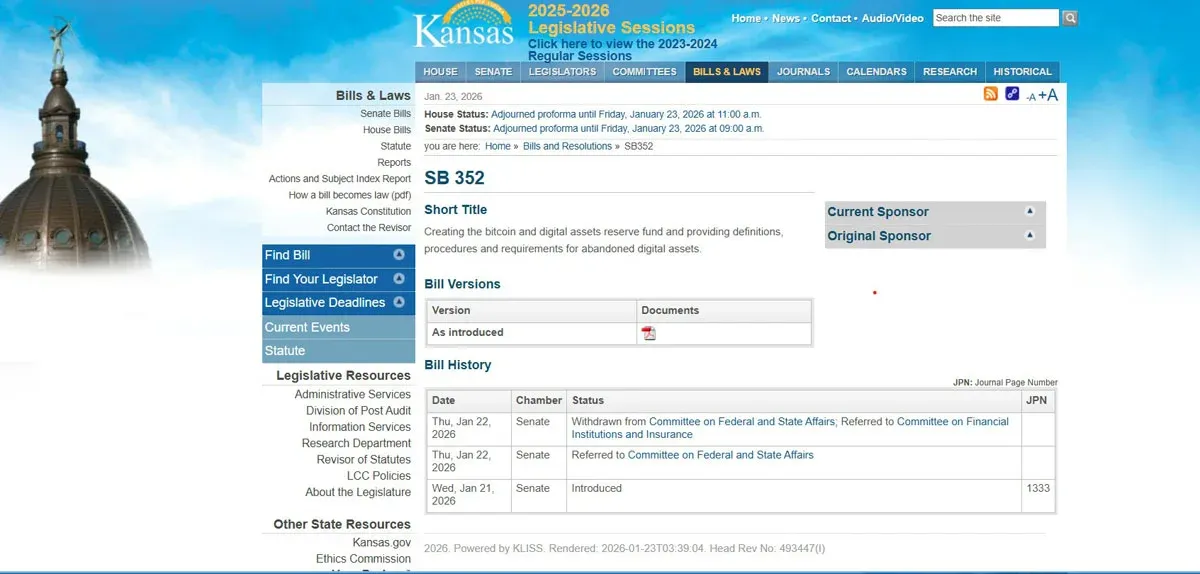
SB 352 also amends Kansas’s unclaimed‑property legislation, providing clear definitions for “digital asset” and “airdrop,” and outlining the procedures for handling these assets when they are deemed abandoned. The proposal was moved on Thursday from the Federal and State Affairs Committee to the Financial Institutions and Insurance Committee for further consideration.
It is worth noting that Kansas has previously introduced several cryptocurrency‑related bills. For example, SB 34, filed in January 2025, permits the state public‑employee retirement system to allocate up to 10 % of its portfolio to a spot Bitcoin ETF; that measure is still pending before the Financial Institutions and Insurance Committee.
In this article we summarize the latest legislative developments in Kansas, explain how the state government intends to build a digital‑asset reserve from unclaimed crypto holdings, and examine how this aligns with federal‑level policy. Understanding the design details and potential impact of this mechanism is important for ongoing observation.
Kansas and Other States Testing Bitcoin Legislation
Kansas is not the only jurisdiction pursuing such experiments; other states have also introduced a variety of legislative proposals ranging from strategic reserves to dedicated working groups and targeted allocations of digital assets.
Internationally, countries such as El Salvador and Bhutan have incorporated Bitcoin into their national development strategies. They do so by holding Bitcoin directly, operating state‑owned mining operations, or using Bitcoin within special economic zones to fund long‑term projects, illustrating the increasing relevance of digital assets in public policy.
For more information on government‑level Bitcoin and digital‑asset reserves, please follow the continuing coverage from Bitaigen (比特根).
Localization notes:
- When referring to fiat currency, the article uses USD for United States transactions and SEPA/SWIFT references for cross‑border transfers.
- U.S. residents wishing to trade on Binance must use Binance.US rather than the global Binance platform.
- Crypto‑related gains may be subject to tax in the relevant jurisdiction; readers should consult local tax regulations or a qualified professional.
Related Reading
- Steak ’n Shake Adds $5M Bitcoin, Rewards Employees in Crypto
- Strategy's Bitcoin-Backed Preferred Shares Financing
- VanEck predicts Bitcoin market cap to hit $2.9 trillion by 2050, powering global
💡 Register on Binance with referral code B2345 for the maximum trading fee discount. See Binance complete guide.
⚠️ Risk Disclaimer: Crypto prices are highly volatile. This is not investment advice.



