
 Bitaigen Research
 Although calling it a “century‑level attraction” may sound a bit exaggerated, there is no denying that cryptocurrencies have become a major force of the 21st century, drawing massive attention and capital. Their rise is rooted in rapid technological progress, the growing demand for decentralized finance, and an increasingly interconnected global economy.
In this article we lay out the core concepts behind Bitcoin and compare altcoins on three key dimensions—issuance mechanism, use‑case scenarios, and supply models. The goal is to help readers quickly clarify the fundamental differences, assess which type of asset aligns with their own needs, and provide practical onboarding guidance for taking the first step.
What Is Bitcoin
Bitcoin is a blockchain‑based, decentralized digital currency. Altcoins refer to all other cryptocurrencies besides Bitcoin, and they differ markedly in issuance mechanisms, intended uses, and supply characteristics.
Bitcoin was released in 2009 by an individual or group using the pseudonym Satoshi Nakamoto. Thanks to its peer‑to‑peer transaction model, high speed and low fees, Bitcoin quickly challenged the traditional financial system. The first altcoin—Namecoin (NMC)—appeared in April 2011, built on Bitcoin’s codebase to enable decentralized domain‑name registration, aiming to create a censorship‑resistant ecosystem and promote freedom of speech.
From that point onward, the cryptocurrency market entered an explosive growth phase, with total market capitalization soaring and attracting a broader audience. Platforms such as Binance (global users) or Binance.US (U.S. residents) provide credit‑card purchase gateways, turning abstract fintech concepts into tangible assets that ordinary investors can acquire.
You might be wondering: how do I decide whether Bitcoin or another cryptocurrency better suits me?
That very question forms the starting point of this guide.
Key Distinctions Between Bitcoin and Altcoins
From a fundamentals perspective, the gap between Bitcoin and altcoins can be grouped into several dimensions:
- History and Market Share
- Bitcoin has been live since 2009 and, as of early 2025, accounted for roughly 62 % of the total crypto market cap; altcoins together made up about 38 %.
- Purpose and Design
- Bitcoin focuses on secure value transfer; altcoins target a variety of needs such as faster transaction speed, lower fees, privacy, smart‑contract capability, and DeFi functionality.
- Supply and Inflation
- Bitcoin’s maximum supply is capped at 21 million coins; most altcoins have either an uncapped supply or a ceiling far above Bitcoin’s.
- Volatility
- Bitcoin’s price swings are generally milder than those of many altcoins, which can experience extreme spikes and drops.
- Adoption
- Thanks to strong brand recognition, Bitcoin enjoys the highest awareness among merchants and institutions; certain altcoins (e.g., Ethereum) have built sizable ecosystems in specific niches.
Technical Differences
- Consensus Mechanism: Bitcoin uses Proof‑of‑Work (PoW); many altcoins employ Proof‑of‑Stake (PoS), Delegated Proof‑of‑Stake (DPoS), or hybrid models.
- Programmability: Bitcoin’s scripting language is deliberately limited, supporting only basic payment functions. In contrast, most altcoins offer full‑featured smart‑contract platforms, enabling more complex business logic.
Factors to Weigh When Evaluating Bitcoin, Altcoins, or a Mixed Portfolio
Investors can approach the decision through two broad lenses:
- Bitcoin as an Emergency‑Reserve Asset
- Its scarcity and strong network effects position it as “digital gold.”
- Altcoins for Portfolio Upside
- Innovative on‑chain features, low entry barriers, and rapid iteration can provide additional return potential.
Illustrative Cases
- During the COVID‑19 pandemic, Bitcoin surged past $29,000 at year‑end, highlighting its hedge‑like qualities.
- The Russia‑Ukraine conflict caused a short‑term dip, but Bitcoin quickly rebounded to above $40,000.
Unique Value Propositions of Altcoins
- Low price thresholds make them accessible for small‑scale entry.
- They often focus on niche use‑cases such as payments, stablecoins, social tokens, etc.
- Short development cycles allow for swift upgrades and new feature rollouts.
- Many support staking and passive‑income mechanisms, boosting the effective yield on held tokens.
Note: Crypto gains may be taxable in your jurisdiction. Be sure to consult a tax professional regarding any obligations.
How to Purchase Bitcoin on Binance
If you have not yet created a Binance account, use the links below to register and download the mobile app.
- [Register on Binance (global) – copy the URL into your browser](https://accounts.binance.com/register?ref=B2345)
- U.S. residents should register on Binance.US instead.
- [Download Binance Android App](https://www.bitaigen.com/binance/download)
Further reading: “2025 Binance Guide – Deposits, Withdrawals, Fees, and Security Overview”
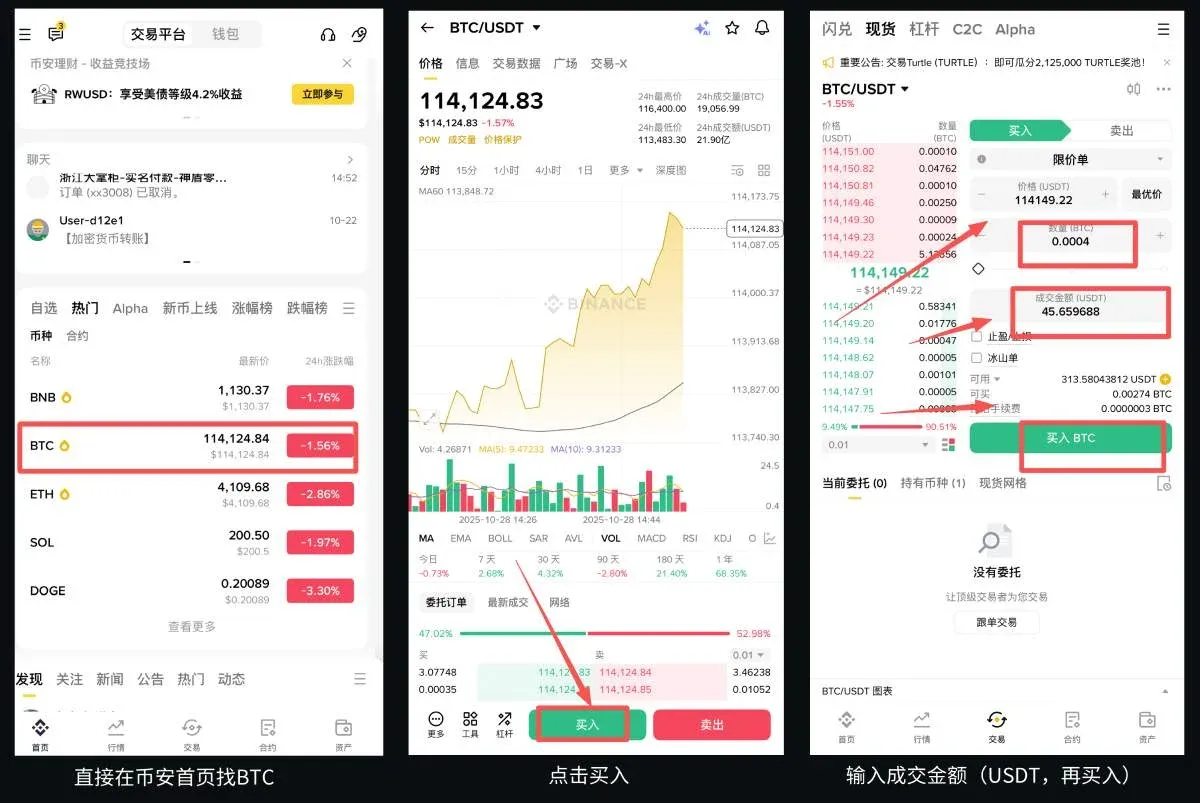
After funding your account with USDT (or fiat via USD, SEPA, or SWIFT transfers where supported), you can start trading. The steps below describe the mobile‑app workflow:
- Tap the Trade button at the bottom of the screen.
- In the upper‑left corner, select the trading pair, type BTC, and choose BTC/USDT (using USDT to buy BTC).
- Press Buy, which presents two order types:
- Market Order – executes instantly at the best available price.
- Limit Order – you set a target price (e.g., you expect BTC to dip to $65,000) and the order fills automatically when that price is reached.
- Enter the price (for a limit order) and either the amount in BTC or the total in USDT you wish to spend.
- Review the details, then tap the green Buy BTC button to submit the order.
Conclusion
Bitcoin and altcoins each bring distinct strengths. The decision is not about choosing one *instead* of the other, but about aligning the asset(s) with your personal risk tolerance, investment objectives, and intended use cases. The framework and information presented here aim to help readers clarify their own needs and identify a suitable entry point.
This concludes the brief overview of “What is Bitcoin? What are the main differences with altcoins? A simple introduction.” For deeper analyses of Bitcoin and altcoins, search Bitaigen or continue reading the related articles below. Thank you for your continued interest and support!
Related Reading
- Crypto stress‑test slashes BTC & ETH, hurting balance sheets
- Bitcoin Mining: Proof-of-Work, Difficulty & Coin Creation
- Understanding Bitcoin Staking: Concepts, Benefits, and Implementations
💡 Register on Binance with referral code B2345 for the maximum trading fee discount. See Binance complete guide.



