
 Bitaigen Research
Cryptocurrency stress‑testing has caused Bitcoin and Ethereum prices to tumble sharply, driving paper losses for companies holding these assets into the billions and delivering a noticeable hit to their balance sheets.
The crypto downturn has also spread to government bonds, exchange‑traded funds (ETFs) and mining infrastructure, underscoring how digital‑asset volatility can reshape corporate financial structures and operating models. This sell‑off is reflected not only in price charts but also directly on balance sheets, spot‑ETF holdings, and the way infrastructure is utilized.
This week, the slide in Ethereum (ETH) forced firms with large sovereign‑bond exposures to register massive unrealized losses; at the same time, Bitcoin (BTC) ETFs gave new investors a first‑hand feel for downside volatility. Extreme weather conditions reminded miners that hash power still depends on the electricity grid, while former miners pivoting to artificial intelligence show that yesterday’s mining hardware is gradually becoming the backbone of AI compute.
This edition of the Crypto Biz newsletter focuses on three hot topics:
- BitMine Immersion Technologies’ growing paper loss on Ethereum.
- BlackRock iShares Bitcoin Trust (IBIT) holders see positions fall below cost.
- A brief U.S. winter storm shock to public‑miner production.
In this report we dissect the recent extreme volatility in the crypto market, explaining how the decline in Bitcoin and Ethereum prices directly pressures corporate balance sheets, and exploring the ripple effects on sovereign‑bond ETFs, mining infrastructure, and emerging AI compute. Through case studies we help readers grasp the full risk‑transmission picture; later sections will provide deeper industry insight.
Note for U.S. readers: trading on Binance.US is required rather than the global Binance platform.
Tax reminder: crypto gains may be taxable in your jurisdiction; consult a local tax professional.
BitMine’s Ethereum paper loss widens
- BitMine Immersion Technologies, chaired by Tom Lee, recently saw its Ethereum reserve dip below $2,200 per ETH.
- Unrealized losses have now topped $7 billion, with the company holding roughly $9.1 billion worth of ether, including a fresh purchase of 40,302 ETH.
- Lee responded to criticism by stating that unrealized losses are an inherent feature of holding Ethereum, saying, “BitMine was designed to track Ethereum’s price, so losses in a down market are expected.”
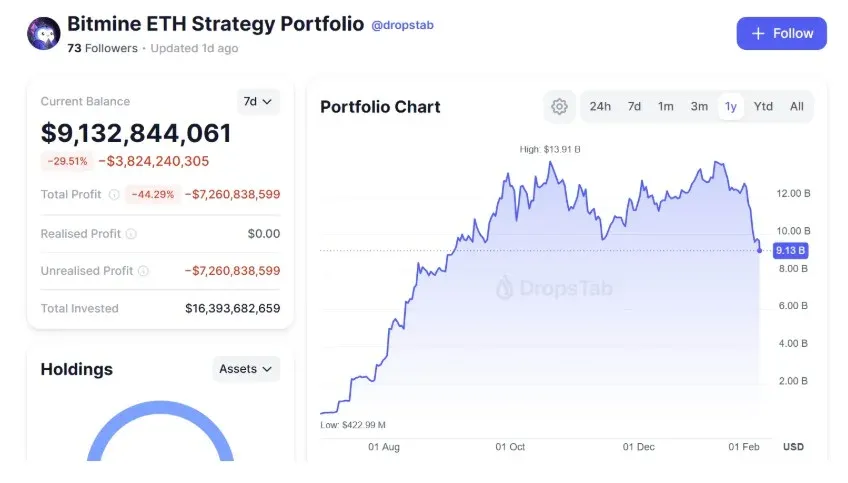
Source: Dropslab
BlackRock Bitcoin ETF holders fall below cost basis
- As Bitcoin slipped under $80,000, BlackRock iShares Bitcoin Trust (IBIT) turned negative on a cumulative‑return basis.
- Unlimited Funds CIO Bob Elliott noted that the average IBIT investor is now sitting in a loss; a further dip below $75,000 intensified return pressure.
- IBIT is one of BlackRock’s most successful ETFs, having rapidly amassed $70 billion in assets, and investors are now feeling Bitcoin’s high volatility firsthand.
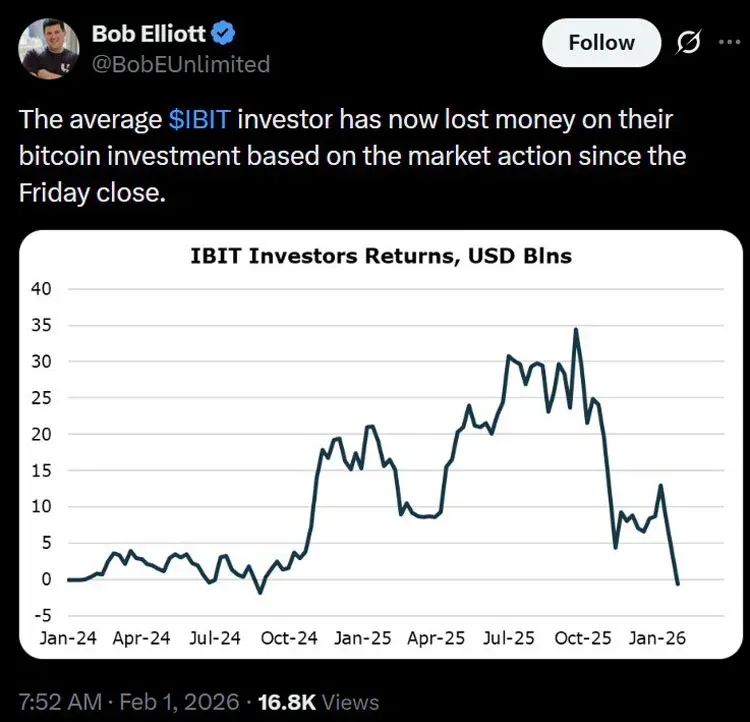
Source: Bob Elliott
U.S. winter storm temporarily slashes Bitcoin production
- A strong winter storm in late January forced U.S. Bitcoin miners to cut output dramatically, exposing the sector’s heavy reliance on the power grid.
- CryptoQuant data show that before the storm, public miners were producing about 70–90 BTC per day; during the peak outage, output fell to 30–40 BTC.
- Production rebounded quickly as weather improved, demonstrating miners’ ability to flexibly adjust operations when electricity is scarce.
- The data cover publicly listed miners such as CleanSpark, MARA Holdings, Bitfarms, Iris Energy, providing a snapshot of industry response to power shortages.
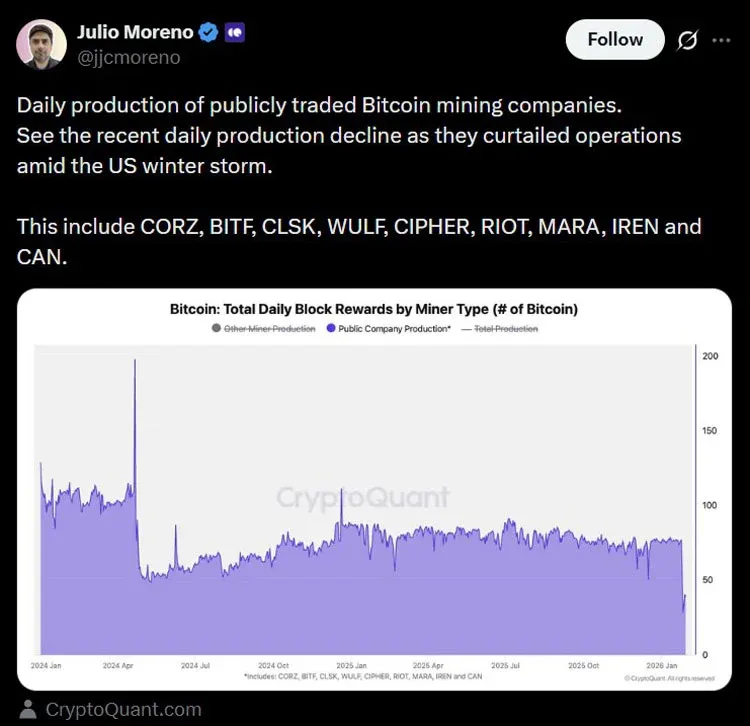
Source: Julio Moreno
CoreWeave shows how crypto infrastructure can become the backbone of AI data centers
- CoreWeave has transitioned from a crypto‑mining operation to an AI‑infrastructure provider, offering a textbook example of mining hardware repurposing for AI workloads.
- Ethereum’s move from proof‑of‑work (PoW) to proof‑of‑stake (PoS) dramatically reduced GPU mining demand, prompting CoreWeave and similar operators to shift toward high‑performance computing and AI.
- Although CoreWeave no longer operates as a crypto company, its pivot provides diversification insights for miners such as HIVE Digital, Hut 8, MARA Holdings, among others.
- After Nvidia agreed to invest $2 billion in equity in CoreWeave, the industry further affirmed that infrastructure originally built for crypto mining is becoming a key component of AI data centers.
The above constitutes a comprehensive analysis of the crypto stress‑test impact on balance sheets, covering the sharp declines of Bitcoin (BTC) and Ethereum (ETH). For more updates, follow Bitaigen (比特根) for subsequent coverage.
Related Reading
- Iranian Rial Collapse Triggers Bitcoin Surge as Safe‑Haven
- Gold vs. Bitcoin 2026: Why Gold Leads as a Safe-Haven Asset
- Bitcoin Difficulty Pullback 2026 Boosts BTC Price Above $94k
💡 Register on Binance with referral code B2345 for the maximum trading fee discount. See Binance complete guide.
⚠️ Risk Disclaimer: Crypto prices are highly volatile. This is not investment advice.



