
 Bitaigen Research
In this article we systematically outline the core principles, historical origins, and real‑world deployments of Proof of Work on major chains such as Bitcoin, helping readers quickly grasp PoW’s security characteristics and technical implementation path. Subsequent sections will delve deeper into its advantages and challenges, making it well worth a careful read.
What is Proof of Work
Proof of Work (PoW) is the most fundamental consensus mechanism in the blockchain space. Early blockchain projects such as Bitcoin, Ethereum and Litecoin all employed PoW to ensure ledger consistency and immutability.
The PoW concept can be simplified to: all network nodes race to solve the same mathematical puzzle; the first one to find the solution gains the right to write a block and receives the corresponding block reward (i.e., newly issued cryptocurrency from the blockchain network).
In 1993, cryptography pioneers Cynthia Dwork and Moni Naor first introduced the PoW concept in a research paper. In 2008, Satoshi Nakamoto selected PoW as Bitcoin’s consensus mechanism. As Bitcoin’s price rose, the value of PoW gradually became widely recognized. Today, PoW is one of the mainstream consensus mechanisms for cryptocurrencies.
On August 7 2010, Satoshi posted on the Crypto‑Punk forum: “Proof of work has a beautiful property: it can be forwarded through untrusted intermediaries.” Implementing PoW consumes a large amount of energy, but this also endows the blockchain network with strong resistance to attacks. To deceive the network under a PoW scheme, an attacker would have to incur an extremely high cost. *(Note: rewards earned from mining may be taxable in your local jurisdiction.)*
How Proof of Work Operates
To achieve consensus on transaction outcomes within a bounded time, the PoW mechanism requires network nodes to compete for the right to write blocks and claim block rewards. Here, “work” refers to computation, and hash power plays a decisive role in PoW.
There is no shortcut to the computation; the only way to solve the puzzle is to pile on hash power and keep “colliding” (guessing) until the unique correct answer is found. Once a node obtains the correct result, it broadcasts it; all other nodes instantly verify the solution, and the transactions in the block become confirmed. The network then moves on to the next round of block‑writing competition, a process commonly called “mining”.
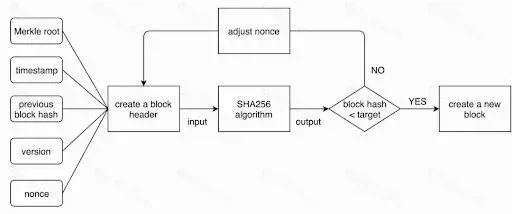
Although only one node receives the reward in each round, each round is independent of the others, ultimately evolving into a pure competition of hash power. The larger the hash power a node controls, the higher its chance of receiving the reward. The time, equipment, and energy expended by all nodes together constitute the cost of maintaining blockchain security. The more nodes there are and the greater the energy consumption, the higher the security of the blockchain.
The PoW design is simple and elegant; Bitcoin, which uses PoW, theoretically achieves the highest degree of decentralisation. Without PoW, the trustless Bitcoin network could not operate.
Advantages of Proof of Work
- Simple and reliable architecture; relatively easy to implement.
- High decentralisation; no central governing body is required, and nodes can freely join or leave.
- High cost of malicious behaviour, leading to strong security. An attacker would need to control more than half of the network’s total hash power (a 51 % attack) to tamper with the chain or seize control. Given the massive scale of global hash power, the attack cost is prohibitively expensive.
Limitations of Proof of Work
- Massive resource consumption due solely to hash‑power competition.
As the Bitcoin network’s hash power has grown, mining energy consumption has become a global concern. The Cambridge Centre for Alternative Finance estimates that, as of 10 May 2021, worldwide Bitcoin mining consumed roughly 149.37 TWh per year. Compared with individual countries, this electricity usage exceeds that of Malaysia, Ukraine and more than 100 other nations, and is close to that of Vietnam, which ranks around 25th in global consumption.
Moreover, a large portion of Bitcoin’s energy comes from coal and other traditional sources, creating environmental pressure. Consequently, several countries—including China—have outright banned Bitcoin mining.
- Low efficiency.
The PoW mechanism makes Bitcoin’s confirmation speed slow and its throughput low. Because of the high difficulty, Bitcoin’s block time is about 10 minutes, meaning a single transaction typically requires around 1 hour (about six blocks) to achieve final confirmation. Bitcoin’s transactions‑per‑second (TPS) rate is only about 7, i.e., it can process roughly seven transactions each second.
- High equipment requirements, leading to centralisation tendencies.
In Bitcoin’s early days, mining could be performed on a personal CPU. As prices rose and hash‑power competition intensified, high‑performance graphics cards and eventually specialised ASIC miners became the norm. The rising hardware barrier gave rise to professional mining pools that control the majority of hash power, which conflicts with Bitcoin’s original decentralisation ethos.
Which Blockchains Use PoW?
Bitcoin and Litecoin
Bitcoin is the world’s first cryptocurrency and the birthplace of PoW; consequently, high‑energy‑consumption PoW is a defining characteristic of Bitcoin. It is expected that Bitcoin will continue to use PoW for the foreseeable future.
Beyond Bitcoin, many early cryptocurrencies borrowed Bitcoin’s architecture and also adopted PoW, such as Litecoin (LTC). Several Bitcoin forks likewise employ PoW, for example Bitcoin Cash (BCH) and Bitcoin SV (BSV).
Ethereum
Ethereum, launched in 2014, originally used a PoW consensus mechanism as well. However, due to several drawbacks of PoW, Ethereum is gradually transitioning to the more energy‑efficient and higher‑performance Proof of Stake (PoS) mechanism—a shift known as the Ethereum 2.0 upgrade.
Ethereum introduced a PoS‑based beacon chain at the end of 2020, and the main chain is expected to merge with the beacon chain by 2022, completing the full transition to PoS.
In addition to Ethereum, some other PoW‑based cryptocurrencies are also considering migration to PoS, such as Dogecoin (DOGE).
Closing Remarks
As the earliest blockchain consensus method, PoW remains widely used today, and its concepts have inspired every subsequent blockchain project. PoW possesses irreplaceable strengths but also significant drawbacks. As the industry matures and user bases expand, issues of energy waste and performance limitations become increasingly prominent.
Many new public chains now market themselves as more decentralised, energy‑saving, and efficient, yet they have yet to displace Bitcoin’s dominant PoW position. Whether a “perfect consensus” will emerge in the future—one that balances security, decentralisation, and resolves PoW’s existing problems—remains a topic worthy of continued attention.
That concludes the article “What is Proof of Work (PoW)? Full Analysis of Principles and Applications.” For more in‑depth coverage of Proof of Work, please search for previous Bitaigen articles or continue browsing the related posts below. We look forward to your continued support of Bitaigen!
💡 Register on Binance with referral code B2345 for the maximum trading fee discount. See Binance complete guide.



