
 Bitaigen Research
 Bitcoin (BTC), as the definitive bellwether of the cryptocurrency market, continues to see its price trajectory dictate the pulse of global investors. This article provides an in-depth exploration of Bitcoin's price path from 2026 to 2040, integrating dimensions of technical analysis and market sentiment alongside historical data and the current macroeconomic environment. By analyzing core factors such as key support levels, market cycle patterns, and institutional participation—and synthesizing prediction models from industry experts—we present a comprehensive analysis of Bitcoin's long-term value.
Current market analysis reveals a significant divergence in Bitcoin price forecasts for 2026. Bulls argue that, driven by institutional accumulation and the lingering effects of the halving, prices could surge toward the $150,000 to $170,000 range. Conversely, bears, relying on the historical four-year cycle theory, predict a major correction during this period, with prices potentially retracing to the $53,000 to $60,000 zone.
As the "North Star" of the crypto market, Bitcoin's cross-cycle movement remains the focal point of industry discourse. The editorial team has synthesized multi-dimensional data—including macro cycles, technical indicators, and institutional dynamics—to forecast potential value trajectories between 2026 and 2040. This article aims to look beyond short-term volatility, dissecting market points of contention and core support levels from a fundamental logic perspective. Our goal is to help you build a rational long-term observation framework to understand the evolution of "Digital Gold" over the next decade. Note that cryptocurrency gains may be taxable depending on your local jurisdiction, and US-based users should utilize regulated platforms such as Binance.US.
In-Depth Technical Analysis of Current Bitcoin Trends
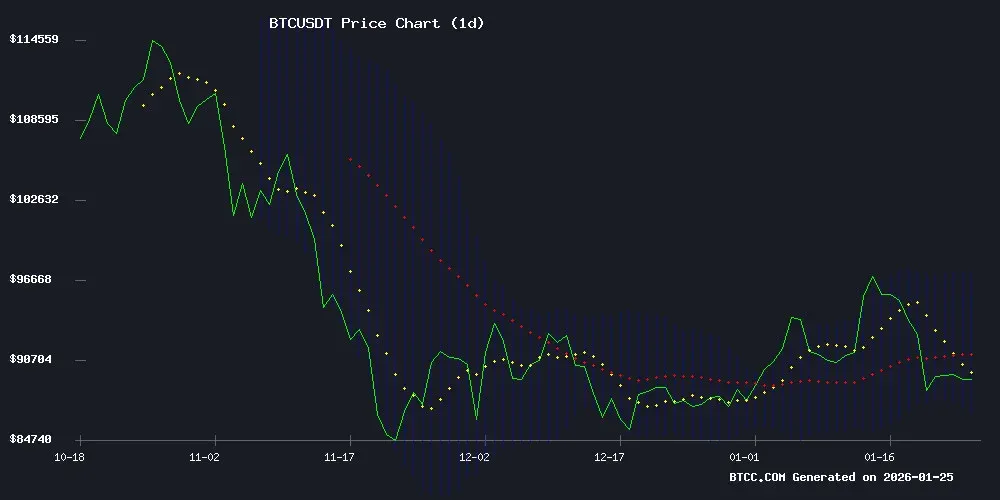
Technical indicators suggest that Bitcoin is currently at a critical market turning point. As of early 2026, Bitcoin prices are fluctuating near the $86,783 level (often denominated in USDT or USD for global trading). From a technical standpoint, the MACD (Moving Average Convergence Divergence) shows a difference of 897.78, indicating that market momentum is rapidly accumulating. Sophia, a senior analyst at BTCC, noted: "Bitcoin has established strong support at the $88,613 level. Although it touched a high of $91,976 over the past 20 days, the current pullback to $86,783 remains within the range of a healthy technical shakeout and consolidation."
The Impact of Institutional Accumulation on the Bitcoin Market
The trend of traditional enterprises incorporating Bitcoin into their corporate balance sheets has become a mainstream reality. A recent high-profile event involved GameStop purchasing 4,710 BTC (representing approximately 4.5% of the total circulating supply at the time), utilizing Coinbase Prime for institutional-grade custody. Data from CryptoQuant indicates that institutional investors are accelerating their positioning, with buying patterns closely mirroring the market bottom of 2022. Such "traditional corporate asset allocation" cases will serve as a primary catalyst for sustained market growth in the coming years. For international investors, the ease of moving fiat via SEPA in Europe or SWIFT globally into major exchanges has further lowered the barrier for these institutional entries.
2026 Bitcoin Price Prediction: The $150,000 Super Cycle
The inertia of institutional investment growth may propel Bitcoin into a new "Super Cycle." Epoch Ventures, an infrastructure-focused VC firm, released a report in early 2026 proposing the aggressive view that the "four-year cycle is dead." They argue that with the full-scale adoption of Spot ETFs and sovereign nations beginning to include Bitcoin in their strategic reserves, Bitcoin's Volatility is undergoing a systemic decline. The move from $126,000 down to $81,000 at the end of 2025 is viewed as a technical "squat" before a jump, rather than the start of a traditional bear market.

According to this logic, 2026 will benefit from the realization of expected Fed rate cuts. The subsequent release of global Liquidity will drive up risk assets.
- Bullish Target: Bitcoin is expected to break its previous all-time highs in the second half of 2026, with a target range of $150,000 - $170,000.
- Model Support: The Power Law model calculates a fair value center of approximately $142,000 for the year 2026.
2026 Bitcoin Price Prediction: The Bearish Script of a Retracement to $53,000
The regularity of historical cycles remains a core risk that veteran traders are wary of. Experienced investors have observed that Bitcoin's history exhibits a distinct "bull-bear alternation" rhythm: the bull markets of 2013, 2017, and 2021 were all followed by deep corrections in the subsequent years. Following this pattern, if a peak was reached in 2025, 2026 could usher in a primary downward wave.

Bearish analysts point out that if the market structure breaks below the 50-day and 200-day Moving Averages (MA), a sustained downtrend will be confirmed.
- First Support Level: $73,000 (the 2024 peak).
- Extreme Retracement Level: The $53,000 - $60,000 range. This area represents a high-density liquidity zone from before the previous bull run started. If the macroeconomy deteriorates or if there is a massive outflow of ETF funds, the asset's drawdown could reach 40% or more.
Steady Growth and the Possibility of a Double Top in 2026
The market in 2026 is highly likely to exhibit a "Double Top" structure. In the first half of 2026, driven by Ethereum ETF upgrades or positive corporate earnings reports, Bitcoin may rally to test the $105,000 - $110,000 resistance zone. However, if it fails to decisively break the $126,000 historical high, this rally could evolve into a final exit window for major smart money players.
In the market tug-of-war of 2026, $89,000 serves as a critical pivot point. Investors should closely monitor the $73,000 "lifeline." A breach below this level would signal a potential "crypto winter," while holding it maintains the hope of a push toward $150,000.
Long-Term Bitcoin Price Forecast (2026-2040)
| Time Period | Predicted Price Range (USD/USDT) | Core Driving Factors |
|---|---|---|
| **2026-2028** | $120,000 - $180,000 | Sustained ETF inflows resonating with the 2028 halving cycle. |
| **2030** | $300,000 - $500,000 | Safe-haven demand amid global CBDC development; market cap approaches Gold. |
| **2035** | $800,000 - $1,200,000 | Adoption by central banks as a reserve asset; widespread use of the **Lightning Network**. |
| **2040** | $1,500,000 - $2,500,000 | Establishment as "Digital Gold"; volatility drops below 15%. |
Key Factors Influencing Bitcoin's Long-Term Price
1. Technical Evolution: The BIP-110 Upgrade
The BIP-110 protocol upgrade is regarded as the most significant improvement since SegWit. It is expected to bring a 30% increase in transaction capacity, more robust smart contract functionality, and enhanced privacy protections. This will significantly strengthen Bitcoin's dual attributes as both a store of value and a global settlement network.
2. Market Structure and Institutional Penetration
Data shows that institutional holdings have doubled from 700,000 BTC in 2021 to 1.4 million BTC by early 2026. The professional "buy low, sell high" operations of institutions are changing Bitcoin's volatility characteristics, transitioning it from a high-risk speculative asset to a mature investment class. For US investors, this transition is facilitated by regulated entities like Binance.US and Coinbase, ensuring a safer environment for large-scale capital.
3. Macroeconomic Independence
According to research by CryptoOnchain, Bitcoin's correlation with the S&P 500 index has dropped to approximately 0.3. Against the backdrop of deepening global debt issues and divergent monetary policies, Bitcoin's role as a "crisis hedge" is becoming increasingly prominent. The ability to move funds via international networks like SWIFT into an asset that is not controlled by a single central bank is a powerful value proposition.
Frequently Asked Questions (FAQ)
- Can the Bitcoin price really reach one million dollars?
Based on mathematical modeling, if Bitcoin's market capitalization reaches 20% of Gold's market cap (approximately $12 trillion), the price per coin would approach $1 million. While the path is likely to be volatile and non-linear, it remains theoretically feasible within a long-term cycle.
- How should average investors position themselves?
A common strategy is the "Dollar Cost Averaging (DCA) + Long-term Holding" approach. It is recommended to use secure platforms (such as BTCC or Binance.US for Americans) for storage and to maintain an investment horizon of at least 3-5 years to mitigate the risks of short-term market fluctuations.
- What is the biggest risk facing Bitcoin?
The primary risks include radical changes in global regulatory policies, potential technical breakthroughs in quantum computing (though the probability remains low in the near term), and competition from alternative technologies. However, Bitcoin's 15-year history has demonstrated the immense resilience of its network.
The above is an in-depth analysis of Bitcoin price predictions and technical support from 2026 to 2040. For more real-time information on the cryptocurrency market and global financial trends, please continue to follow professional industry channels. Always remember to consult with a financial advisor and be aware of the tax implications of your trades in your specific country.
Related Reading
- Bitcoin Price Forecast 2026: Technical Analysis & Sentiment
- Bitcoin 2026 Price Forecast: Global Trends & Market Drivers
- Texas Gov't $5M Bitcoin Deal: ETF First, Self‑Custody Next
💡 Register on Binance with referral code B2345 for the maximum trading fee discount. See Binance complete guide.



