
 Bitaigen Research
The fourth Bitcoin Halving is expected to occur on the morning of April 20. However, recent market sentiment has been turning bearish due to cooling expectations of a Federal Reserve (Fed) rate cut and heightened geopolitical tension in the Middle East. News of the Israel‑Iran conflict pushed BTC down to around $59,600, a drop of roughly 6.4 % in a short period.
Historical patterns show that Bitcoin halvings are usually accompanied by sharp price swings. Current analysis points to a short‑term downside or consolidation after the halving, driven by a negative funding rate, macro‑level headwinds, and the perception that “all the good news has already been priced in.” Institutions such as JPMorgan have warned that, because the market is in an overbought zone, investors should be wary of downward pressure following the halving.
Institutional Outlook: JPMorgan and Deutsche Bank Flag Potential Pull‑backs
Mainstream financial firms are taking a cautious stance on post‑halving price action. JPMorgan noted in its latest research note that, based on an examination of Bitcoin futures open interest, BTC remains in an overbought condition and is likely to face downward pressure after the halving.
Deutsche Bank analysts share a similar view, arguing that short‑term upside is limited. Their core reasoning includes:
- Advance pricing of expectations: the market has already absorbed the positive impact of the halving over the past several months.
- Price staying high: although an immediate surge is unlikely, factors such as spot‑ETF approval could keep the price oscillating within the current range.
Funding Rate Bottoms Out, Downtrend May Extend Into June
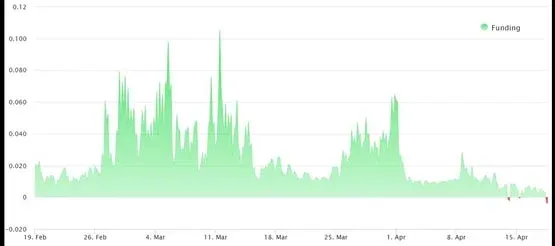
The Funding Rate metric has shown abnormal swings, catching the eye of technical analysts. Monitoring data reveals that BTC’s funding rate turned sharply negative on April 15 and April 18, hitting the lowest level seen in roughly six months.
Term Explanation: Negative Funding Rate
When the perpetual contract funding rate is negative, short‑position holders (bearish traders) must pay a fee to long‑position holders (bullish traders). This is generally interpreted as a sign of extremely pessimistic market sentiment.
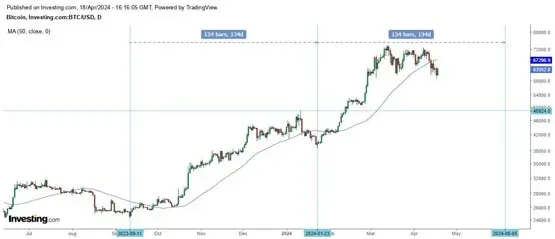
According to traders on the X platform, Bitcoin’s downward trend may not end abruptly. From a technical standpoint, the cryptocurrency has already closed below its 50‑day moving average and beneath the low recorded on March 20. Should this trajectory persist, the cyclical low of the current correction could surface around early June.
As the fourth Bitcoin halving approaches, the market has not delivered the expected one‑sided rally. Instead, price volatility has intensified under the combined influence of macro‑policy shifts and geopolitical developments. This article delves into the sentiment shift behind the negative funding rate, incorporates the latest warnings from leading institutions, and explores the potential for post‑halving oscillations and pull‑backs. In the face of miner‑sell‑off concerns and the “good news already priced in” narrative, we invite readers to follow the in‑depth logical framework presented here to identify the core signals amid a complex market environment.
Recommended Mainstream Bitcoin Exchanges
1. Binance
Binance remains the world’s largest cryptocurrency exchange by trading volume. Its services span North America, Europe, Taiwan, Southeast Asia and more than 180 countries and regions, supporting over 600 digital assets.
- Key strengths: 24‑hour trading volume has exceeded $76 billion, and the platform counts over 120 million registered users, giving it a clear edge in liquidity and order‑book depth.
Note for U.S. residents: Binance’s global platform is not available in the United States. U.S. users should use Binance.US, which complies with local regulations.
2. OKX
OKX is a leading global virtual‑currency and Web3 platform. It offers spot and derivatives trading for assets such as BTC, ETH and USDT to a worldwide user base.
- Key strengths: In Chinese‑language markets the brand enjoys high recognition; its security architecture and fee structure are competitive, and its integrated Web3 wallet features are among the most comprehensive in the industry.
3. HTX (formerly Huobi)
Huobi (now operating under the HTX brand) is a globally influential digital‑asset service provider headquartered in Singapore, with independent operation centers in Hong Kong, South Korea, Japan and other regions.
- Key strengths: As an established exchange, Huobi boasts a mature risk‑control framework and extensive customer‑service experience, and it once held the record for the highest global Bitcoin trading volume.
4. Gate.io
Founded in 2013, Gate.io is one of the longest‑standing exchanges in the space. Its original mission is to provide a secure trading venue for cryptocurrency enthusiasts, and it now serves more than 4 million users across 130+ countries.
- Key strengths: The platform publishes 100 % margin audit reports, offering high asset transparency, and it has built a robust fiat‑and‑derivatives ecosystem in Southeast Asia.
The above sections provide a comprehensive look at post‑halving Bitcoin price considerations and a rundown of leading trading platforms. For further analysis on Bitcoin price dynamics and market depth, stay tuned to Bitaigen’s (比特根) ongoing coverage.
Related Reading
- Is Bitcoin Staking Worth It? BTC Yield & 2026 Price Prediction
- Bitcoin Breaks $62K Resistance: Altcoin Rally Ignites
- Bitcoin Funding Rate Hits 100%: Bullish Sentiment Soars
💡 Register on Binance with referral code B2345 for the maximum trading fee discount. See Binance complete guide.



