
 Bitaigen Research
 In this article we focus on C² founder Ciara Sun’s interpretation of the recent weakness in the U.S. Dollar Index, examine how it could channel short‑term capital into Bitcoin, and outline the underlying policy and macro‑economic drivers. By dissecting the key logic, readers can spot potential market opportunities; subsequent sections will expand the analysis further.
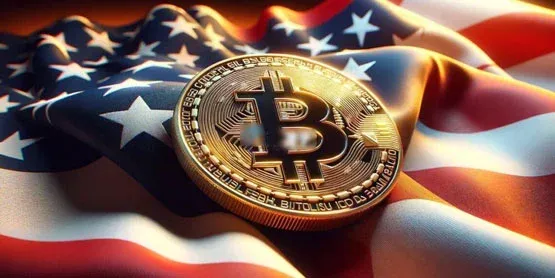
The U.S. Dollar Index has slipped to its lowest level in almost six months, weakening the greenback and, in the short run, creating an inflow opportunity for Bitcoin, which is being viewed as a positive catalyst. Consequently, demand for Bitcoin may experience a temporary uptick.
U.S. President Donald Trump announced today new tariffs on American‑made goods exported to several countries. Following the announcement, the U.S. Dollar Index (DXY) fell sharply, reaching its lowest point since mid‑October of last year. This fresh bout of dollar weakness could translate into an investment opening for Bitcoin.
- The U.S. Dollar Index is a composite measure of the dollar’s exchange rates against six major currencies, including the euro, yen, and pound. Recently it has been hit by multiple downside pressures, such as deepening recession expectations and escalating global trade frictions.
- After hitting a two‑year high at the start of the year, the Dollar Index has dropped roughly 4 % throughout the first quarter. Industry consensus suggests that a softer dollar may provide short‑term support for Bitcoin.
Ciara Sun, founder of C² Ventures, points out that the Federal Reserve (Fed) is increasingly likely to cut rates multiple times this year, which would further erode the dollar and boost Bitcoin’s appeal. She believes that a slowdown in the Dollar Index’s momentum helps risk assets perform better.
Sun’s view aligns with a CoinGecko report released at the end of last year. That report noted that Bitcoin and the U.S. Dollar Index usually exhibit a negative correlation—when the dollar weakens, Bitcoin tends to strengthen and act as a safe‑haven for capital.
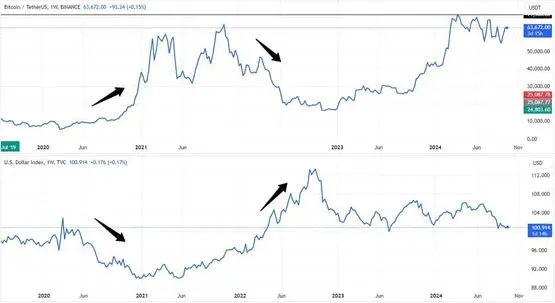
Correlation Between Bitcoin and the U.S. Dollar Index (DXY)
- Arthur Hayes, co‑founder of BitMEX, commented: “If Bitcoin can hold steady above $75,000 before the U.S. tax filing deadline (April 15), market risk may ease.” *Note: crypto gains may be taxable in the trader’s local jurisdiction, and U.S. taxpayers should consult a tax professional.*
- Hayes further projected that if the Fed initiates a quantitative easing (QE) program, Bitcoin could climb to $250,000 by year‑end, a statement that has fueled bullish sentiment.
Nevertheless, investors should remain vigilant. While a weaker dollar might provide short‑term support for Bitcoin, changes in U.S. monetary policy, ongoing global economic uncertainty, and other macro factors could still pose significant risks.
As of the latest data, Bitcoin has been influenced by market sentiment, slipping 1.6 % over the past 24 hours to $83,629. The overall cryptocurrency market capitalization has also retreated, with an intraday decline of 3.3 %.
The analysis above reflects Ciara Sun’s complete take on “the U.S. Dollar Index falling to a near‑six‑month low, offering short‑term upside for Bitcoin.” For more information on Bitcoin and the U.S. Dollar Index (DXY), please refer to other articles on Bitaigen (比特根).
*For users in the United States, trading on Binance must be conducted via Binance.US rather than the global Binance platform. Fiat deposits and withdrawals typically use SEPA (for EUR) or SWIFT (for USD) networks, depending on the jurisdiction.*
Related Reading
- Top 5 Free Bitcoin Cloud Mining Sites 2026 – Transparent
- Grayscale: Q3 2025 ‘Special’ Altcoin Season, Bitcoin Lags
- Will Altcoins Return? Bitcoin Season Still Dominates 2026
💡 Register on Binance with referral code B2345 for the maximum trading fee discount. See Binance complete guide.



