
 Bitaigen Research
 We analyze the macro‑level capital flows behind the temporary suspension of U.S.–China tariffs, dissect why Bitcoin experienced an unexpected pull‑back even as traditional safe‑haven assets recovered, and offer a deep look at shifting market sentiment to help readers gauge the potential trajectory of crypto assets amid policy tailwinds. Please continue reading.
Summary
- After the United States and China reached a tentative agreement that could end the current trade war, capital tilted toward equities, and Bitcoin lagged behind.
- Macro‑economic sentiment shifted from gold to stocks, creating a divergence in demand for scarce assets.
The de‑escalation of U.S.–China tariffs, driven by diplomatic pressure, sparked expectations of a stock‑market rally. Capital migrated into equities, reducing demand for Bitcoin and prompting a price decline. At the same time, demand for traditional safe‑haven assets such as gold weakened, further diminishing Bitcoin’s appeal.
On May 12, Bitcoin briefly touched $105,720, a three‑month high, before slipping to roughly $102,000. Although the tariff dispute showed signs of easing, the price correction left traders puzzled: why did Bitcoin react negatively in what appeared to be a favorable macro environment?
The 90‑day tariff “pause” lowered certain import duties. U.S. Treasury Secretary Scott Bennet noted that, provided both sides maintain goodwill and engage in constructive dialogue, the agreement could be extended further. Yahoo Finance reported that negotiation topics include “currency manipulation,” “steel dumping,” and semiconductor export restrictions, among other key areas.
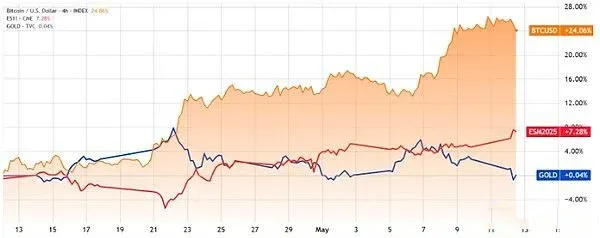
Bitcoin/USD (orange) versus S&P 500 futures (red) and gold (blue). Source: TradingView / Cointelegraph
Definition: Over the past 30 days, Bitcoin posted a cumulative gain of 24 %, while the S&P 500 futures rose 7 % and gold prices were essentially flat.
This indicates that Bitcoin still exhibits a high correlation with traditional financial markets, with a 30‑day correlation coefficient of about 0.83; investors anticipate limited divergence between the two.
Furthermore, Bitcoin’s market capitalization has now surpassed that of silver and Google, ranking it as the sixth‑largest tradable asset worldwide.
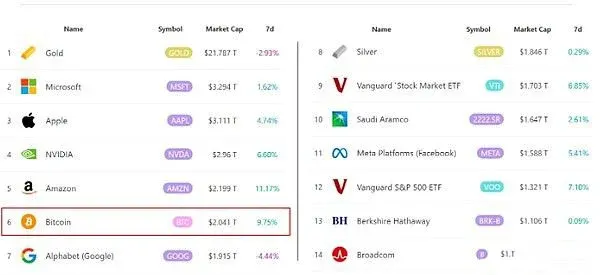
The world’s largest tradable asset: USD. Source: 8marketcap
Strategy accumulated 13,390 BTC between May 5 and May 11, drawing market attention. BlackRock and Strategy together now hold roughly 11,900 BTC, about 6 % of the circulating supply. Some traders worry that the price‑support impact of Michael Saylor’s firm may be overstated.
- Critics such as Peter Schiff argue that Strategy’s rising average purchase price could lead to losses, forcing it to liquidate part of its holdings to cover financing costs.
- However, the firm has doubled its capital‑raising ceiling, adding $21 billion in equity and $21 billion in debt, which eases funding pressure.
Macro‑Economic Events Favor Stocks Over Gold, Bitcoin Price Stagnates
Core thesis: Bitcoin’s retreat around the $105 k level is driven mainly by macro‑economic conditions rather than any single catalyst. The tariff suspension directly benefits equities but diminishes the attractiveness of scarce assets.
- On May 12, gold fell 3.4 %, signaling a drop in safe‑haven demand.
- The same day, the U.S. Dollar Index (DXY) climbed to its highest level in 30 days. Although U.S. Q1 GDP contracted 0.3 % YoY, pending home sales rose 6.1 % MoM in March, indicating renewed investor confidence.
When Bitcoin approached the $105 k mark, investor interest in scarce assets waned, partly because equities are viewed as the direct beneficiaries of the U.S.–China trade agreement. Lower import tariffs are expected to boost corporate revenues and margins, drawing more capital into the stock market.
From May 1 to May 9, the United States spot Bitcoin exchange‑traded fund (ETF) — note that U.S. investors must use Binance.US rather than the global Binance platform for any related crypto‑related services — saw notable activity.
Tax note: Crypto gains may be taxable in your jurisdiction; consult local tax regulations or a professional advisor.
---
*All figures are presented in United States dollars (USD). For fiat transfers, SEPA or SWIFT channels are commonly used in the global market.*
Related Reading
- Bitcoin Near $70k as Coinbase Premium Goes Positive
- Bitcoin Price Drops to $69,863 – Market Analysis & Funding Rate Insight
- Key Factors Influencing Bitcoin Price: Supply, Macro Trends & Tech
💡 Register on Binance with referral code B2345 for the maximum trading fee discount. See Binance complete guide.



