
 Bitaigen Research
 Why Is Bitcoin (BTC) Capped at 21 Million Coins?
The total supply limit of Bitcoin is set at 21 million (actually 2 099 999 997 690 000 “satoshi”, i.e., 20999999.97690000 BTC). This figure stems from both mathematical calculations and technical implementation considerations. After reading this article, you will have a systematic understanding of where this number comes from.
---
From both technical and economic perspectives, we examine the original design intent, the mathematical principles, and the implementation mechanisms behind Bitcoin’s supply cap. By dissecting block rewards, halving cycles, and code constraints, readers can clarify why Bitcoin can only ever be issued in a limited quantity and grasp the logic behind its scarcity. To master this core piece of history, keep reading.
Basic Formula for Calculating the Total Supply
Bitcoin issuance follows two simple rules:
- Each block initially rewards 50 BTC
- The reward halves every 210 000 blocks
Applying these rules as a geometric series yields:
\[
(50 + 25 + 12.5 + 6.25 + 3.125 + \dots) \times 210\,000 = 21 million\ \text{coins}
\]
Because a new block is created roughly every 10 minutes, 210 000 blocks correspond to about four years—this is what the Bitcoin community calls a “halving period”.
---
Supplementary Details at the Granular Level
1. The Actual Integer Scale
Inside the Bitcoin protocol the supply is not exactly 21 million; it is 2 099 999 997 690 000 (approximately 21 trillion satoshi). When displayed to users the system keeps eight decimal places, resulting in the representation 20999999.97690000. This design originates from storing values as a 64‑bit integer combined with an 8‑decimal‑place fixed‑point representation.
2. Why the Result Is Slightly Below 21 Million
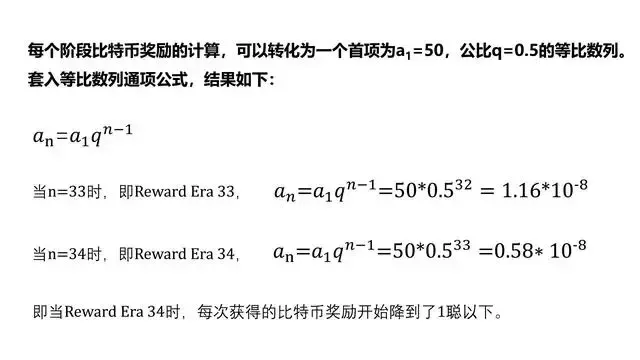
The geometric series is theoretically infinite, but in practice the series stops when the reward reaches 0.00000001 BTC (1 satoshi). Halving once more would produce 0, so the series is truncated at that point. Consequently, the accumulated total is a little lower than the ideal 21 million.
3. Decimal‑Point Position Can Be Shifted
Although the protocol uses a trillion‑scale integer internally, the external decimal‑point location is not immutable. Moving the decimal point left to the 5th or 4th digit changes the displayed format, for example:
- 5 decimal places: 20 999 999 976.90000
- 4 decimal places: 2099 9999 9769.0000
Satoshi Nakamoto mentioned this “display shift” idea in a 2009 reply to Mike Hearn, suggesting it would allow transactions of varying sizes to retain sufficient granularity.
“Values are 64‑bit integers with 8 decimal places, so 1 coin is represented internally as 100 000 000. … if 0.001 is worth 1 Euro, then it might be easier to change where the decimal point is displayed …”
“币值是 64 位整数并保留 8 位小数,因此 1 枚比特币在内部记作 100 000 000。若 0.001 BTC 等于 1 欧元,调整小数点位置会更便于使用。”
---
Constraints Imposed by Computer Storage
Limits of 64‑Bit Double‑Precision Floating‑Point Numbers
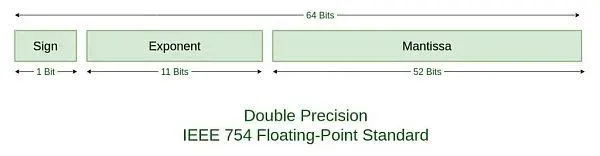
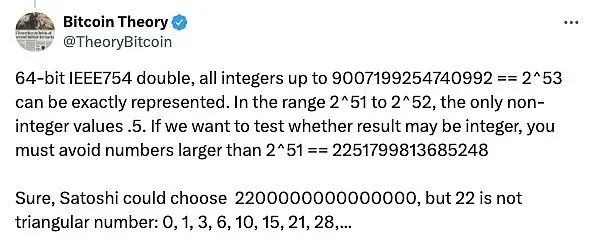
The IEEE 754 double‑precision format uses 64 bits, of which 53 bits store the mantissa (significant digits). When mixing integer and fractional parts, the integer portion can safely occupy at most 53 bits, i.e., 2⁵³ ≈ 9 × 10¹⁵. To avoid overflow, many implementations conservatively limit the usable integer range to 2⁵¹ ≈ 2.25 × 10¹⁵.
The 21 trillion satoshi figure (2 099 999 997 690 000) sits comfortably below this safety threshold, ensuring that most programming languages can handle Bitcoin amounts without precision loss or overflow errors.
Historical Guess About a 32‑Bit Integer Limit
Another hypothesis suggests that the original design may have been based on a signed 32‑bit integer (maximum 2³¹‑1 ≈ 2.147 × 10⁹). Using a fixed‑point representation with two decimal places would allow roughly 21 474 836.47 BTC, which rounds to 21 million. This line of reasoning explains why the number “21” appears in early code versions.
---
Overview of the Supply Schedule
The progression of Bitcoin issuance can be visualized in the table below:
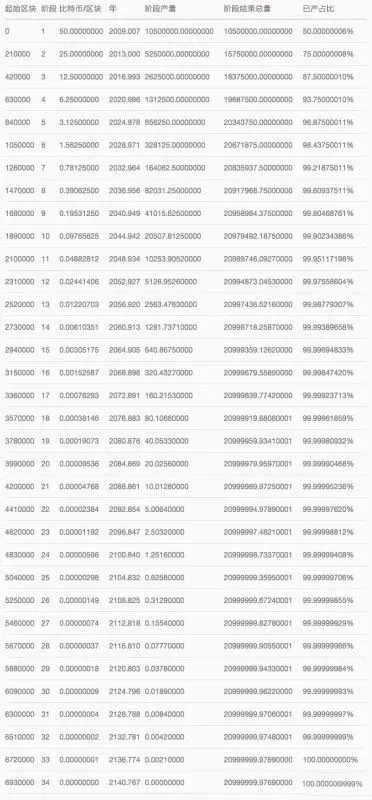
- Genesis block (0) – 2009‑01‑03 18:15:05 UTC, reward 50 BTC (i.e., 5 000 000 000 satoshi).
- Block 210 000 – 2012‑11‑28 15:24:38 UTC, reward halves for the first time to 25 BTC. Subsequent halvings occur every additional 210 000 blocks until the 33rd halving reduces the reward to zero.
- Difficulty adjustment every 2016 blocks – The network looks at the actual time taken to mine the most recent 2016 blocks and adjusts mining difficulty so that the next 2016‑block window targets 14 days (≈ 6 blocks per hour).
---
Satoshi’s Own Explanation of the Number Choice
In the email exchange with Mike Hearn, Satoshi disclosed that he did not pre‑determine the 21‑million figure. Instead, he first set parameters such as block time, initial reward, and halving interval, and later discovered that these values naturally produced an upper bound of roughly 21 million. Excerpts from his reply:
“I thought about 100 BTC and 42 million, but 42 million seemed high. … I wanted typical amounts to be in a familiar range. If you're tossing around 100 000 units, it doesn't feel scarce. The brain is better able to work with numbers from 0.01 to 1000.”
“我曾考虑过 100 BTC 与 4200 万的上限,但感觉太大。希望大多数持有者的数量落在 0.01‑1000 之间,这样才更易于感知稀缺性。”
These comments indicate that Satoshi preferred a supply that would keep the average holder’s balance in a range that feels intuitive and scarce, rather than arbitrarily choosing an extremely large or small figure.
---
Popular Speculations Circulating in the Community
Even though the technical explanation is fairly complete, many imaginative theories still float around:
| # | Theory | Brief Description |
|---|---|---|
| 1 | **“21 is half of 42”** | A tongue‑in‑cheek nod to *The Hitchhiker’s Guide to the Galaxy* where 42 is the “Answer to the Ultimate Question”. |
| 2 | **“Living in the 21st Century”** | A tenuous link to the current era. |
| 3 | **“Parameters naturally output this”** | The view that Satoshi first fixed the 10‑minute block time, 50 BTC reward, and 4‑year halving, which mathematically yields ~21 million. |
| 4 | **“Gold‑volume analogy”** | Humanity has historically mined roughly a 21 m³ cube of gold; Bitcoin is cast as “digital gold”. |
| 5 | **“21‑point game”** | A playful suggestion that Satoshi might have been a fan of Blackjack (21). |
| 6 | **“Floating‑point precision limit”** | Based on the 53‑bit mantissa of IEEE 754 double precision; 21 million sits safely within the precision envelope. |
| 7 | **“32‑bit integer ceiling”** | Using the maximum signed 32‑bit integer (2 147 483 647) and a fixed‑point conversion yields about 21 million BTC. |
Among these, theory 6 aligns most closely with the technical analysis above, while theory 7 offers an alternative historical possibility. All of them reflect the fact that the Bitcoin designers balanced technical feasibility with human‑centred usability when picking the cap.
---
Summary
- Effective supply cap: 20999999.97690000 BTC (≈ 2 099 999 997 690 000 satoshi), marginally below the round 21 million.
- Issuance mechanism: Reward halves every 210 000 blocks (≈ 4 years), with a new block roughly every 10 minutes.
- Technical constraints: A 64‑bit integer paired with 8 decimal places satisfies precision requirements while staying well under the safe limit of double‑precision floating‑point numbers.
- Design philosophy: Satoshi aimed for most users to hold amounts between 0.01 BTC and 1 000 BTC, a range that feels both scarce and easy to work with.
The 21‑million Bitcoin cap is not an arbitrary number; it is the product of intertwined technical, economic, and cognitive considerations. Understanding these nuances helps us view Bitcoin—as a fundamentally “finite‑supply” digital asset—through a more objective lens.
*All fiat references are expressed in USD; cross‑border transfers can be made via SEPA or SWIFT. U.S. residents should use Binance.US rather than the global Binance platform. Crypto gains may be taxable under the laws of your local jurisdiction.*
Related Reading
- Bitcoin Critical Turn: Indicators & Institutional Accumulation
- Bitcoin Investment Guide: Returns, Risks & Market Outlook
- Why Invest in Bitcoin? BTC as a Leading Digital Asset
💡 Register on Binance with referral code B2345 for the maximum trading fee discount. See Binance complete guide.



