
 Bitaigen Research
 We systematically outline the revenue models of DeFi mining in this article, dissecting key strategies, calculation methods, and common risk‑mitigation points to help investors make more rational decisions in the complex on‑chain environment. To learn how to balance safety and returns, keep reading.
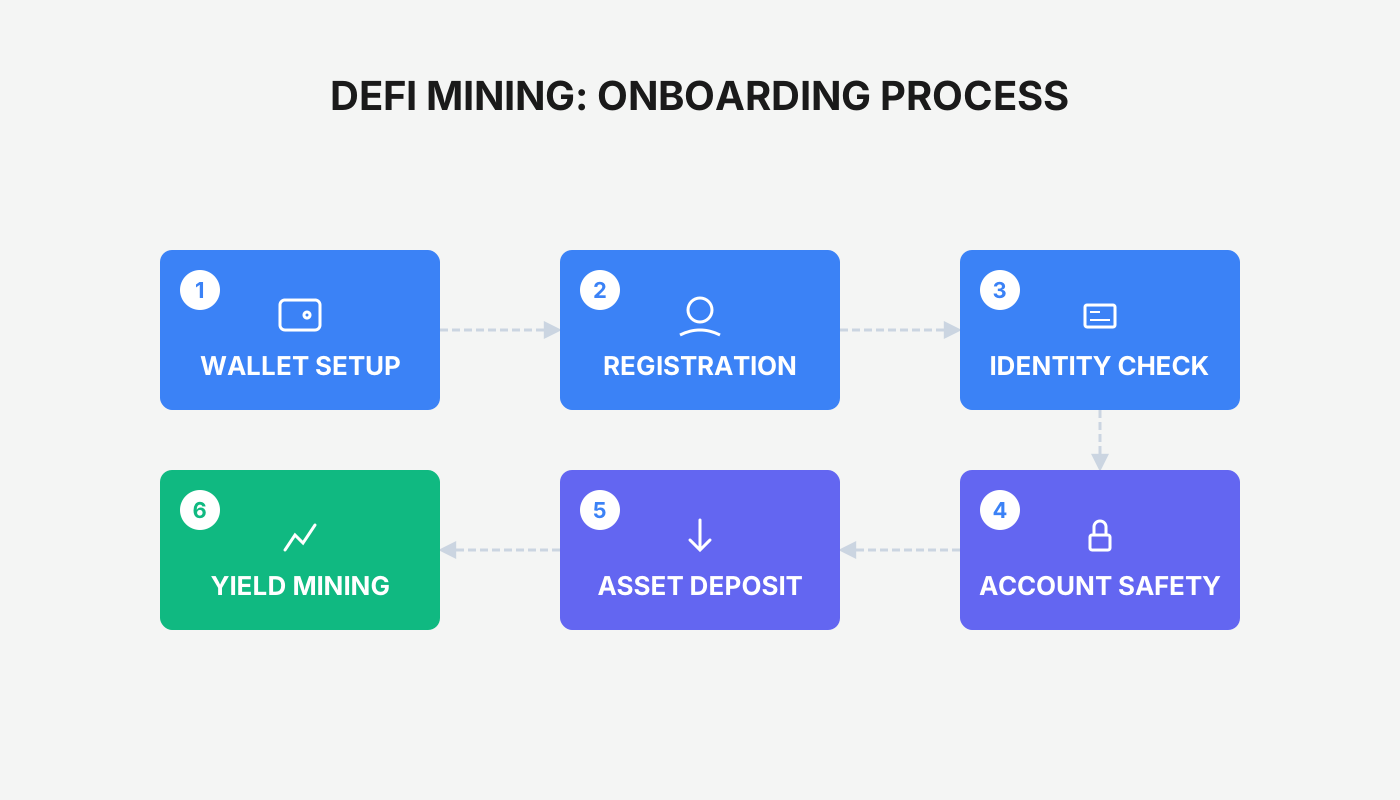
Risks and Entry Considerations
Before committing to DeFi mining, you should evaluate the several categories of risk you may face:
- Contract security: Code flaws can result in asset theft. A typical example is the 2022 Wormhole bridge hack, which caused losses of roughly $320 million.
- Impermanent loss: If the price of the assets you provide fluctuates sharply, the value of a liquidity provider’s position may fall below that of simply holding the assets.
- Reward‑token depreciation: A decline in the market price of incentive tokens weakens overall returns.
- Insufficient liquidity: During periods of market stress, withdrawing funds may encounter slippage or may not be executable in a timely manner.
When selecting a suitable protocol, consider the following factors:
- Audit records and operating age – platforms such as MakerDAO, Aave, etc., have undergone multiple security audits and possess several years of on‑chain history.
- Total Value Locked (TVL) size – Generally, projects with higher TVL provide stronger guarantees of capital safety and revenue stability (though this is not absolute).
- Token‑economics model – Examine the inflation rate of reward tokens, their actual utility, and any governance functions.
- Community governance structure – Decentralized governance mechanisms help reduce the probability of single‑point failures.
Regarding the scale of capital, DeFi has no hard minimum. However, the gas fee on Ethereum mainnet typically ranges from $10‑$50 per transaction; if your capital is too small, transaction costs can erode most of the profit. It is commonly recommended to have at least $3,000 of principal to ensure that earnings can cover fees. If you wish to lower costs, consider operating on Layer‑2 networks such as Arbitrum, Polygon, or on newer chains like Solana.
*Note: U.S. residents should use Binance.US rather than the global Binance platform for any fiat on‑ramps or withdrawals, which typically rely on SEPA/SWIFT for USD transfers.*
Overview of Basic Principles
DeFi mining revenue mainly comes from two sources: Liquidity Mining and Staking.
- Liquidity Mining: Users deposit tokens into a liquidity pool and receive a share of trading fees plus governance tokens issued by the protocol.
- Staking: Assets are locked in lending or validator protocols to earn interest or block rewards.
Key variables commonly used in revenue calculations include:
- APY (Annual Percentage Yield) – Combines base fee or interest income with any additional token incentives.
- TVL (Total Value Locked) – The total amount of assets locked in the pool, directly influencing each user’s share of earnings.
- Reward emission rate – The number of reward tokens the protocol distributes per block or per time interval.
For example, on Uniswap, liquidity providers (LPs) earn from the 0.3 % trading fee, allocated proportionally to their share of the pool; lending platforms such as Compound or Aave adjust borrowing rates dynamically based on asset utilization.
Revenue Calculation Models and Real‑World Data
Constant Product Market Maker (CPMM)
On Uniswap‑V2‑style decentralized exchanges, LP earnings can be approximated by:
```
Revenue = (LP tokens held / Total LP token supply) × Total trading fees
```
Assume an ETH/USDC pool processes $10 million in daily volume with a 0.3 % fee. The pool would generate roughly $30,000 in fees per day. If a user owns 1 % of the LP tokens, the daily revenue would be about $300.
Lending‑Protocol Interest Model
Compound’s utilization‑based model is expressed as:
```
Borrow rate = Base rate + Utilization × Rate multiplier
Supply rate = Borrow rate × Utilization × (1 – Reserve factor)
```
Public data from Q4 2023 shows the USDC market on Compound delivering a supply APY of roughly 2.5 %‑4.5 %; during the same period, Aave V3’s comparable pool fluctuated between 3 %‑5 %.
Reward‑Token Distribution Mechanism
Many protocols adopt a “per‑block reward” scheme. If a protocol releases 1,000 incentive tokens daily, an individual user’s daily reward can be calculated as:
```
User daily reward = (User stake / Total stake) × Daily emission
```
Quick FAQ
How should I calculate DeFi mining returns?
You need to combine three categories of earnings:
- Base return – Fees or interest allocated by the protocol.
- Incentive return – Governance tokens distributed to attract liquidity.
- Compound effect – Re‑investing earned returns can markedly boost long‑term performance.
For instance, providing liquidity to Curve Finance’s USDT/DAI/USDC pool yields a 0.02 % trading‑fee share plus CRV tokens. By using Curve’s official calculator—entering your stake, pool share, and the current CRV price—you obtain a combined APY.
What is the typical annualized return for DeFi mining?
The range varies widely by protocol, asset class, and market conditions. During the 2021 bull market, some emerging projects posted APYs above 1,000 %, but they carried commensurate risk. As of 2024, reference figures for mainstream platforms are:
- Uniswap V3 ETH/USDC pool (fees only): 5‑15 % APY
- Aave USDT deposit: 3‑8 % APY
- Compound ETH staking: 2‑4 % APY
Higher yields usually imply larger impermanent‑loss exposure or greater contract risk.
How can I reduce impermanent loss?
- Choose stable‑coin pairs with minimal price volatility (e.g., USDC/DAI).
- Employ dedicated hedging tools or insurance products.
- Configure automatic hedging strategies within yield‑aggregator platforms.
*Crypto gains may be taxable according to the investor’s local jurisdiction; consult a tax professional for guidance.*
Revenue‑Optimization Tools and Techniques
Yield Aggregators
Platforms such as Yearn Finance automatically allocate assets to the highest‑yielding strategies. Their yVaults, through auto‑compounding and iterative strategy upgrades, typically deliver APYs 1‑3 % higher than manual deployment.
Cross‑Chain and Layer‑2 Solutions
Providing liquidity on Layer‑2 networks like Polygon or Arbitrum can shrink gas costs to roughly $0.01 per transaction, compared with $10‑$50 on Ethereum mainnet. This cost reduction is especially friendly to smaller investors.
Practical Impermanent‑Loss Hedging
Utilizing stable‑coin pairs or activating built‑in insurance mechanisms within the same protocol can cap loss magnitude during sharp price moves, albeit at the expense of slightly lower overall returns.
Future Directions and Compliance Trends
Tighter regulatory scrutiny may force DeFi projects to incorporate KYC and other identity‑verification procedures. Simultaneously, algorithmic designs are shifting toward “veTokenomics” (vote‑escrowed token models), exemplified by Curve’s veCRV, which incentivizes long‑term locking for higher yields and governance influence.
Technical evolution is also refining revenue models: some protocols now adjust rewards dynamically based on user behavior, or introduce true revenue‑sharing mechanisms to lessen reliance on pure inflationary token issuance.
Closing Thoughts
The revenue algorithms behind DeFi mining intertwine mathematics, finance, and game theory. While high returns are alluring, only a thorough understanding of compensation mechanics and associated risks enables rational operation. We recommend starting with modest amounts, leveraging reliable monitoring tools, and staying up‑to‑date with security bulletins and protocol upgrades. Education and prudence remain the best defenses for protecting your assets.
The above constitutes the full content of “Deep Dive into DeFi Mining Revenue Algorithms: Strategies, Calculations, and Risk Management.” For further material, follow Bitaigen’s upcoming articles.

Related Reading
💡 Register on Binance with referral code B2345 for the maximum trading fee discount. See Binance complete guide.



