
 Bitaigen Research
 From a practical usage perspective, we compare the fee structure, confirmation time, and network congestion of TRC20 versus ERC20 when transferring USDT, helping readers quickly determine which chain best fits their transaction needs. This article also provides real‑world link references for further verification and reference.
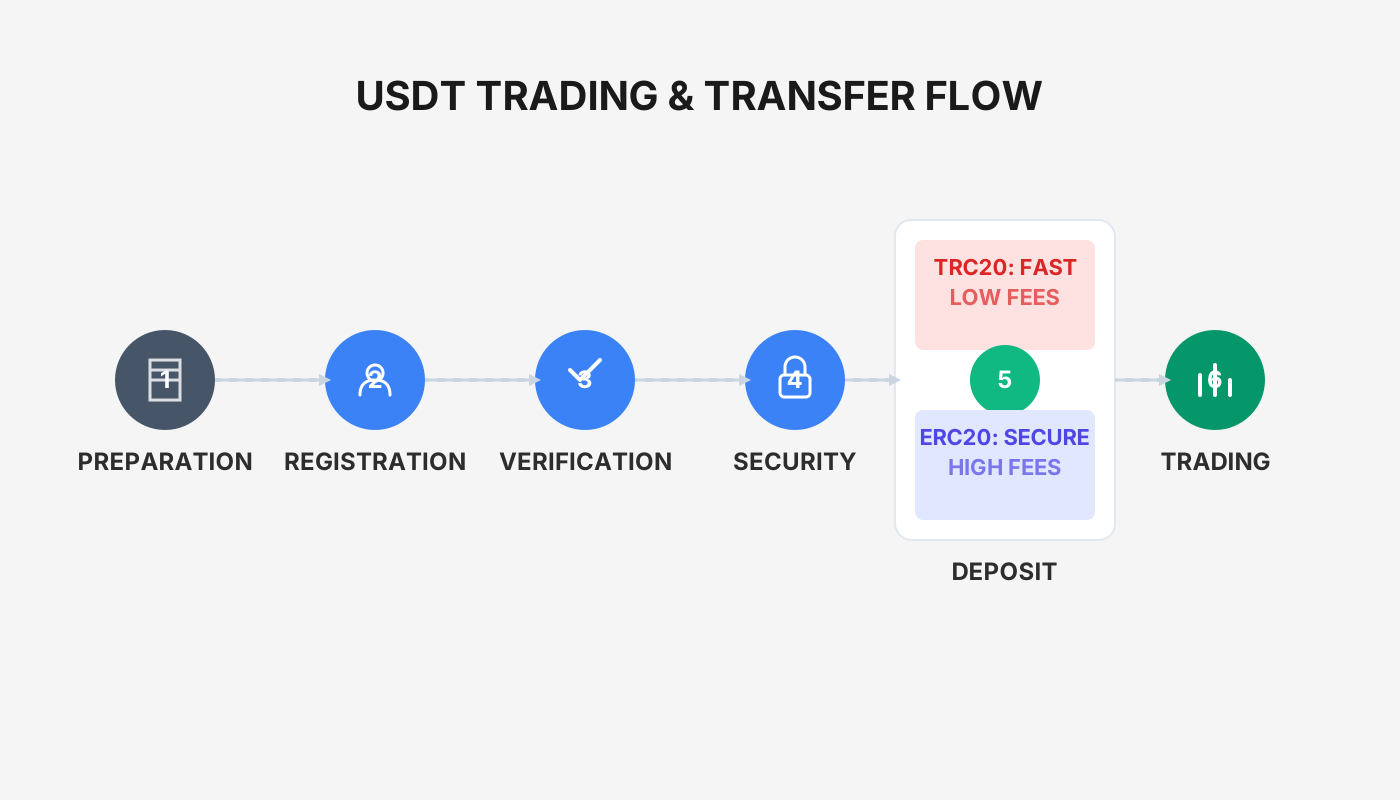
What are the differences between TRC20 and ERC20 when transferring USDT?
TRC20 incurs virtually zero transaction fees for USDT transfers and produces a block roughly every 3 seconds, resulting in fast confirmations; ERC20, on the other hand, has higher fees, a block time of about 15 seconds, and slower confirmations.
Anyone who has entered the crypto space knows that a transaction fee must be paid when moving digital assets. Users who deposit ETH are already accustomed to this. Recently, fees have risen sharply, mainly because a flood of DeFi smart‑contract calls has congested the network, driving gas costs up.
This article focuses on the ERC20 and TRC20 token standards when transferring USDT, outlining their respective advantages and differences, and provides link references for readers to decide which channel suits them best.
TRC20 and the Tron blockchain
TRC20 is a token standard built on the Tron (TRX) public blockchain. Tron was founded by Justin Sun, and its native coin is TRX. The biggest highlight of TRC20 is that transferring USDT incurs virtually no extra fee, which is especially cost‑effective compared with the high gas fees on ERC20.
Although some industry observers argue that Tron is a copy of Ethereum, Tron has cultivated a mature ecosystem where staking and DApp deployment are relatively straightforward. The free or near‑free transfer pathway makes TRC20 an attractive option in cost‑sensitive scenarios.
The relationship among USDT, TRC20 and ERC20
USDT (full name Tether) is currently the stablecoin with the highest market share, maintaining a 1:1 peg to the US Dollar. USDT can be issued and circulated on multiple blockchains, the most common being ERC20 (Ethereum), TRC20 (Tron) and Omni (Bitcoin). The tokens all represent the same value; the only difference lies in the underlying transmission protocol—similar to the difference between a bank wire transfer and an ATM withdrawal, where fees and settlement times vary.
USDT quick facts
- Issuer: Tether Limited
- Collateral model: Since 2023‑03‑14, a portion of the US‑Dollar backing has been replaced by loans collateralised by affiliated entities such as BitFinex.
- Regulation: BitFinex is incorporated in the British Virgin Islands, operates with KYC (Know‑Your‑Customer) verification, and is subject to relatively stringent oversight.
*Note: Crypto gains may be taxable in your jurisdiction; consult a tax professional for guidance.*
What is ERC20?
ERC20 is the token standard on the Ethereum blockchain. Ethereum currently uses a Proof‑of‑Work (PoW) consensus mechanism with an average block time of around 15 seconds. When transferring USDT on ERC20, you must pay gas fees in Ether (ETH); during periods of network congestion, these fees can increase dramatically.
ERC20 addresses always start with `0x`, a crucial detail that helps users verify they are using the correct chain and avoid accidental loss of assets.
What is TRC20?
TRC20 (TRC20 Token Standard) is a token specification implemented via smart contracts on the Tron public chain. Tron employs a Delegated Proof‑of‑Stake (DPoS) consensus, achieving a block time of roughly 3 seconds and offering the following advantages:
- High throughput: processes a large number of transactions per second
- High scalability: supports complex DApps
- High reliability: the network demonstrates strong stability
Tron also acquired BitTorrent Inc., whose distributed technology handles about 40 % of global internet traffic daily, providing a solid infrastructure foundation for the efficient transmission of TRC20 tokens.
TRC20 vs. ERC20 comparison
| Comparison item | TRC20 (USDT) | ERC20 (USDT) |
|---|---|---|
| Underlying chain | **Tron (TRX)** | **Ethereum (ETH)** |
| Issuer | Tether Limited | Tether Limited |
| Block time | ~3 seconds | ~15 seconds |
| Arrival speed | Fast (typically a few seconds) | Slower (depends on network congestion) |
| Fees | Essentially free (or negligible) | Requires ETH gas; fees are volatile |
| Wallet prefix | `T…` (Tron address) | `0x…` (Ethereum address) |
| Compatibility | Supported by most Tron wallets | Supported by most Ethereum wallets |
On the Tron network, in addition to the TRX balance, you will also see a “Show 1 Token” entry, which represents the USDT (TRC20) token held by the user. When using hardware wallets such as the Ledger Nano X, Tron can automatically split accounts, improving management convenience.
How to choose?
- Prioritising low fees: Opt for TRC20, especially when transferring modest amounts and speed matters.
- Needing the Ethereum ecosystem: If you need to interact with DeFi, NFTs or other Ethereum‑based DApps, you must use ERC20.
- Wallet compatibility: Verify the destination address prefix (`T…` vs `0x…`) to avoid sending assets to the wrong chain.
Summary
- TRC20: Low cost, fast block times, suitable for everyday small‑value transfers.
- ERC20: Higher fees and slower block times, but offers a richer ecosystem of DeFi, NFT and other services.
By understanding the technical characteristics and fee structures of both standards, users can decide which chain to use for USDT transfers based on their own requirements and use cases. For a deeper analysis of the differences between TRC20 and ERC20 transfers, stay tuned to future articles from Bitaigen.
Localization note: When converting fiat to crypto, use USD and standard SEPA/SWIFT channels for international transfers. Users located in the United States should use Binance.US rather than the global Binance platform.
Related Reading
- TRC20 vs ERC20: Speed, Fees, and Ecosystem Comparison
- On‑Chain Transfer: Match Networks (TRC20, ERC20, BEP20)
- Transfer USDT from TokenPocket to OKX (TRC‑20/ERC‑20)
💡 Register on Binance with referral code B2345 for the maximum trading fee discount. See Binance complete guide.



