
 Bitaigen Research
 MegaETH (MEGA) Token is a high‑performance Layer 2 scaling solution built on Ethereum, marketed as an “instant blockchain” capable of handling 100,000 transactions per second (TPS), sub‑millisecond block production, and ultra‑low fees.
In this article we conduct an in‑depth analysis of the MegaETH Layer 2 protocol, explaining its technical foundations and design philosophy, how it overcomes Ethereum’s scalability bottlenecks to achieve near‑instant transaction finality, and the potential value it brings to decentralized finance, gaming, and other use‑cases. Read on to gain a comprehensive understanding of this real‑time on‑chain innovation.
What is MegaETH?
MegaETH is a high‑throughput Layer 2 scaling solution built atop Ethereum, billed as the world’s first “real‑time blockchain.” Its goal is to bring Web 2‑level response speeds to decentralized applications (dApps), addressing the three core pain points of the Ethereum mainnet: poor scalability, high transaction fees, and long confirmation delays.
- Traditional public blockchains require seconds to minutes to finalize a block; MegaETH squeezes confirmation time down to the millisecond range, theoretically supporting over 100,000 TPS.
- By employing a more efficient network architecture and execution model, it retains decentralization while processing tens of thousands—or even hundreds of thousands—of transactions within a fraction of a second.
- MegaETH’s vision is to give every user the same instantaneous experience they enjoy on conventional web services, eliminating the need to wait for block packaging or endure second‑level latency.
The project aims to become the foundational infrastructure for the next generation of dApps, enabling on‑chain financial transactions, game interactions, social communications, and everyday payments to settle instantly.
Recent MegaETH Activity
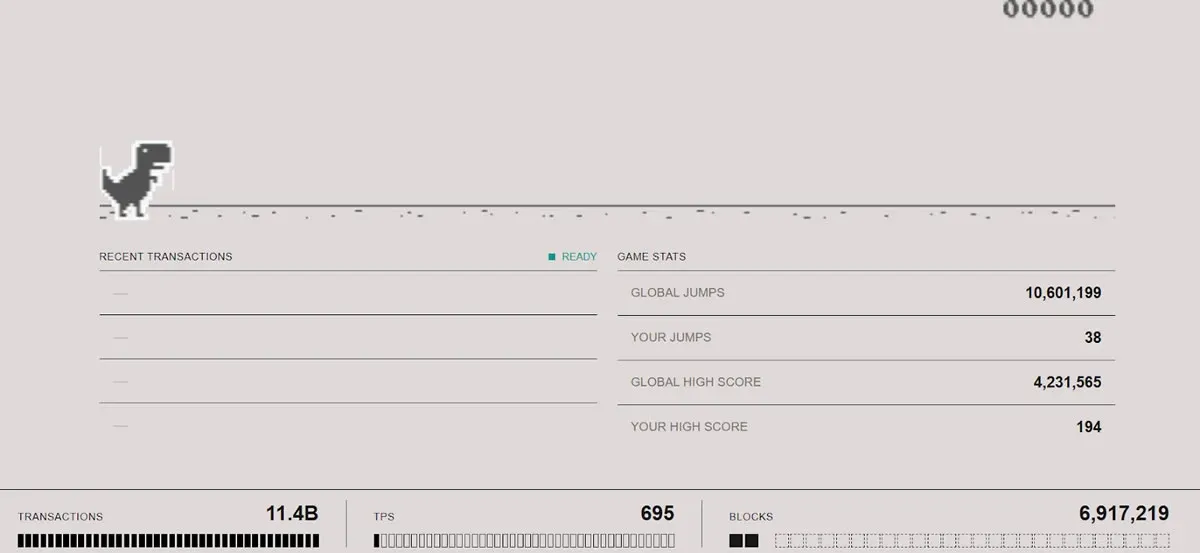
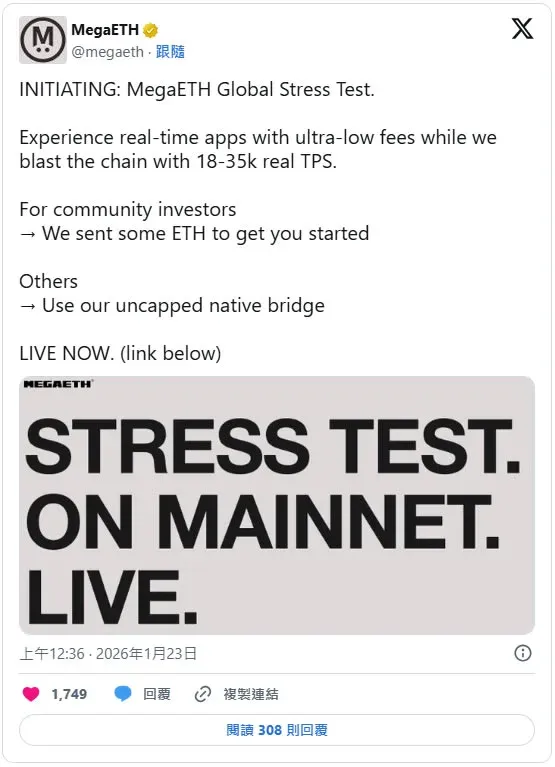
- 2026‑01‑22 – Launched a seven‑day mainnet stress test targeting 11 billion total transactions and a throughput of 15,000–35,000 TPS.
- The official website now hosts a dashboard comparing MegaETH, Solana, and Base, and it has rolled out several on‑chain interactive apps, including a small dinosaur Easter‑egg that appears when the network disconnects.

Interactive Game Samples
- Showdown – A Texas‑hold’em‑style card‑strategy game.
- Crossy Fluffle – A “cross‑the‑road” challenge where every step registers as an on‑chain interaction.
- Stomp – A sprite‑battle game that emphasizes strategy and counterplay.
- Smasher – A luck‑based title where consecutive challenges can multiply ETH rewards; a single failure resets the earnings to zero.

- After the stress test is confirmed, the mainnet is scheduled to launch on 2026‑02‑09. At that time, ecosystem projects such as brix_money, the native DEX SectorOne, and the USDM stablecoin will provide interactive experiences.

- The TVL (Total Value Locked) on MegaETH rose noticeably once the stress test began.
Core Positioning and Performance Targets
| Dimension | Key Metric |
|---|---|
| Block Time | **10 ms** (target sub‑millisecond) |
| Throughput | **Up to 100,000 TPS** (testnet has reached 35,000 TPS) |
| Compatibility | Fully **EVM** compatible, allowing any Ethereum dApp to migrate directly |
| Security | Ethereum mainnet serves as the decentralized settlement layer |
| Mainnet Launch | **9 February 2026** (Frontier phase) |
MegaETH positions itself as a “real‑time on‑chain computation and asset‑exchange platform,” differentiating itself from most L2 solutions that focus solely on fee reduction and throughput gains. Its core competitive advantages are true‑time experience, low‑latency response, and ultra‑fast execution.
MEGA Tokenomics
- Token Name: MegaETH
- Symbol: MEGA
- Total Supply: 10 billion tokens (hard cap)
Core Allocation
- 53 % – KPI rewards (released according to protocol‑development milestones)
- 15 % – Public sale
- The remainder is earmarked for venture funding, team incentives, ecosystem grants, governance, transaction‑fee payments, sequencer node staking, and security guarantees.
It is noteworthy that the 5.3 billion MEGA allocated for KPI rewards will be released in batches based on the achievement of four major KPIs—ecosystem growth, decentralization level, performance improvement, and security—rather than on a fixed calendar.
MegaETH (MEGA) Development Timeline and Milestones
- 2022 – Conceptualized by Yilong Li
- Mid‑2024 – Development kicked off after the first fundraising round
- October 2025 – MEGA token details published; the round closed at 27.8× oversubscription, raising US 70 million
- November 2025 – Bridge opened, supporting USDC transfers with a cap of US 250 million
- January 2026 – Global stress test completed; mainnet launch date (9 Feb) confirmed
- February 2026 – Mainnet Beta “Frontier” phase slated to commence
Why Is MegaETH Gaining So Much Attention? The Pre‑Sale Sparked Massive Interest

During its token pre‑sale, MegaETH reached its highest auction valuation within minutes, reflecting strong market enthusiasm for the instant blockchain concept. The ICO allocated 5 % of the total supply (approximately 500 million tokens) to the public sale, with a single‑bid ceiling of US 186,000 and a minimum entry of US 2,650.
Because demand vastly outstripped supply, the project employed a “special allocation mechanism” that weighed two primary factors to determine each participant’s final allotment:
- Historical activity of the user within the MegaETH ecosystem or the broader Ethereum community.
- Whether the user opted for a one‑year lock‑up (locked participants received priority).
The mechanism is designed to balance fairness between early contributors and newcomers.
Note: Crypto gains from token purchases may be taxable in your jurisdiction; please consult a qualified tax professional.
MegaETH Public Allocation Strategy
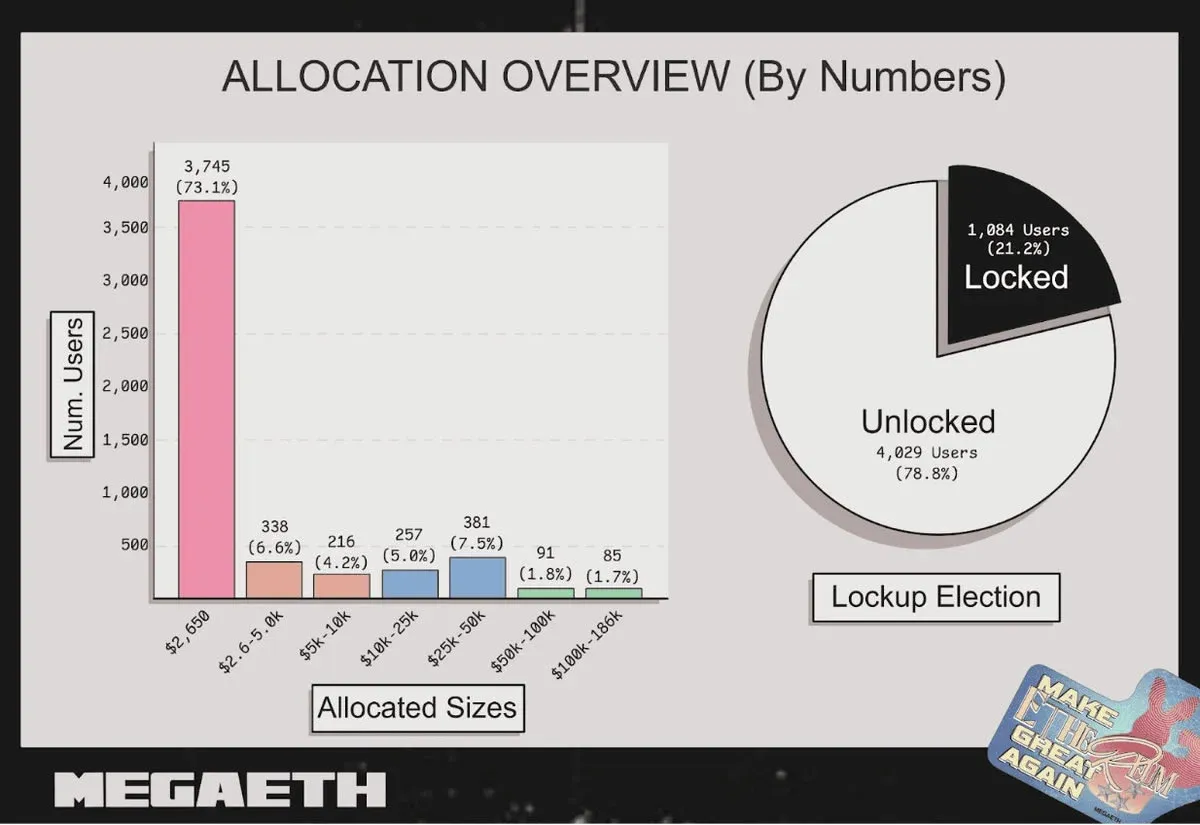
Official data indicates that, with over 50,000 participants and 28× oversubscription, the project adopted a dual‑track distribution model:
- Early‑community reserved quota – Roughly 9.5 % of addresses received 25 % of the allocation pool.
- Data‑driven scoring system – Combined four metrics: on‑chain activity, community signals, MegaETH‑specific contributions, and willingness to lock tokens.
In the end, about 21 % of participants chose to lock their tokens, while 79 % remained unlocked. The design blends manual vetting with algorithmic scoring to achieve fairness, transparency, and incentive alignment.
Core Technical Features of MegaETH
1. Ultra‑Fast Transaction Processing & Minimal Latency
- Target of 100,000 TPS with block confirmation times around 10 ms, delivering an on‑chain “instant” feel.
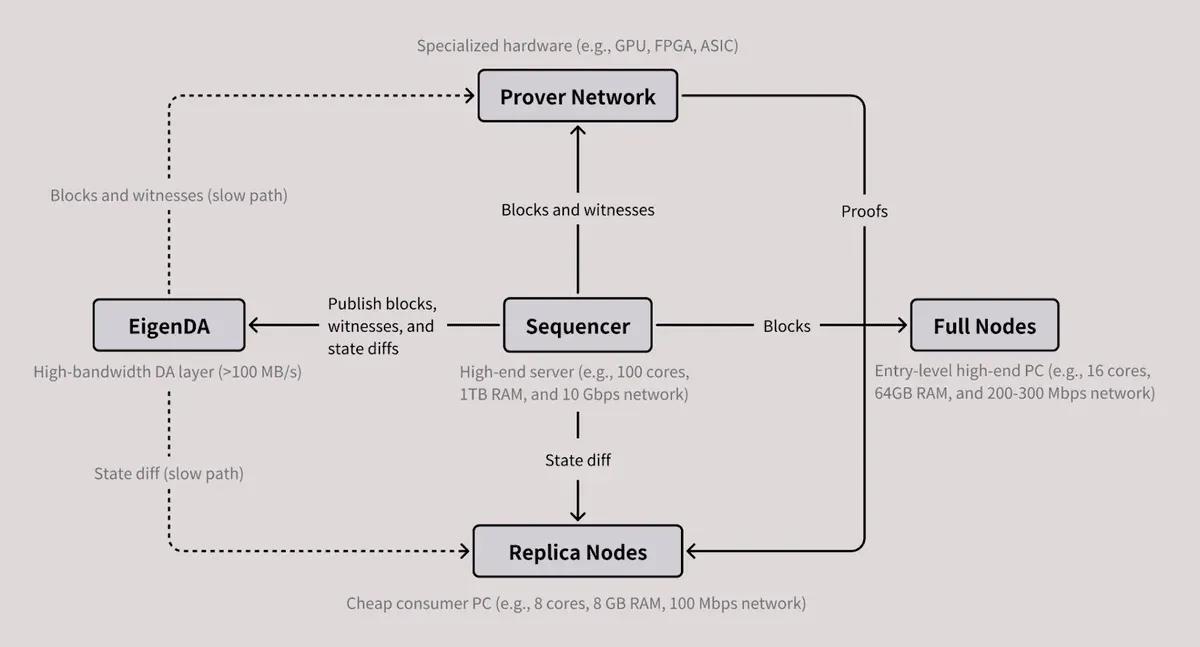
2. Node Specialization
| Node Type | Primary Role |
|---|---|
| **Sequencer** | Receives transactions, orders them, executes, and pushes state changes |
| **Prover** | Generates cryptographic proofs for transaction execution |
| **Full Node** | Re‑executes all transactions to provide the highest‑trust validation |
| **Replica Node** | Receives state diffs and updates local state rapidly |
3. Full Ethereum EVM Compatibility
- Supports Solidity smart contracts; developers can migrate existing Ethereum projects without learning a new language.
4. Tailored for Real‑Time Interactive Applications
- The low‑latency architecture makes it especially suitable for high‑frequency finance, real‑time gaming, social platforms, and live‑stream interactions.
5. Security Leveraged from Ethereum Mainnet
- Uses Ethereum as the decentralized settlement layer, preserving security while staying within the broader Ethereum ecosystem.
Technical Ecosystem Analysis: How MegaETH Constructs an Instant On‑Chain World
Conventional blockchains suffer from consensus‑related latency. MegaETH separates speed from security through node specialization and a delayed‑consensus, instant‑execution model:
- Instant Execution – Sequencer nodes execute transactions swiftly on the native chain.
- Delayed Settlement – Final security validation is delegated to the Ethereum mainnet, achieving an instant‑execution + delayed‑settlement consensus approach.
Who Is Backing MegaETH? From Ethereum Pioneers to Top Crypto Funds
To date, MegaETH has raised US 30 million across the following rounds:
| Round | Date | Amount |
|---|---|---|
| Seed | June 2024 | Approximately **US 20 million** |
| Community | December 2024 | Approximately **US 10 million** |
Lead investor Dragonfly Capital spearheaded the round, with participation from Figment Capital, Robot Ventures, OKX Ventures, ABCDE Capital, Folius Ventures, CatcherVC, MitonC, Tangent, Inception Capital, Credibly Neutral, among others.
Individual backers include Vitalik Buterin, Joseph Lubin, Sreeram Kannan, and industry thought leaders Cobie, Hasu, Mert Mumtaz, Kartik Talwar.
Additionally, MegaETH conducted a community‑fundraising campaign using NFTs, raising roughly US 10 million, underscoring the combined trust of the Ethereum developer community and DeFi investors.
Real‑World Use Cases for MegaETH
MegaETH’s Block‑STM parallel execution engine and Instant Block Finality deliver millisecond‑level confirmation, addressing three major pain points:
- On‑Chain Compute Latency – Instant finality makes on‑chain interactions feel like traditional web requests.
- Single‑Thread Throughput Bottleneck – A four‑layer node division (Sealer, Proposer, Executor, Verifier) enables parallel processing.
- Application‑Layer Real‑Time Interaction – The Live State Layer continuously syncs on‑chain state with front‑end clients, ideal for games, social apps, and DeFi products that require real‑time feedback.
MegaMafia: An Accelerator Driving Ecosystem Innovation

MegaMafia is an accelerator launched by MegaETH to support early‑stage teams building innovative applications on the MegaETH network. The program offers funding, mentorship, and ecosystem integration across DeFi, gaming, social, and AI domains.
- MegaMafia 1.0 has incubated projects that collectively raised US 40 million.
- MegaMafia 2.0 attracted 300+ team applications, ultimately selecting 15 for the development phase.
The core mantra is “Users First, Crypto Second,” emphasizing that the MegaETH ecosystem evolves around superior user experience. Even when some projects (e.g., GTE) exit, MegaMafia remains open and decentralized, continuing to push OMEGA (Only Possible on MegaETH) applications toward launch.
Potential Challenges Facing MegaETH
- High Technical Complexity – The advanced layered node architecture increases maintenance and debugging difficulty; coordination failures could introduce execution delays.
- Degree of Decentralization – High‑performance nodes demand robust hardware, and the sequencer role is limited to a single active instance at any moment, creating a potential single‑point‑of‑failure.
- Ecosystem Development Timeline – Attracting a critical mass of migrating or newly built dApps will require more comprehensive grant programs and community outreach.
Closing Thoughts: Real‑Time Operation as a New Starting Line for Blockchain
The emergence of MegaETH marks the advent of a “instant interaction” era for blockchain technology. Beyond merely speeding up transactions, it introduces foundational innovations—node specialization, delayed consensus, instant execution—that unlock unprecedented performance. Financial settlement, gaming interaction, and social networking can all become truly on‑chain, real‑time experiences.
The road ahead hinges on balancing speed with decentralization and on attracting a broader base of nodes and developers. Regardless of how the market ultimately judges it, MegaETH has already opened a fresh pathway, proving that a decentralized world can also operate in real time.
*This concludes the full analysis titled **“What Is MegaETH? The Instant‑Scaling Revolution for Ethereum.”* For further updates, stay tuned to Bitaigen’s (比特根) ongoing coverage.
Related Reading
- Consensys Linea Layer-2: Features, Tokenomics & Airdrop
- Arbitrum (ARB) 代币解析:技术原理、治理功能与投资前景
- Solana vs Ethereum: High-Speed, Low-Cost Scaling
💡 Register on Binance with referral code B2345 for the maximum trading fee discount. See Binance complete guide.



